The exact page text, read by your browser's voice.

THE NORTH · WELLS STREET / SPY RUN AVENUE
The north corridor is the oldest road out of Fort Wayne. In 1803 Captain William Wells was instructed to mark a path from the fort toward Chicago — the Fort Dearborn Trail — and the line became Wells Street. The street's own ground explains its companion avenue: Congress granted Wells 320 acres in 1808, the Wells Pre-emption west of the St. Joseph River, and in the words of the Public Library's Streets of Fort Wayne (1953), Wells "was said to have been captain of the mounted spies for Anthony Wayne, so the small brook which ran through his land became known as 'Spy Run.'" The road along the brook took the same name: Spy Run Avenue. Wells's house stood on the east bank of Spy Run at the north end of the present avenue; he was killed escorting the Fort Dearborn evacuees in August 1812. The Neighborhoods section treats Spy Run the neighborhood; the avenue is its corridor, carrying the north side's traffic out along the creek to State Boulevard and beyond.
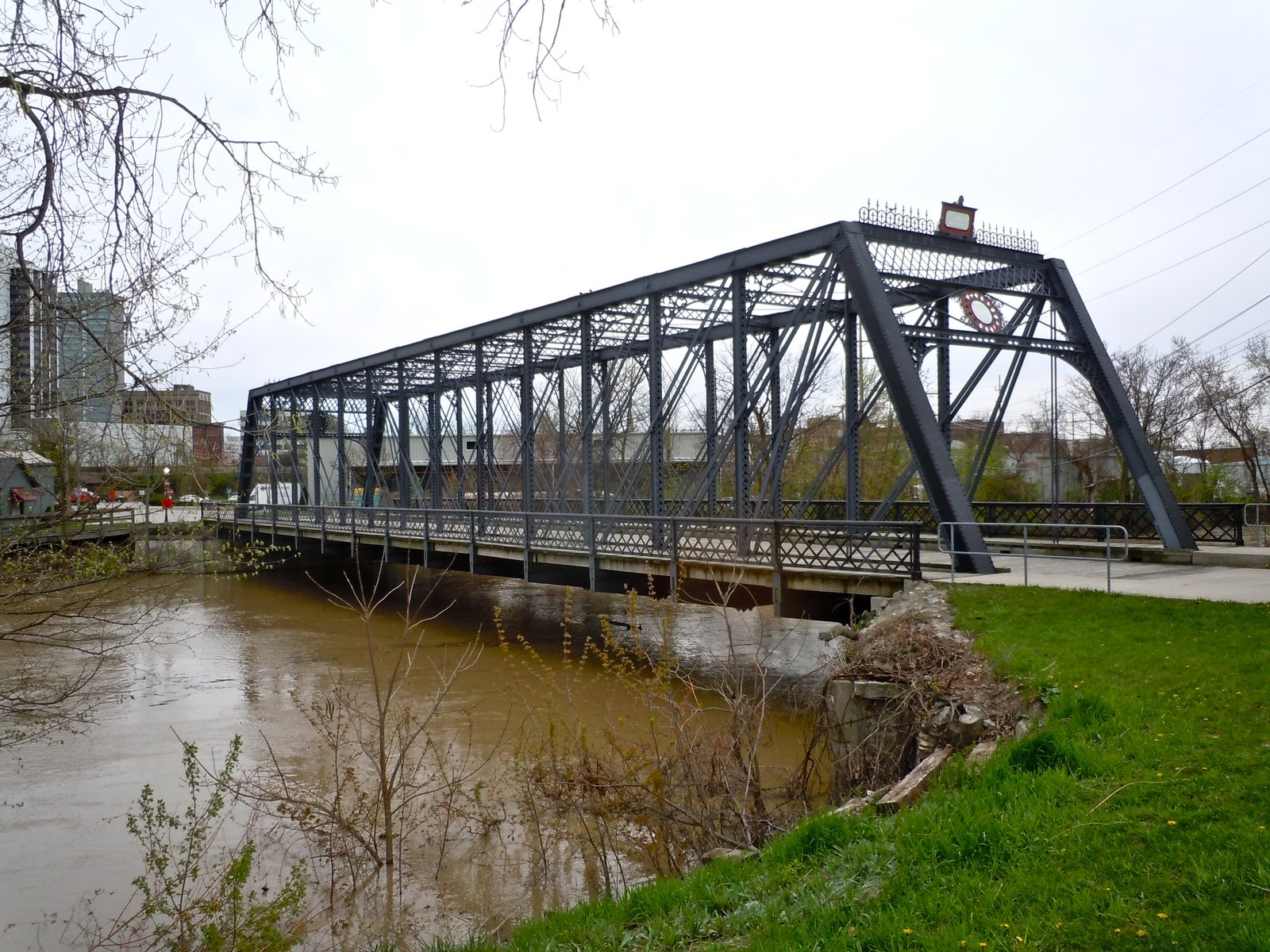
Wells Street stacked the centuries on one line. It became the Lima Plank Road — the plank-road era's improved highway north — and in the early twentieth century it carried the Lincoln Highway as well; the Hake Block historic-district staff report (2024) lists the layers at that single corner of Wells and Cass: the river, the trail, the canal, the plank road, the railroad at the Cass Street Depot, the streetcar, and the highway. The Wells Street Bridge, built by the Canton Bridge Company in 1884 — the first iron bridge over the city's rivers, and the only iron truss bridge left in Fort Wayne — tied Bloomingdale to downtown; trolley tracks crossed it from 1890. The corridor's commercial row (the Hake Block, built 1884–85, stands at 1008–1014 Wells) served the bridge and depot traffic. The bridge closed to vehicles and was restored as a Rivergreenway pedestrian crossing under the Parks Department from 1998; Wells itself remains the working north street, and its northern ground, around the former OmniSource site at 1600–1610 North Calhoun, is inside the City's North River redevelopment district.
Sources: Public Library of Fort Wayne and Allen County, Streets of Fort Wayne (1953), via archive.org; ARCH Fort Wayne, William Wells heritage page; City of Fort Wayne historic-preservation staff report, Hake Block–Fort Wayne Bottling Works Local Historic District (Feb. 26, 2024); History Center, Notes & Queries, "The Oldest Iron Bridge"; Indiana Brownfields Program, North River South and Calhoun Street Historic Fill report (2026).