The exact page text, read by your browser's voice.

1941 — 1946
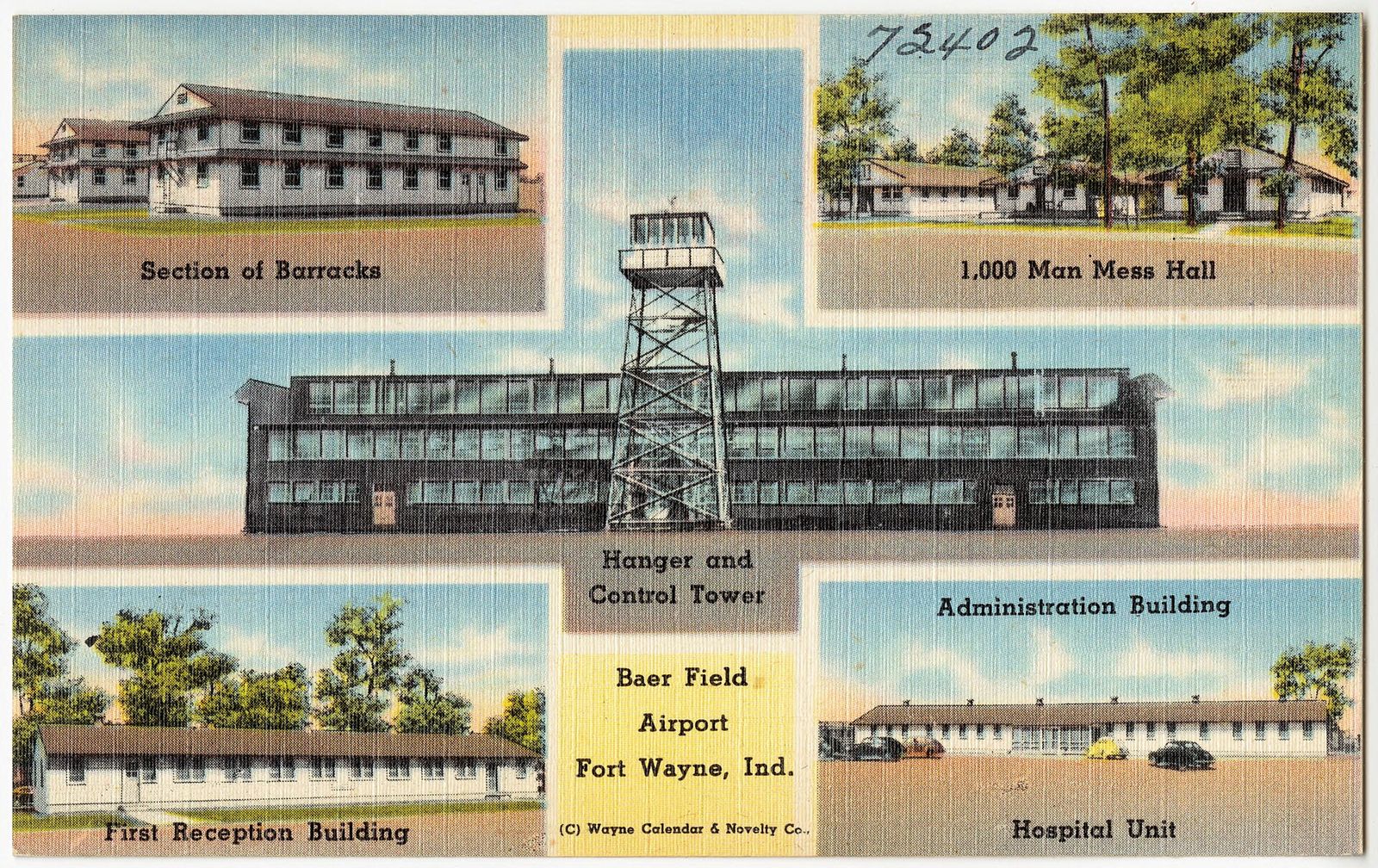
The base the city asked for: Baer Field was unusual among wartime bases in that Fort Wayne requested it. The city took options on some 700 acres southwest of town; when the War Department decided in January 1941 to build if the land could be had by 1 February, thirty local businessmen signed notes totaling the 125,000 dollars needed, four banks advanced the city the money, landowners were given fifteen days to vacate, and the federal government signed a lease at one dollar a year. The field was named for Paul Baer of Fort Wayne, the World War I ace with sixteen victories who had been killed flying the mail in China in 1930 — War Department policy required bases to be named for deceased military aviators. Construction was substantially finished by July 1941, about 150 days after the lease, at a cost put at ten million dollars; the Army Air Forces took possession on 31 October 1941. The ground station north of the runways held more than one hundred buildings — barracks, hangars, a control tower, headquarters and mess halls — most of them temporary wood and tar-paper construction, and wartime accounts credit the field with processing on a scale the popular histories put at more than 100,000 military personnel over the course of the war; no official personnel total is published in the sources consulted, and the figure is carried here as the field's received scale, not as an audited count.
Its mission changed with the war's needs. Assigned first to I Fighter Command, First Air Force, it received the 31st Pursuit Group — the first group equipped with the Bell P-39 Airacobra — on 6 December 1941, the day before Pearl Harbor, and the 78th Fighter Group was activated there on 9 February 1942 with P-38 Lightnings. In March 1942 jurisdiction passed to III Bomber Command, which used Baer as a staging and processing field for B-26 Marauder groups. From March 1943, under I Troop Carrier Command, Baer found the role it kept: a processing center for troop-carrier aviation. New C-47 Skytrains and C-46 Commandos were ferried in from the factories, inspected line by line in the largest hangar, modified to current orders, fitted with long-range ferry tanks — two 100-gallon tanks for the North Atlantic route, four for the South Atlantic, eight for the Pacific — flight-tested on an eighty-mile round trip to Kendallville and back with one engine shut down, and delivered to their crews. Ten to forty crews a day were processed, typically over two to three weeks each; the troop carrier groups processed through Baer included the 375th, 403rd, 433rd through 442nd in sequence. From April 1944 the field repaired war-weary aircraft returned from combat and processed Lend-Lease C-47s for Russia and Britain. In December 1945 the field went to temporary inactive status; in 1946 it was declared surplus except for the areas reserved for Reserve and Air National Guard use — the carve-out that preserved Fort Wayne's military airfield into the present. The 31st Pursuit Group's and the other wartime units' combat records are in the Wars record.
Sources:
- "Fort Wayne Air National Guard Base" — the city-request origin, the 125,000-dollar notes and the one-dollar lease, construction and 31 October 1941 possession, the 31st Pursuit Group (6 December 1941) and 78th Fighter Group (9 February 1942), the III Bomber Command and I Troop Carrier Command missions, the inspection and ferry-tank procedure, the processed groups, the December 1945 inactivation and the 1946 surplus-with-reserve carve-out.
- 122nd Fighter Wing Public Affairs fact sheet (2014) — Baer Field named for Paul Baer, built 1941 for ten million dollars, and the wing's own summary that Baer "serves as a maintenance center for C-47 transports heading to war."
- Fort Wayne International Airport history summaries — operations beginning April 1941 under the name Baer Army Air Base; the "over 100,000 military personnel" scale is stated there in popular form and is attributed as such in the text.