The exact page text, read by your browser's voice.
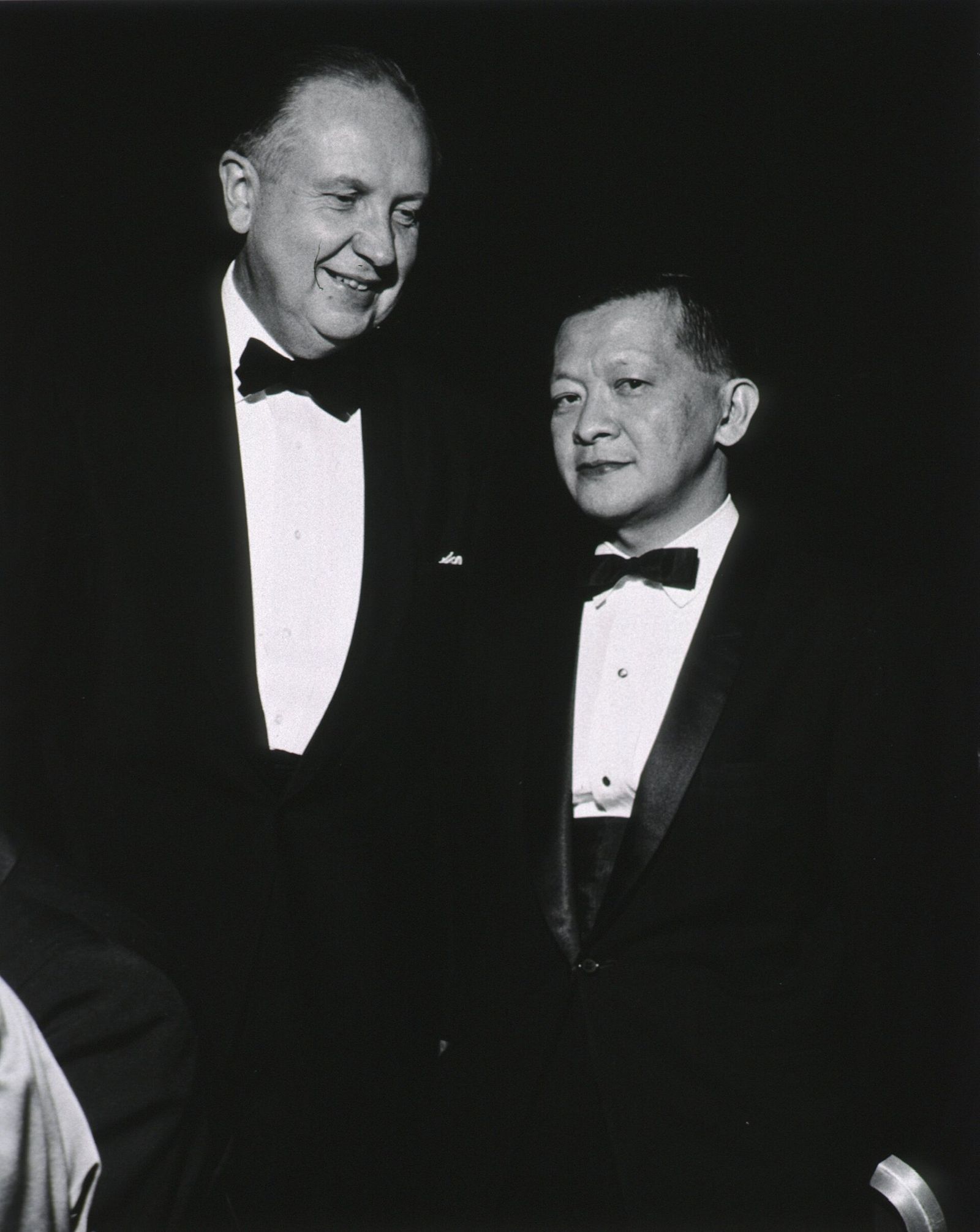

Seventh Surgeon General of the United States
On the record
Leonard Andrew Scheele was born at home at 1238 Oak Street, Fort Wayne, on July 25, 1907, and was named for Major General Leonard Wood, the Army physician his parents admired. His father, Martin Ferdinand Scheele, was a pharmacist, and at the historic Dreier pharmacy in Fort Wayne the boy watched his father work and was urged by him toward medicine. He graduated from Central High School, took his A.B. at the University of Michigan in 1931, and there fell under Professor C. C. Young, whose teaching turned him from practice toward preventive medicine. He took his medical degree at the Detroit College of Medicine and Surgery in 1934 and entered the United States Public Health Service on July 2 of that year.
The Service sent him up its research side. At thirty-two he was officer in charge of the National Cancer Institute's first cancer control program, the institute having been created by the National Cancer Act of 1937. Stephen J. Jay's biographical essay in Traces of Indiana and Midwestern History records distinguished service under Dwight D. Eisenhower in the Second World War, and after the war Scheele rose to direct the National Cancer Institute itself. On April 6, 1948, President Truman made the forty-year-old Fort Wayne native the seventh Surgeon General of the United States. He served eight years, under Truman and then Eisenhower, until August 8, 1956, and twice presided over the World Health Assembly of the World Health Organization.
His tenure is the hinge on which the modern Surgeon General's office turns. The Public Health Service under Scheele gave formal support to fluoridation of public water in June 1950, and on April 24, 1951, he issued his public and unqualified recommendation of it, staking the office's credibility on a measure that was then being fought town by town across the country. The same years brought programs against water pollution (1948), ionizing radiation (1948) and air pollution (1955), the transfer of the Interior Department's health bureau for American Indians to the Public Health Service in 1954, and the transfer of the Armed Forces Medical Library in 1956, the act that created the National Library of Medicine.
Then came the spring of 1955. After the successful 1954 field trial of Jonas Salk's polio vaccine, Scheele and Secretary of Health, Education and Welfare Oveta Culp Hobby announced the vaccine's licensing at a press conference on April 12, 1955, the tenth anniversary of Franklin Roosevelt's death. Within weeks, children who had received vaccine made by Cutter Laboratories of Berkeley, California, began falling ill with polio from the vaccine itself. On April 27 Scheele asked Cutter to recall its vaccine; he built a Poliomyelitis Surveillance Unit at the Communicable Disease Center and a national case-reporting system from the states; and in May he halted the entire national vaccination campaign until the remaining manufacturers' product was cleared. The campaign resumed under far tighter federal control, and the surveillance machinery he improvised became permanent. Scheele himself later named the three satisfactions of his career: the creation of the National Library of Medicine on the National Institutes of Health grounds, the appropriation to build the NIH Clinical Center, and the approval of the polio vaccine that began the disease's eradication in the United States.
He resigned in August 1956 to become president of Warner-Chilcott Laboratories, and retired in 1967. Retirement did not end the public calls. In 1961 President Kennedy asked him to join the team negotiating the release of the Bay of Pigs prisoners held by Cuba; Jay's essay follows his diary through the work, to the agreement signed on December 21, 1962, that brought the prisoners home. Scheele died on January 8, 1993, at George Washington Medical Center in Washington, aged eighty-five, and is buried at Arlington National Cemetery. Fort Wayne's claim on him is plain: the city gave the Public Health Service its seventh Surgeon General, and the pharmacist's son from Oak Street ran American public health through fluoridation, the birth of the National Library of Medicine and the worst month the polio vaccine ever had.
Find them on this page
- § 06 — people of the record · famous-people supplement
Sources:
- Stephen J. Jay, "Leonard A. Scheele," Traces of Indiana and Midwestern History, Fall 2008 (Indiana Historical Society): the Fort Wayne birth and family, the naming for Leonard Wood, Martin Scheele and the Dreier pharmacy, C. C. Young at Michigan, the July 2, 1934 commission, cancer control at thirty-two, war service under Eisenhower, the Bay of Pigs committee diary and the December 21, 1962 agreement, retirement in 1967, death at George Washington Medical Center.
- Office of Public Health and Science, "Leonard A. Scheele," Surgeon General biography (U.S. Department of Health and Human Services, January 4, 2007), as reproduced in the Leonard A. Scheele entries of Wikipedia and related references (accessed 2026): the April 6, 1948 appointment and August 8, 1956 retirement; fluoridation support in June 1950 and the April 24, 1951 recommendation; the April 12, 1955 licensing announcement with Secretary Hobby; the April 27 Cutter recall; the Poliomyelitis Surveillance Unit and the May halt; the 1954 Indian health transfer and the 1956 Armed Forces Medical Library transfer; the water, radiation and air pollution programs; the presidency of Warner-Chilcott; the three satisfactions.
- Indiana Historical Society essay by Stephen J. Jay (2006), researched with the Allen County Public Library, and the Wayne State University School of Medicine alumni profile, as carried in this history's existing record: the Oak Street birth, Central High School, the 1931 Michigan degree and 1934 medical degree, the direction of the National Cancer Institute, two presidencies of the World Health Assembly, and burial at Arlington National Cemetery.