The exact page text, read by your browser's voice.
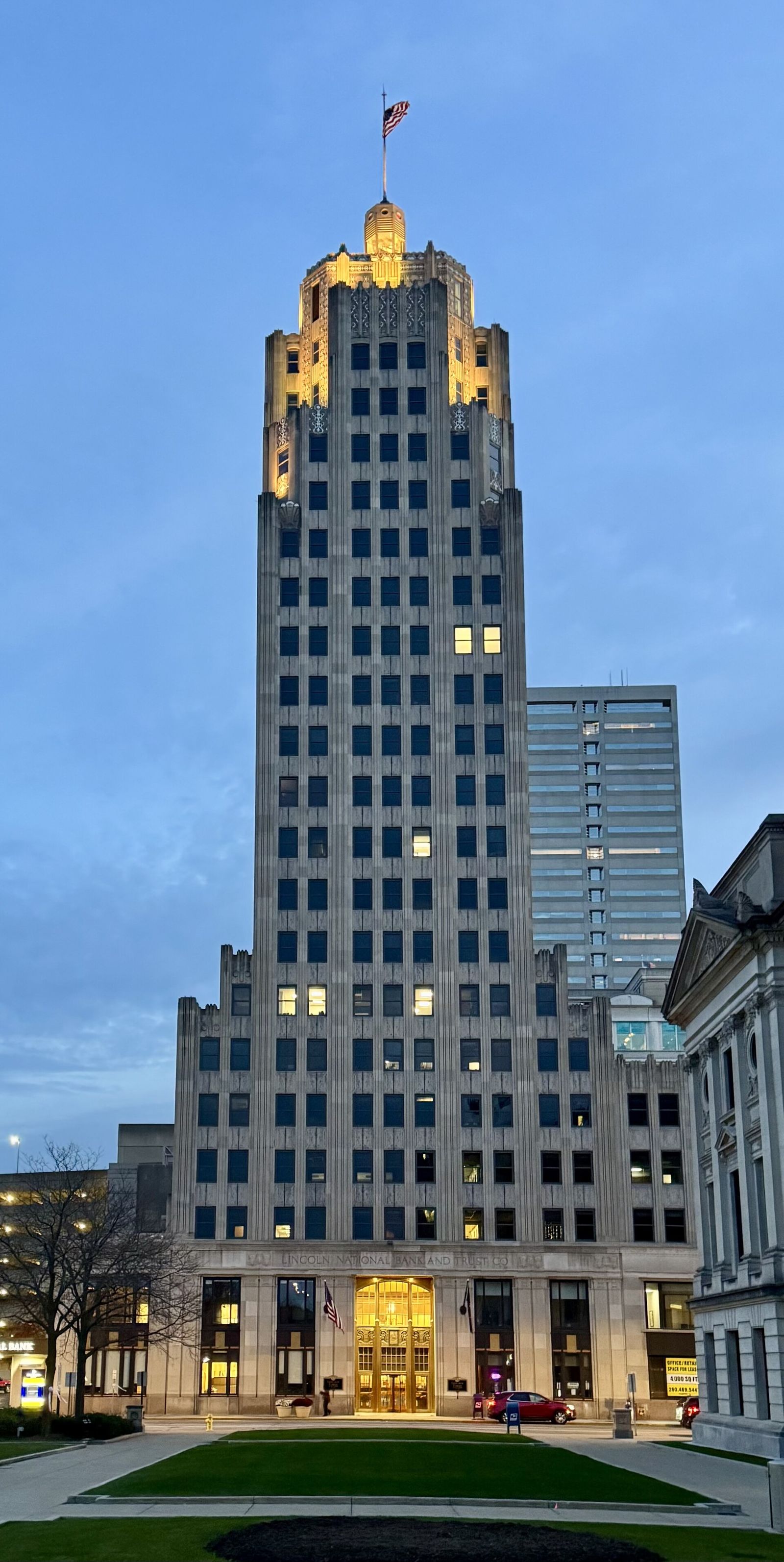

Ground was broken on August 16, 1929, weeks before the stock market crash, and the Lincoln National Bank and Trust built straight through it: the tower opened on November 16, 1930, when more than 38,000 people came to walk through it. It cost $1.3 million. The design, by the Cleveland firm of Walker & Weeks with Fort Wayne's Alvin M. Strauss as associate architect — the credit is often shortened to Strauss alone, and ARCH lists it "A.M. Strauss/Walker & Weeks" — took Chicago's Tribune Tower as its model and rose in seven setback tiers, 22 stories and 312 feet to the tip of the flagpole, built of 1,774 tons of structural steel faced in Indiana limestone and granite, with terra cotta and gold highlights at the crown and bronze panels at the entrance depicting scenes from Abraham Lincoln's life. The Hagerman firm (the Buesching-Hagerman Company) was the contractor; Charles Buesching, the bank's president, was the project's driving force.
At 312 feet it was the tallest building in Indiana from 1930 until 1962, and the tallest in Fort Wayne until 1970 — a fact the tower's admirers often compress into "Indiana's tallest into the 1970s." It is routinely called Indiana's first skyscraper. Tippmann Properties acquired and refurbished it in 1998; it housed Tower Bank, acquired by Old National Bank in 2014, and remains a working bank and office tower at 116 East Berry Street.
Sources: ARCH Inc., Built Heritage ABCs, "L: Lincoln Tower"; ACGSI, Lincoln Tower page (drawing on the Journal Gazette's historical anniversaries); Indiana Architecture Database (Indiana Landmarks), Lincoln Bank Tower entry; Wikipedia, "Lincoln Bank Tower."