The exact page text, read by your browser's voice.
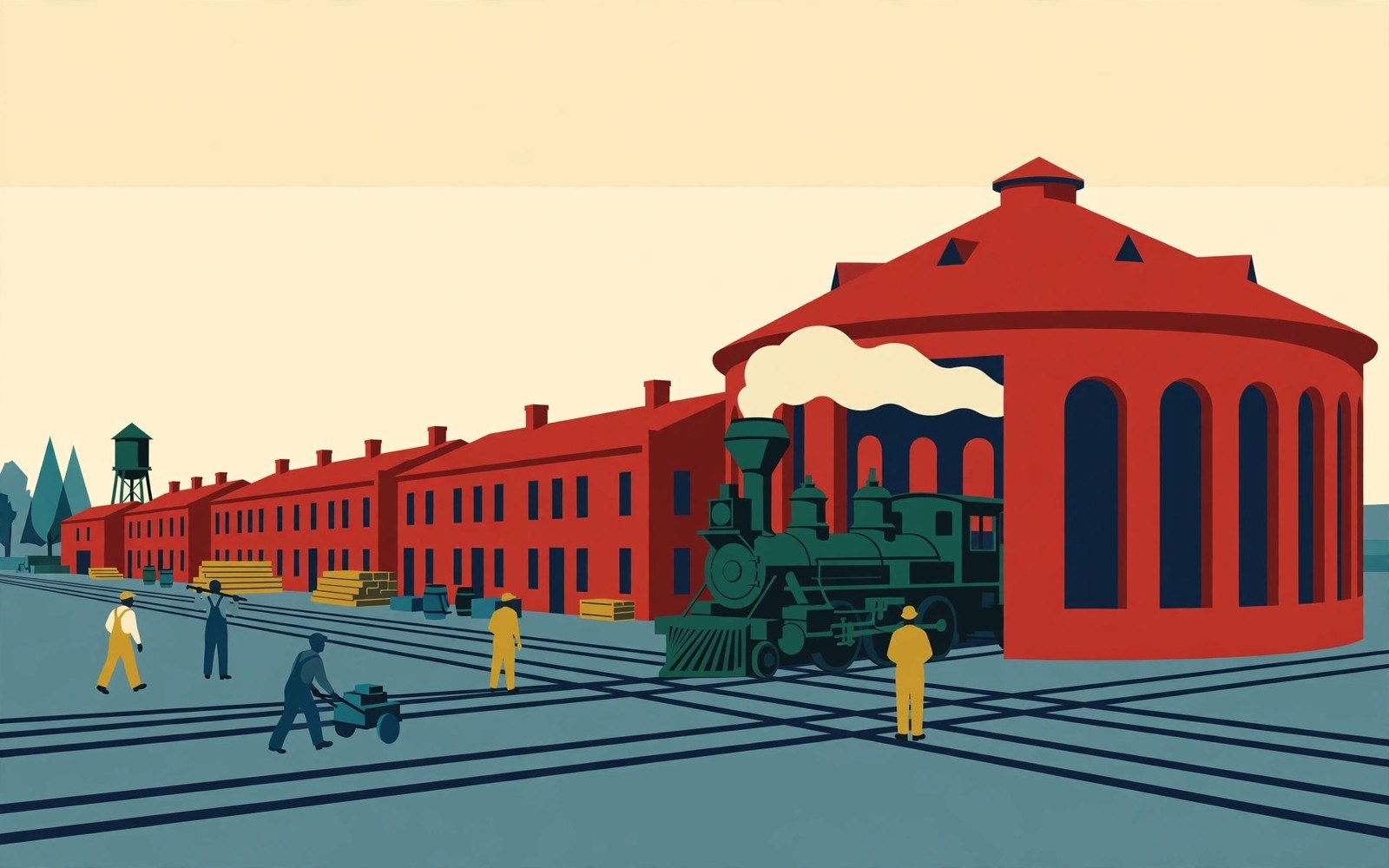
1857 – 1953
Founded: 1857 — The National Register Baker Street Station nomination states: "In 1857, shortly after the Pittsburgh, Fort Wayne, and Chicago Railroad was formed, the directors of the railroad (with encouragement from Samuel Hanna) chose Fort Wayne as the site for the line's all-important repair and construction shops." The News-Sentinel Cityscapes account gives the transaction and month: in September 1857 the shops "were sold to the forerunner of the Pennsylvania Railroad, the Pittsburgh, Fort Wayne and Chicago line, by Jones, Bass & Co." Two framings of Hanna's role sit side by side in the record and are flagged, not merged: a History Center account reproduced by ACGSI says Samuel Hanna donated a parcel of land east of Clinton in 1852 for the anticipated railroad shops; the nomination says only that the choice was made "with encouragement from Samuel Hanna" and that the railroad bought the Bass operation already on the site. The site itself had been developed in 1853 by blacksmiths John and Charles Cooper and purchased in 1854 by Sion Bass, who established a foundry and machine shops there before selling the whole operation to the railroad (nomination, citing Griswold p. 446).
Founders: The Pittsburgh, Fort Wayne & Chicago Railroad (consolidated 1856; leased by and incorporated into the Pennsylvania Railroad system in 1869, per the nomination), acting on Samuel Hanna's encouragement; on the ground, the predecessor operation was John and Charles Cooper's 1853 blacksmith shop, bought and built up by Sion S. Bass and sold on by Jones, Bass & Co. in 1857.
What it did: The line's construction and repair shops: designed, built, tested, repaired and overhauled locomotives and railroad cars on a complex that "once stretched along the Pennsylvania tracks for nearly three miles" (nomination). Signature products included the "Fort Wayne Silver Palace Cars," a refinement of the Pullman sleeping-car design (seven built 1867–1869 at $18,000 each, per the ACGSI History Center account), "Boone-built" locomotives under master mechanic James Boone in the 1870s, and the Pennsylvania system's Class X (Steffin) locomotives built 1892–1897 (nomination). The site marker quoted by Cityscapes totals 300 locomotives and 12,000 cars designed and built here.
Course: Major buildings were completed in 1863, and the shops grew significantly during the Civil War supplying the Union war effort (nomination; Cityscapes). The Pennsylvania Railroad expanded them in 1882, 1903 and 1918 (nomination). Employment: the nomination says "over one thousand men employed at one time"; David Steiner's Quest Club paper, citing John F. Bonsib's 1979 Quest Club paper, gives the much larger figure of 3,950 workers by 1913 — both figures are carried here as their sources give them; they describe different dates and are not averaged. Fort Wayne was "even briefly labeled as the 'Altoona of the West' because of the importance of the shops" (nomination) — as a period label, with no coiner or first use found. The end of locomotive work is conflicted in the sources and flagged: the nomination and ACGSI agree locomotive production ceased after World War I, with repair and overhaul continuing until 1933; Cityscapes instead says engine construction "came to a halt near the turn of the century" because bigger locomotives outgrew the shops, while agreeing repairs continued through the Great Depression.
Fate: After locomotive rebuilding ended in 1933, passenger-car production/repair continued, then "declined sharply after World War II" (nomination; ACGSI) — The marker quoted by Cityscapes says the Pennsylvania Railroad used the site "for 100 years — until the early 1950s — for construction and repair of rolling stock." The History Center account on ACGSI is more precise: "in 1953 the last of the railroad operations closed, and by 1966 all the property had been abandoned; the roundhouse, the last vestige of the Pennsy Shops, was razed in 1984." The nomination independently gives abandonment of all shop property by 1966 and demolition of the roundhouse, "the last and most distinctive remaining building of the shops," in 1984. Cityscapes adds the piecemeal disposal: in the mid-1950s the complex between Clinton and Lafayette was sold off (Lincoln Life took the machine and blacksmith shops for parking; International Harvester bought the largest buildings), and the last buildings came down shortly before work on the new postal facility began in the late 1970s. Penn Central / Conrail era: the record opened does not carry the shops into that era — they were closed in 1953 and abandoned by 1966, before the 1968 Penn Central merger — so any claim that the Pennsy Shops operated under Penn Central or Conrail is not supported on these sources. (The separate Baker Street passenger station, opened 1914, is a different property; ACGSI refers to it in passing as the former Penn Central station, which is a station history, not a shops history.)
Sources:
- National Register nomination, Pennsylvania Railroad Station (Baker Street Station), Statement of Significance, §8 pp. 12–14 (1857 choice of Fort Wayne, Cooper/Bass site, expansions, "Altoona of the West," production to after WWI, repairs to 1933, abandonment by 1966, roundhouse demolished 1984) — https://npgallery.nps.gov/GetAsset/f2117a9e-7ba2-4da7-9d02-57eff891e1ca
- ACGSI / Allen INGenWeb, Railroad History of Fort Wayne (History Center account: Hanna's 1852 land donation, Cooper shop 1853, Sion Bass purchase and 1857 sale, Silver Palace cars, rebuilding ended 1933, last operations closed 1953, property abandoned by 1966, roundhouse razed 1984) — https://www.acgsi.org/genweb/fort-wayne/railroad-history-fort-wayne-allen-county-indiana.html
- News-Sentinel Cityscapes, Kevin Leininger, "The Pennsy Shops," 26 December 1981 (September 1857 sale by Jones, Bass & Co.; site marker; construction halted near the turn of the century; mid-1950s piecemeal sale; last buildings down in the late 1970s) — http://egen.fortwayne.com/ns/projects/history/scapes37.php
- Quest Club paper, David Steiner, "Trends in Industry in Allen County," citing John F. Bonsib's 1979 Quest Club paper (Pennsylvania Railroad Shops "grew to employ 3,950 workers by 1913") — https://www.barrettlaw.com/history-trends-in-industry-allen-county