The exact page text, read by your browser's voice.
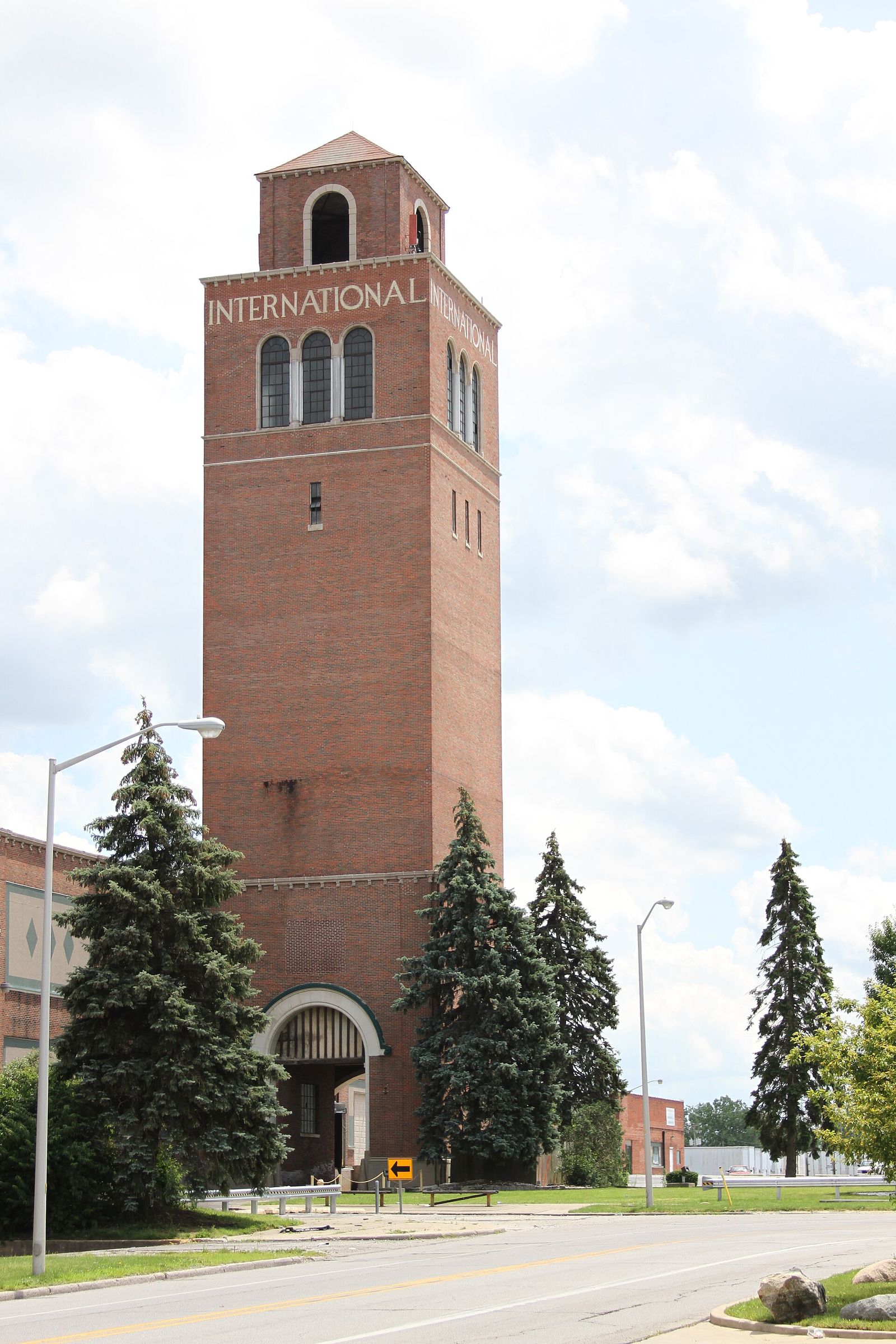

Heavy trucks and the Scout · International Harvester Co.
On the record
Founded (Fort Wayne Works): construction began 1922, production began 1923, strong for the years. ACGSI gives construction beginning in 1922 at East Pontiac Street and Bueter Road, corroborated by a contemporary Fort Wayne Journal Gazette of 1 July 1923 reporting buildings commenced the previous year “nearing completion”; ACGSI, PBS Fort Wayne, MotorTrend and the News-Sentinel all agree production began in 1923. The parent, International Harvester Co., was formed in 1902 by merger of McCormick, Deering and three smaller firms — a corporate plant, not a locally founded firm; there is no individual Fort Wayne plant founder. Siting: IH approached the Fort Wayne Chamber in 1919 with a $5 million truck-plant proposal (4,000–5,000 jobs) among 28 possible locations.
What it did: built heavy- and medium-duty trucks (Truck Plant 1), including Class 8 over-the-road tractors, and wartime vehicles in World War II; designed and engineered trucks, and ran a parts warehouse / Master Parts Depot, a Truck Sales Processing Center, a test track and a reliability and technology centre on the Fort Wayne complex. In an adjacent plant (Plant 101) it built the Scout, an early sport-utility / off-road vehicle, precursor to modern SUVs.
Course: total Fort Wayne truck production was 1,527,299 heavy and medium trucks before closure, strong. A City of Fort Wayne blog figure of “5.1 million vehicles” is irreconcilable with 1,527,299 trucks + 532,674 Scouts = 2,059,973 and is not established, probably erroneous, and not used. The one-millionth truck, a semi-tractor, was reached in 1963. Scout: produced November 1960 to October 1980, 532,674 built, strong (first Scout 1 December 1960; last Scout 21 October 1980). Fort Wayne employment reached nearly 9,000 by the end of the 1960s and peaked at 10,600 in early 1979, strong, for all Fort Wayne IH facilities, not Truck Plant 1 alone. By mid-century Fort Wayne was called the “Heavy-Duty Truck Capital of the World” as usage. Decline: a 172-day UAW strike, 1 November 1979 – April 1980, with over 8,000 Fort Wayne workers out (Locals 57 and 305).
Fate: truck production closed 1983 — the last truck is proven; the wider Fort Wayne presence ended in stages, not in 1983. In July 1982 IH announced consolidating three truck plants into two, Fort Wayne (60 years old) against Springfield, Ohio (17 years old). Fort Wayne, Allen County and Indiana assembled a $31 million retention package against Springfield’s $30 million, strong; IH kept Springfield. The closure was announced on 27 September 1982 and reported on the front page of the Journal Gazette on 28 September 1982 — the later date is the newspaper date, not the announcement date. The last truck rolled off the Fort Wayne line on 15 July 1983 (ACGSI, News-Sentinel, Input, and the Journal Gazette’s retrospective all agree on the exact date). An engineering and parts centre was reported to remain, with about 2,000 employed in 1984 as a closure-period report. The parent sold its agricultural division in 1985 and the remaining truck and engine business became Navistar International in 1986. The Fort Wayne Truck Development and Technology Center was phased out from 2011 and finally closed in July 2015, with the test track sold in 2015, thin.
Find them on this page
- § 05 — business
Sources: ACGSI / Allen INGenWeb, International Harvester in Allen County — https://www.acgsi.org/genweb/fort-wayne/ih-harvester-in-allen-county-indiana.html ; News-Sentinel decade history ; Input Fort Wayne retrospective — https://inputfortwayne.com/international-harvester-museum/ ; MotorTrend / Harvester Homecoming — https://www.motortrend.com/events/1910-harvester-homecoming-celebration-international-harvester-fort-wayne-indiana ; PBS Fort Wayne, Truck Town — http://pbsfortwayne.org/trucktown/ ; Ball State Daily News, 28 Sept 1982 — http://dmr.bsu.edu/digital/api/collection/BSUDlyNws/id/46339/download . Sources as cited in the profile.