The exact page text, read by your browser's voice.
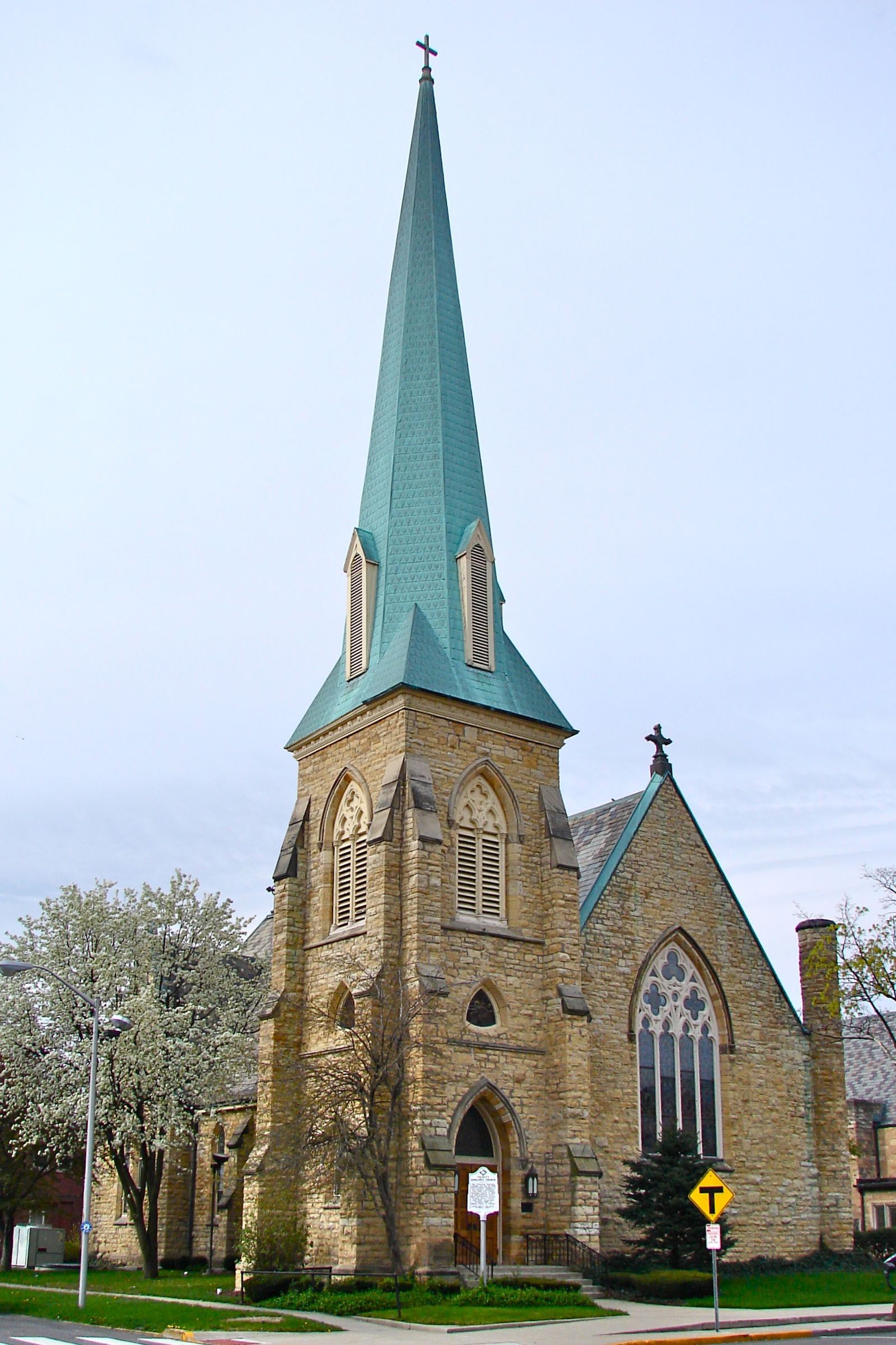

Christ Church 1839 — Trinity organized 25 May 1844 — present church 1866
Two foundings: The Episcopal Church came to Fort Wayne on the visits of Jackson Kemper, missionary bishop of the Northwest, who first assessed the town in 1837. In 1839 he sent the Rev. Benjamin Hutchins of Philadelphia, and Christ Episcopal Church was formally established on 26 May 1839 — but the parish folded in less than a year when Hutchins departed. In 1844 Peter P. Bailey, a New York merchant who missed the services of his home church, began lay readings from the Book of Common Prayer and persuaded Kemper to send another missionary, the Rev. Benjamin Halsted. Trinity Episcopal Church was formally organized on 25 May 1844, meeting at first in the county courthouse; its first small frame church rose at Berry and Harrison in 1848, fitted with a four-stop organ the diocesan archive calls the first documented church organ in town.
The present church: During the Civil War, under the second rectorate of the Rev. Joseph S. Large, the vestry and the parish women raised the money for a Gothic Revival church designed by Charles Crosby Miller of Toledo, completed in the fall of 1866 and consecrated in 1868 by Bishop Joseph Cruikshank Talbot. It stands at 611 West Berry Street and was listed on the National Register of Historic Places in 1978. When the Diocese of Michigan City — today's Diocese of Northern Indiana — was created in 1898, Trinity was its largest parish and, in the diocesan archive's words, "exercised much influence"; retired Bishop Edward S. Little called it "very Cathedralesque." The diocese's cathedral, however, is the Cathedral of St. James in South Bend, the see since 1957; St. Paul's in Mishawaka served as the diocese's pro-cathedral before it, until 1950. Fort Wayne is a seat of Catholic and Lutheran government, but it has never been the Episcopal cathedral city, a distinction loose retellings sometimes blur. The parish's sesquicentennial history, Beyond These Stones (1994), was written by John D. Beatty.
Sources:
- Episcopal Diocese of Northern Indiana Archives (scalar.usc.edu), "Trinity Episcopal Church, Fort Wayne" — Kemper 1837, Hutchins and Christ Church, Halsted and the 25 May 1844 organization, the organ, the 1866 church, the 1898 diocese, Beatty's history.
- "Trinity Episcopal Church (Fort Wayne, Indiana)," Wikipedia — Christ Church established 26 May 1839, first church 1848, built ca. 1865, NRHP 1978.
- Episcopal Diocese of Northern Indiana Archives, “Cathedral of St. James, South Bend” — St. James became the cathedral in 1957 (Bishop Reginald Mallett enthroned 20 January 1957); St. Paul's, Mishawaka, served as pro-cathedral during Bishop Gray's episcopate, the designation ending in 1950.