The exact page text, read by your browser's voice.
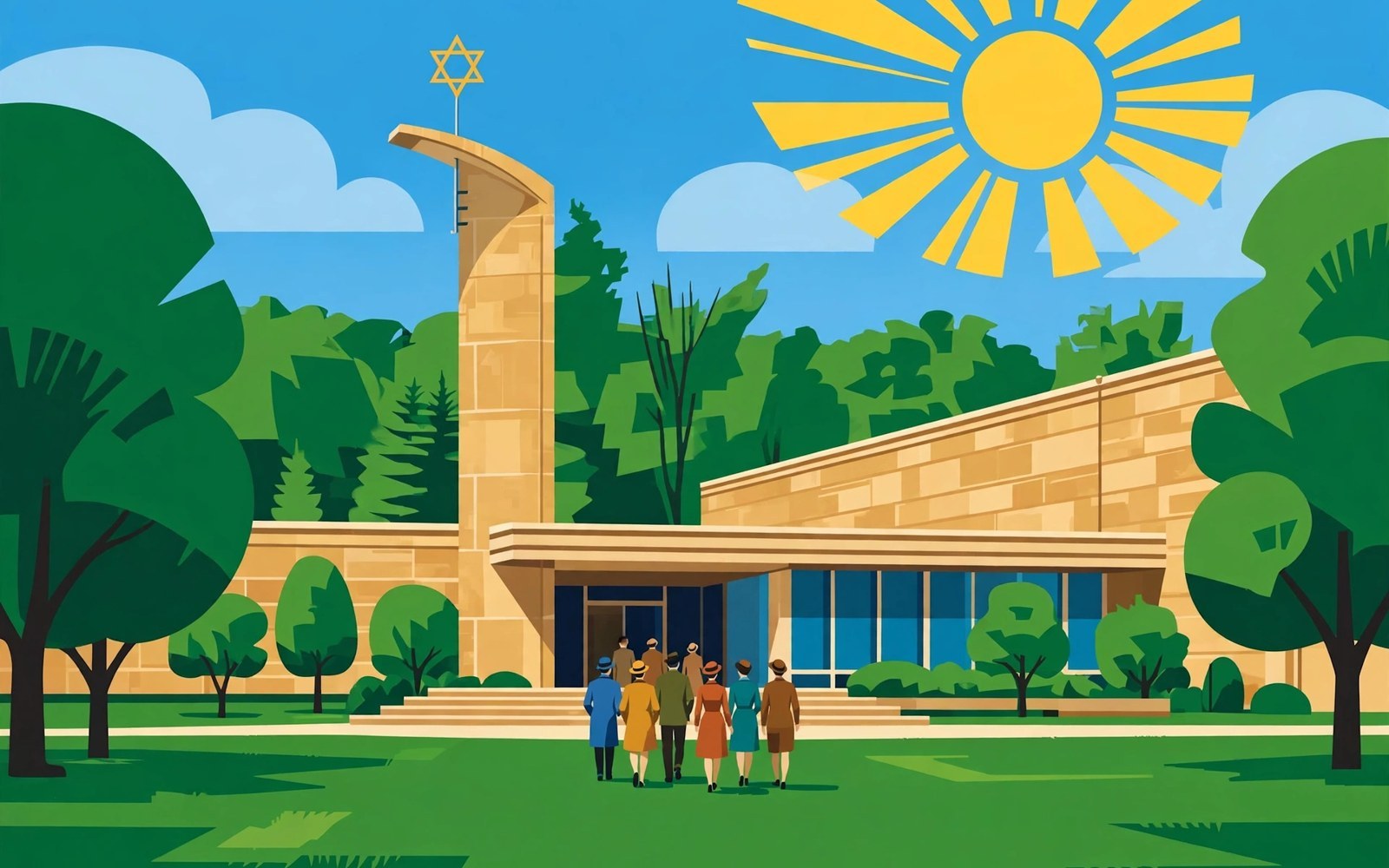
Organized 26 October 1848 — the oldest Jewish congregation in Indiana
The founding: Jewish life in Fort Wayne began in 1840, when Abraham Oppenheimer and Sigmund Redelsheimer became the city's first Jewish residents. On 13 October 1848 a society of twenty-three members — organized as a "Society for Visiting the Sick and Burying the Dead," with Frederick Nirdlinger as president and Redelsheimer as vice-president — bought for 200 dollars the old burial ground adjoining what is now McCulloch Park. On 26 October 1848 it officially organized the first Jewish congregation in the state of Indiana. The name it took in 1861, Achduth Vesholom, is Hebrew for "unity and peace." In May 1874 the congregation became Reform and joined the Union of American Hebrew Congregations; it is also described as the second-oldest Reform congregation west of the Alleghenies. Until its first synagogue opened in 1859, the founders had met at Frederick Nirdlinger's home at Main and Harrison; the congregation has since had five homes and twenty-three rabbis.
The course: In 1884 the congregation purchased a section at Lindenwood Cemetery and began moving its dead from the first burial ground; a separate Fort Wayne Jewish Cemetery on Decatur Road was dedicated in 1911. The present Temple, at 5200 Old Mill Road, opened in 1961; its grounds are now the Rifkin Campus, shared with the Jewish Federation of Fort Wayne and the Madge Rothschild Resource Center. In November 2023 the Fort Wayne Museum of Art marked the congregation's 175th year with the exhibition Jewish History and Art Illuminated. The congregation's records for 1848–1883, kept in German, were translated and published by Frances Lowens (1990), and its first 125 years were written up by Ruth G. Zweig for the Indiana Jewish Historical Society in 1973, from research by Mrs. I. L. Bronstein. The Jewish merchants of the congregation's first century are in the Business record; the Temple's religious school and its long-running Temple Head Start are in the Schools section; the 2019 union with B'nai Jacob is in the entry below.
Sources:
- Congregation Achduth Vesholom, "Our Story" (templecav.org) — the 1848 organization, the burial-ground purchase, the 1861 name, Reform in 1874, the 1961 building, the 2019 union.
- Jewish Federation of Fort Wayne, "History" and "Community" (fwjf.org) — Oppenheimer and Redelsheimer 1840, the Rifkin Campus, the 2019 merger.
- Indiana Jewish Heritage Initiative, Compiled Jewish Heritage Initiative: Allen County History (in.gov) — the Society for Visiting the Sick and Burying the Dead, the 1884 Lindenwood purchase, Lowens's translated records.
- Ruth G. Zweig, The First Hundred and Twenty Five Years (Indiana Jewish Historical Society, Publication No. 2, September 1973) — the founders' officers, the Nirdlinger home meetings to 1859.
- Whatzup, "The Temple marks 175th year with exhibit" (2023) — five locations, twenty-three rabbis, the FWMoA exhibition.