The exact page text, read by your browser's voice.

1858 — 2025
A century of using the rivers as the drain, then a machine to stop: Fort Wayne's first sewer line was completed in 1858, and for the next century and a half the arrangement it began was simple: the city's waste went to the rivers, latterly through a combined system in which one pipe carried sewage and stormwater together and, in any hard rain, spilled the mixture at outfalls along all three rivers. The modern record puts numbers on the habit: in a typical year the combined system overflowed on the order of seventy times — 71 events in the tunnel program's engineering summaries, 76 in the Journal Gazette's — discharging diluted sewage to the St. Joseph, the St. Marys, and the Maumee, the St. Joseph alone taking a dozen or more spills a year. It is worth holding this beside the entry above: the same decades in which the city learned to drink from the cleanest of its rivers were the decades in which it was still using all three as its sewer outfall.
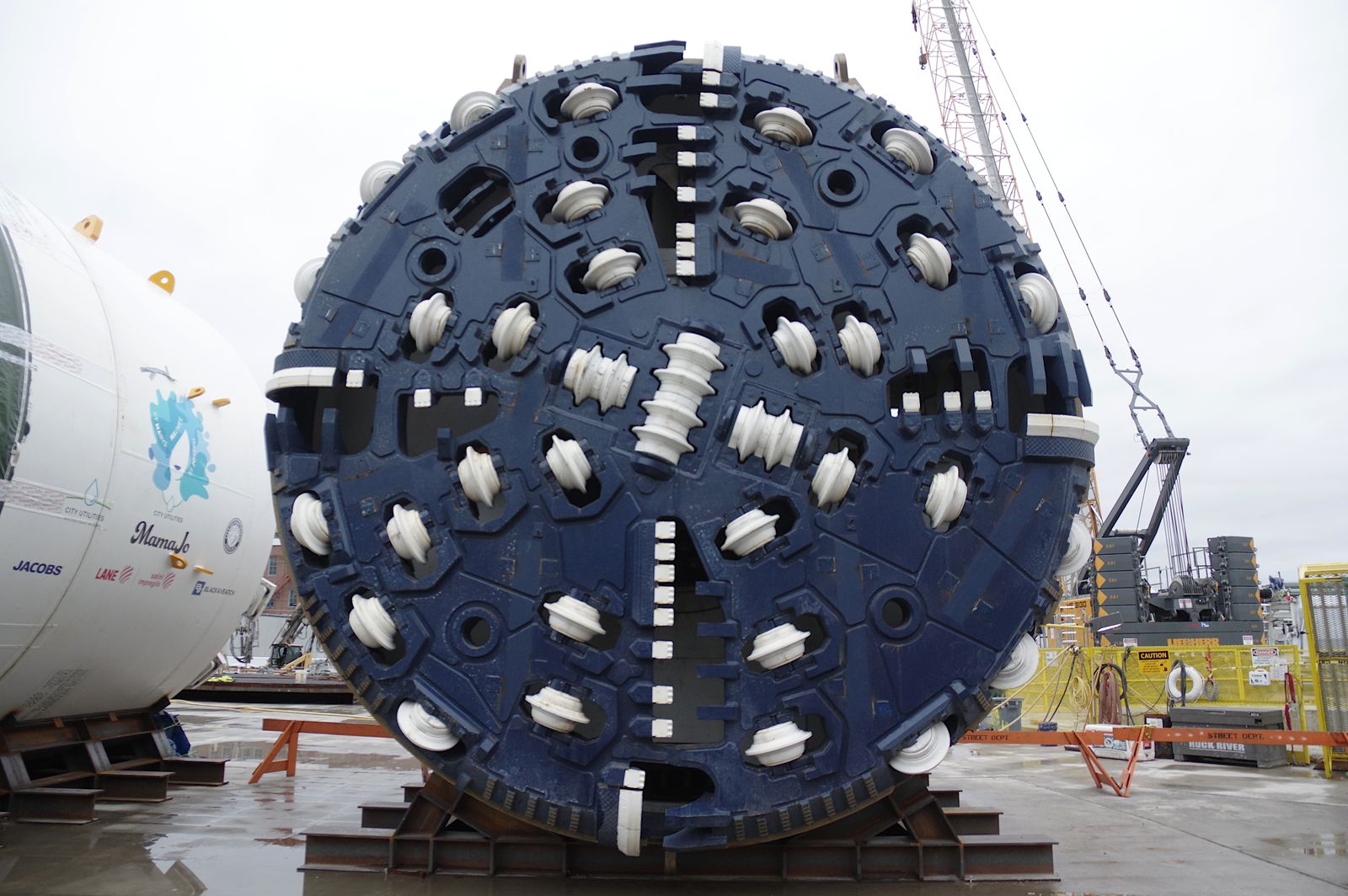
The reckoning arrived as federal law. After more than ten years of negotiation with the EPA, the Justice Department, and the Indiana Department of Environmental Management, the city entered a consent decree — agreed in late 2007 and entered by the U.S. District Court on April 1, 2008 (Case No. 2:07-cv-00445) — committing it to an 18-year, roughly $240 million long-term control plan of fifteen control measures, aimed at cutting overflows in a typical year from the seventy-odd to four. The plan's centerpiece is a hole in the ground: the Three Rivers Protection and Overflow Reduction Tunnel — 3RPORT — a deep rock tunnel about five miles long and sixteen feet in finished diameter, bored as much as 220 feet below the city along the St. Marys and Maumee corridor by a tunnel-boring machine the city named MamaJo, from the first syllables of the three rivers it protects: Ma-ry, Ma-umee, Jo-seph. Financed in part by a $188 million Clean Water State Revolving Fund loan and built for a bid of about $188 million, it was the largest public works project in the city's history. The decree's paperwork tells the finishing story with bureaucratic honesty: a force-majeure event won the city an extension of the tunnel measure's full-operation deadline to December 31, 2024, and the thirty-fourth six-month status report, filed March 25, 2025, records full operation achieved for multiple outfalls in 2025. The same federal fish-passage program that figures in the dams entry below removed the low-head dams on Spy Run Creek in 2025, signs on the bank now explaining to walkers that the creek named for William Wells runs free to the Maumee again.
Sources:
- Consent Decree, United States et al. v. City of Fort Wayne, No. 2:07-cv-00445 (N.D. Ind.), entered April 1, 2008, and its modifications — the fifteen control measures, the performance standard of four overflow events in a typical year, and the tunnel's substitution for the parallel interceptors.
- City of Fort Wayne, Consent Decree Six-Month Status Report No. 34 (March 25, 2025) — the force-majeure extension to December 31, 2024, and full operation for multiple outfalls in 2025.
- Municipal Sewer & Water (December 2017) and Tunnel Business Magazine — the five-mile, sixteen-foot tunnel, the 800-million-gallon-per-day capacity class, the $188 million SRF loan, and the 90 percent reduction expectation.
- Allen County Genealogical Society, Deep Rock Tunnel page, compiling City Utilities and Journal Gazette accounts — the $240 million, 18-year program, the 76-to-four overflow figures, the MamaJo name's derivation, and the St. Joseph's 12–15 annual spills.
- The History Center, City Light ID tag record — the first sewer line, 1858.