The exact page text, read by your browser's voice.
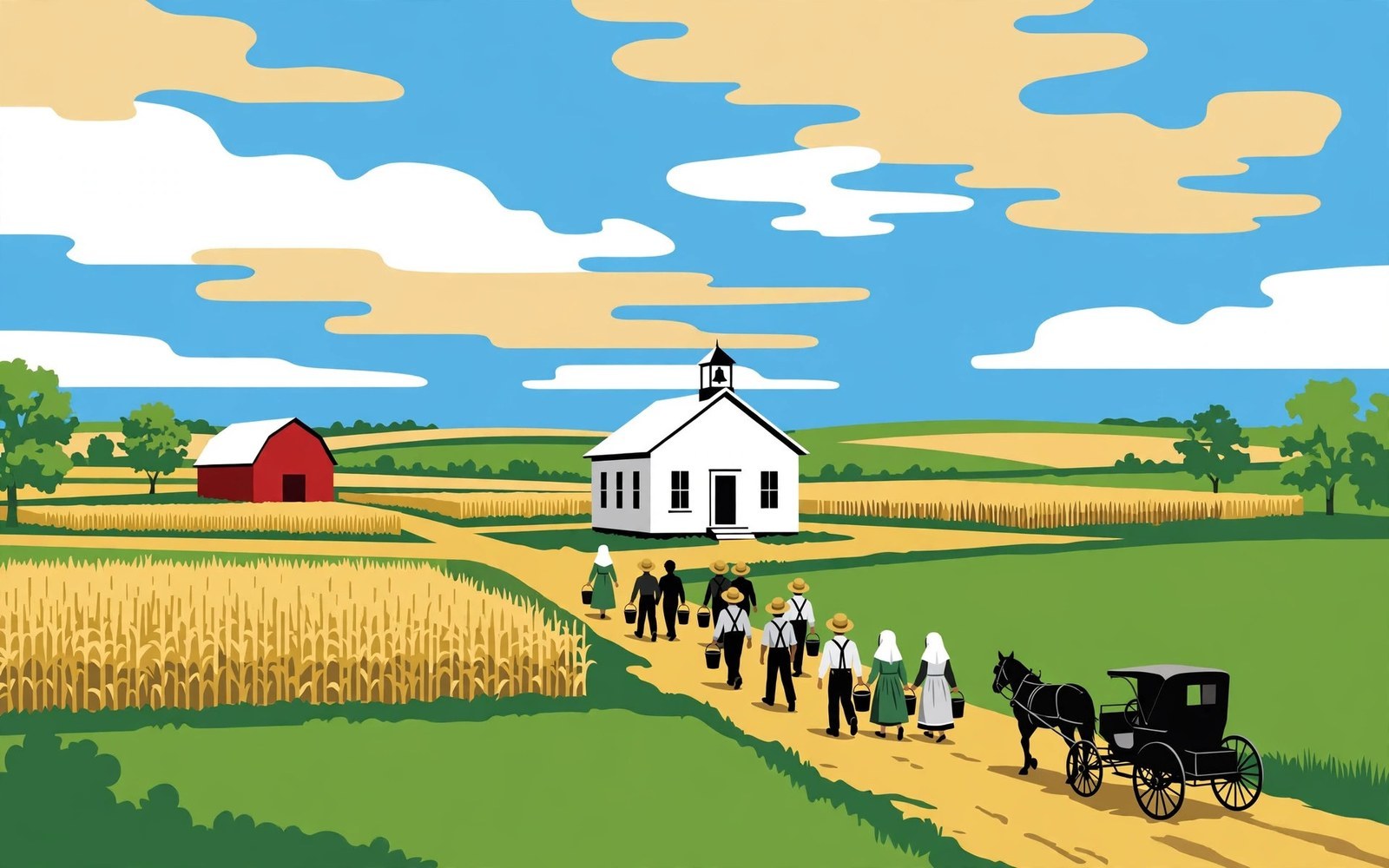
Eastern Allen County; the parochial schools of the Grabill-New Haven Old Order Amish settlement, founded 1852 or 1853 (sources differ, printed below)
The settlement: The schools belong to a settlement before they belong to a map. The Old Order Amish of eastern Allen County, the Grabill-New Haven settlement, began when Amish families from Stark County, Ohio, settled northeast of Fort Wayne: the Young Center for Anabaptist and Pietist Studies dates the founding to 1852, and the Global Anabaptist Mennonite Encyclopedia Online tells of fifty-two persons who migrated by ox team in 1853, and the two dates stand here as their sources give them. They were, GAMEO records, the only Indiana settlement made up primarily of nineteenth century Amish immigrants from Alsace, and their descendants still speak an Alsatian dialect, rare among the Amish. Their farms and church districts spread across the eastern townships with addresses at Leo, Grabill, Harlan and Woodburn, and by 1955 the settlement stood in three groups: the original congregation, the Graber congregation begun in 1909 by ministers Joseph and John Graber, and the Lengacher congregation organized in 1943 by Bishop Seth H. Byler.
Why their own schools: A settlement that keeps its own discipline keeps its own schools. GAMEO's 1990 account of Allen County says it in one sentence: the Allen County Amish maintain a strict church discipline, and operate several schools for the careful education of their children. The schools are parochial in the strict sense, belonging to the church districts whose children they teach, governed by the families of the district, taught commonly by young women of the community, and they teach through the eighth grade, where formal schooling ends. The pattern is the Indiana Amish pattern generally, described for the Nappanee district by the Christian Science Monitor in 2004: one-room schoolhouses built by the families themselves when a school outgrows its room, children of all ages under one roof, and schooling complete at fourteen or so, the community's young people going then to work and to the church's instruction. Allen County's schools are of that pattern; the Monitor's twenty schoolhouses are Nappanee's, not Allen County's, and are not counted here.
The documented record: The paper record of the Allen County schools is thin, and what stands in it is printed here entire. In May 1965 the study of East Allen County Schools made at Ball State University recorded a shared time program between Woodburn Elementary School and the local Amish Parochial School: twenty-two parochial students took part, nine boys in shop and thirteen girls in home economics, each for four periods a week, the earliest dated account of an Allen County Amish school at work that this history has reached. The federal nonpublic school list for 1991-92 names, for Allen County, an Amish Parochial School, an Amish School No. 1, a Cedar Creek Amish School and a Fairview Amish School, carried here in the list's own names, its surviving transcription imperfect. The one school the directories follow into the present is Black Creek Amish School at Woodburn: the federal Private School Survey counts eighty-nine students in grades one through eight taught by five teachers, at 17116 Notestine Road, while Private School Review counts one hundred nine students and five teachers and now carries the school as closed in 2025, a directory claim no community or state source reached confirms, and the two standings are printed unresolved. Two schools the directories name in the same breath, Cuba Mennonite School and Maumee Valley School, are Mennonite schools, not Amish, and are not this settlement's.
Scale: The settlement has grown around its schools. Seven church districts served a population of about one thousand in 1986. The Young Center counted twenty-two districts and an estimated three thousand one hundred ninety people in 2017, and its 2025 table counts twenty-six districts and an estimated four thousand five people, ranking the settlement among the twelve largest Amish settlements in North America. A scholarly profile of the settlement built from Amish directories counts higher still, four thousand four hundred eighty-five people in 2015, and projects six thousand five hundred sixteen for 2025. The measures differ, estimate against directory count against projection, and stand here unreconciled. How many schools the settlement keeps today, no source reached publishes: the roster stands where the inventory of this section left it, in the Indiana Department of Education's non-public school data by township corporation, only partly published, and this entry is the class record, not the roster. A school that opens, closes or moves inside the settlement changes the count, and the count is not guessed.
Sources:
- Global Anabaptist Mennonite Encyclopedia Online (gameo.org), "Allen County (Indiana, USA)": Samuel L. Yoder, 1955 and 1990, with the 2017 update by Harold S. Bender and Samuel J. Steiner: the migration of 1853, the Alsatian character of the settlement, the three congregations, seven church districts and about 1,000 people in 1986, 22 districts and an estimated 3,190 in 2017, and the schools operated by the community
- Young Center for Anabaptist and Pietist Studies, Elizabethtown College, "Twelve Largest Amish Settlements, 2025": the Allen County area settlement, 26 districts, an estimated population of 4,005, founded 1852
- Journal of Amish and Plain Anabaptist Studies 12(1), 2024, "Brief Amish Population Profile, Allen County, Indiana Settlement," profile 08: founded 1852; population 4,485 in 2015 on directory-based counts; 6,516 projected for 2025
- Wikipedia, "Allen County, Indiana": the Alsatian dialect of the settlement, and Amish parochial schools keeping children through the eighth grade in rural eastern Allen County
- Development of a Plan for the Reorganization of East Allen County Schools (Ball State University, Teachers College, May 1965), chapter 2: the shared time program between Woodburn Elementary School and the Amish Parochial School, 22 students in shop and home economics
- National Center for Education Statistics, Private School Universe data as republished by UnivStats and Private School Review: Black Creek Amish School, Woodburn, 89 students and five teachers in the federal data; 109 students, five teachers, and a closed in 2025 directory flag in Private School Review
- U.S. Department of Education, Private School Universe Survey 1991-92, school list for Indiana, as transcribed at archive.org: the Amish Parochial School, Amish School No. 1, Cedar Creek Amish School and Fairview Amish School entries for Allen County
- Christian Science Monitor, October 1, 2004, Daniel Scherding, "In Amish Country, an Education Beyond the Eighth Grade": the Indiana one-room parochial school pattern, cited for the Nappanee district's twenty schoolhouses as Indiana context only