The exact page text, read by your browser's voice.
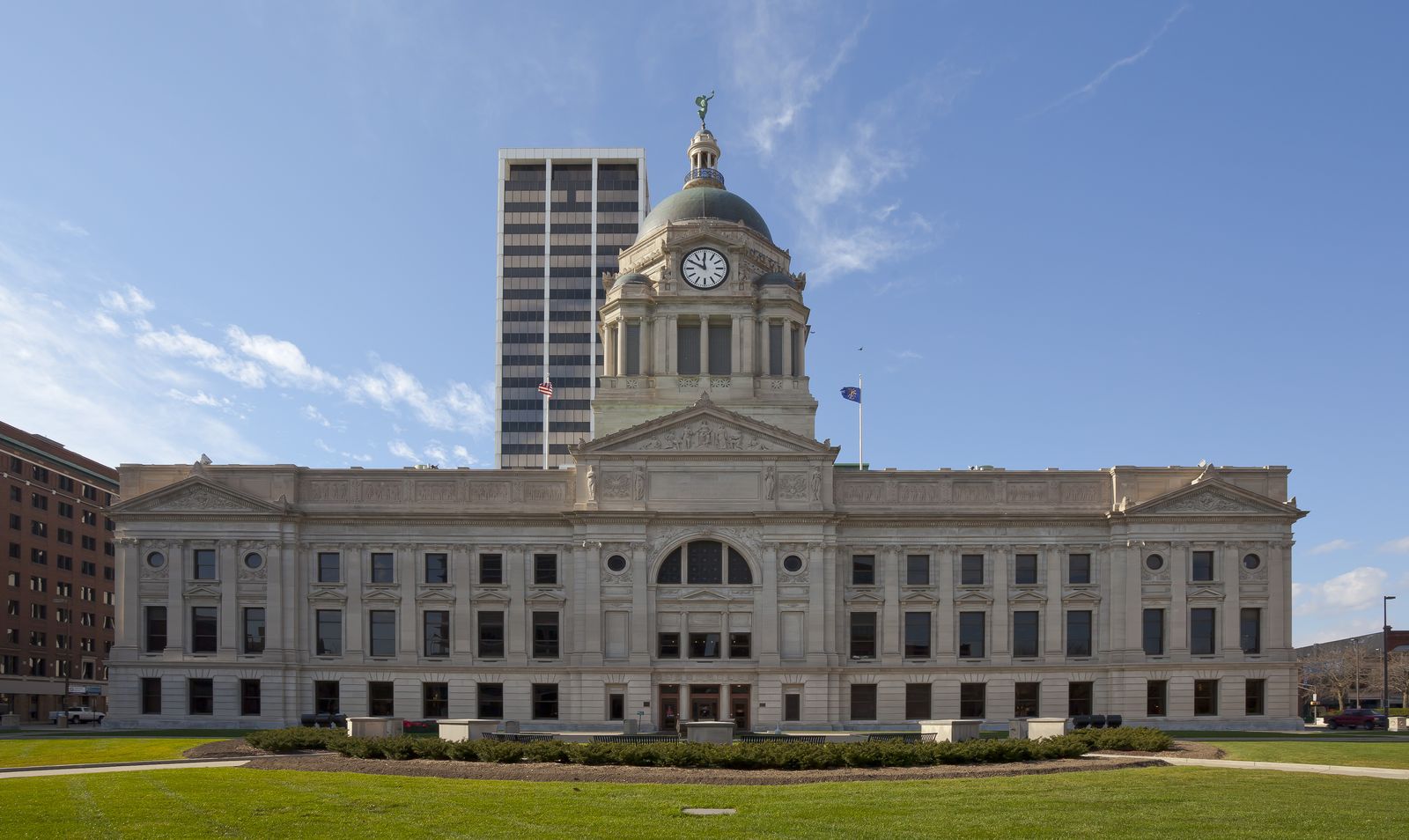

The courthouses. The 1824 plat reserved a public square for a courthouse, and four county courthouses have stood on it. The first, built in 1831, was poorly constructed, never properly finished and in time condemned as a safety hazard. The third — the "Civil War courthouse," designed by Edwin May of Indianapolis, its cornerstone laid in May 1861 and the building in use by July 1862 — served thirty-five years before demolition in 1897. The fourth is the present Allen County Courthouse: designed by Fort Wayne's own Brentwood S. Tolan in the Beaux-Arts manner, of Bedford limestone and Vermont granite, filled with Charles Holloway's murals, twenty-eight kinds of scagliola and art glass. Its cornerstone was laid on 17 November 1897 in the largest public ceremony Fort Wayne had held to that time — Governor James A. Mount officiating, and Louis Peltier, who had been born in the old fort in 1813, as guest of honor. It was dedicated on 23 September 1902 at a final cost of $817,553.59; President Theodore Roosevelt was scheduled and did not come. It was listed on the National Register of Historic Places in 1976, designated a National Historic Landmark on 31 July 2003, and rededicated on its centennial, 23 September 2002, after a seven-year restoration costing $8.6 million. It is still a working courthouse.
The city halls. City government sat in taverns and rented rooms before it sat in buildings of its own; the Barr and Berry site hosted city offices from the 1840s. The surviving sandstone City Building — Richardsonian Romanesque, by the local firm of Wing & Mahurin — was commissioned in 1892 under Mayor Zollinger, cost about $69,000, and was dedicated on 20 April 1893. For seventy-eight years it held the council chamber, the city court, the police department and the city jail. On 11 March 1971 Mayor Harold Zeis proclaimed the new City-County Building open and walked the city's employees the few blocks to it, ending the old hall's career; in October 1980 the Allen County–Fort Wayne Historical Society opened its museum there, and the building — on the National Register since 1973 — has been The History Center since 2002.
The shared buildings. The City-County Building at 1 East Main Street — designed by Strauss Associates, built by Hagerman Construction, ground broken in the fall of 1968, ten stories and 217,000 square feet, dedicated in September 1971 — was the physical expression of the merger that never happened: city and county under one roof, governed separately. Forty years on, city government moved again: in 2009 the city bought the 1959 Wolf & Dessauer department store building at 200 East Berry (later Lincoln National's offices and the Lincoln Museum's home) for $7.3 million under Mayor Henry, spent some $10 million remodeling it, and opened it in June 2011 as Citizens Square — the name chosen after a public naming contest in which the runaway popular vote for "Harry Baals Government Center," honoring the former mayor in the table above, drew national attention and was politely set aside. In April 2012 the old City-County Building was renamed the Edwin J. Rousseau Centre, for a man who had spent forty years across the city council, the county council and the board of commissioners; county row offices and the police headquarters remain there, and the County Council meets there still, as the original section records.
Sources: Allen County Courthouse marker (hmdb.org) and en.wikipedia.org; ARCH Fort Wayne; The History Center, Old City Hall collections notes; Allen County Government and Allen INGenWeb, City-County Building history; Around Fort Wayne, "Citizens Square Officially Open," June 2011.