The exact page text, read by your browser's voice.
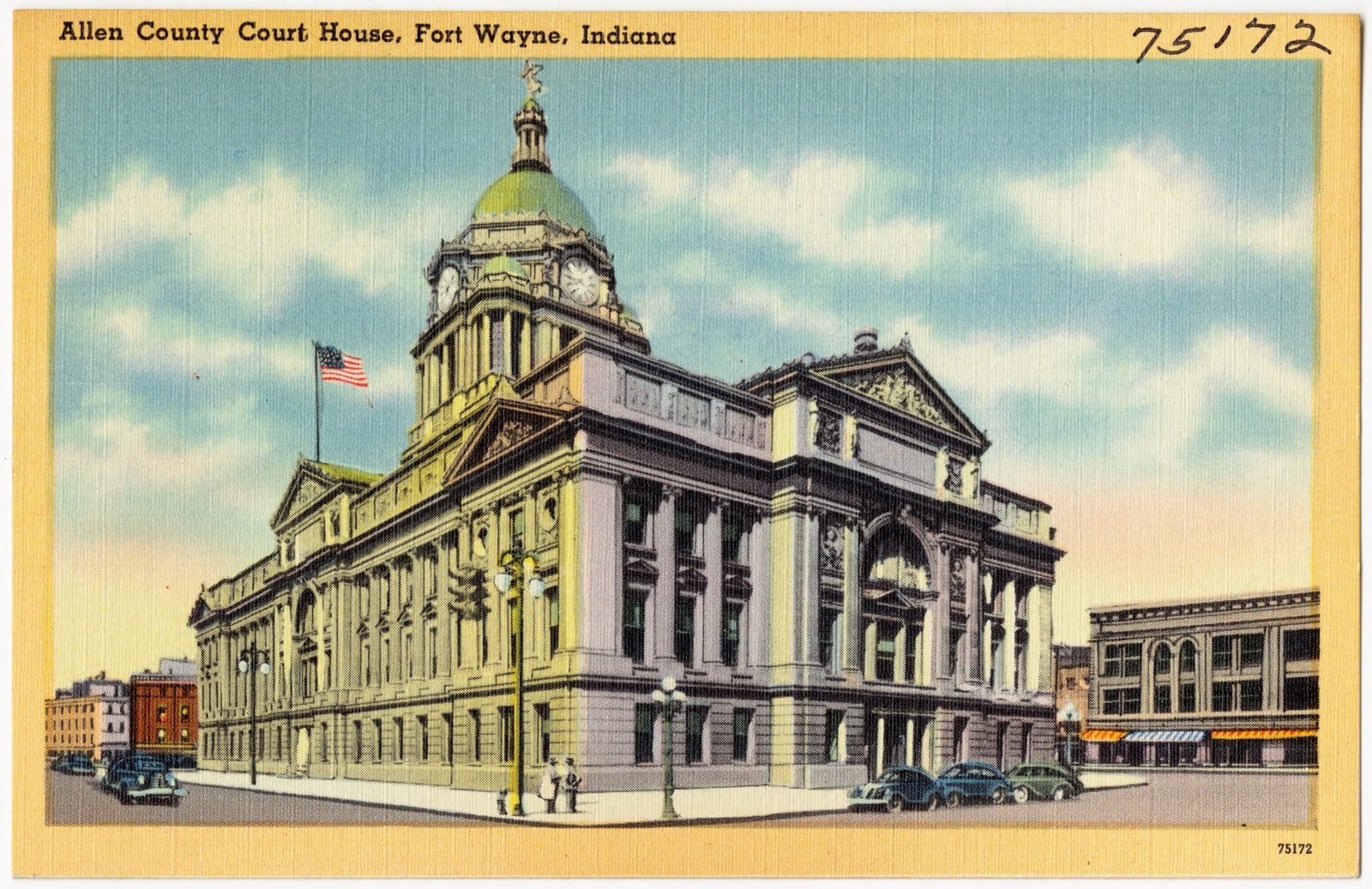

Fort Wayne's first government was not American, French or British. It was Miami: Kekionga, at the meeting of the St. Joseph and St. Marys rivers, was the capital of the Miami people and the seat of their council house, and this section begins there. The American machinery followed in layers the articles take one at a time: Allen County created by an act of the General Assembly passed on 17 December 1823 and effective 1 April 1824, named for Colonel John Allen; the first officers chosen at a tavern; a sheriff's succession the record can verify at dated points from 1824 forward; and the mayors, councils and courts that succeeded the garrison. A closing article walks the buildings government has lived in, from the courthouse square outward, because in Fort Wayne the offices have moved almost as often as the officeholders.
Before the county: how Kekionga governed itself
Fort Wayne's first government was not American, French or British. It was Miami. Kekionga, at the meeting of the St. Joseph and St. Marys rivers, was the capital of the Miami people (Myaamia) and the seat of their council house…
Three flags over the fort: the commandants, 1722–1819
Between the Miami council house and the county courthouse, the place was governed from a succession of forts, and its governors were commandants. The French built the first palisaded Fort Miami (Fort St. Philippe des Miamis) at…
Fort Wayne commandants — the 1803–1807 sequence and the 1813–1814 hole, filled
One loose thread: a secondary commanders list also names a Col. Henry Burbeck for 1803. No source consulted reconciles that entry with the Pasteur–Pike–Whipple sequence above, so it is flagged here rather than built on.
Government · how it started, and who held it
From officers chosen in a tavern in 1824 to a nine-member council in Citizens Square.
It started in Ewing's Tavern
When Allen County was organised in 1824, the founding fathers gathered in Ewing's Tavern, at Barr and Columbia streets, and, in the News-Sentinel's Cityscapes telling, selected one another for the county's offices. Six years on, the village's citizens assembled, debated, and voted to incorporate Fort Wayne as a town, electing an assessor, a treasurer, a tax collector, a marshal and a street supervisor. “In this primitive fashion,” the paper wrote, “Fort Wayne was governed for 11 years.”
City government begins 22 February 1840: incorporation, a prompt election, and George W. Wood as first mayor, a New Yorker who had read law at Ann Arbor, then given it up to become the town's second newspaperman alongside Sentinel founder Thomas Tigar. Wood won a second one-year term in 1841, then asked the council, halfway through it, to let him go back to his private affairs. The first mayor was also the first to quit.
Source: News-Sentinel, Cityscapes, egen.fortwayne.com; incorporation dates per the standard record
City government today
Fort Wayne runs a strong mayor–council system: the mayor is chief executive, proposing the budget, signing legislation, appointing department heads, running day-to-day operations, and the Common Council is the legislative and fiscal body. The mayor serves four-year terms with no limit. Population 263,886 (2020 census). Offices below as of 1 November 2026.
Sharon Tucker
Democratic. In office since 23 April 2024, seated by party caucus to complete Tom Henry's term after his death in office; she had served on City Council. Next mayoral election: 2027.
John McGauley
Elected office, in service since January 2026. The clerk keeps the city's official records, ordinances and council agendas, runs the Violations Bureau and parking enforcement, and administers oaths of office. Before it: Allen Superior Court executive (2014–2025) and two terms as Allen County Recorder.
Source: City of Fort Wayne staff directory, cityoffortwayne.in.gov
Nine seats, six districts
Six members represent districts of roughly 44,000 residents each; three are elected at-large. Four-year terms, no term limit. Council meets the first four Tuesdays of the month, 5:30 p.m., Room 35, Citizens Square (200 E. Berry St). Districts were last redrawn in 2022 after the 2020 census, by moving exactly one precinct.
Source: City of Fort Wayne council FAQ, cityoffortwayne.in.gov
| Seat | Member | Party | Notes |
|---|---|---|---|
| At-large | Martin Bender | Republican | Council President (presiding in the council's October 2026 sessions) |
| At-large | Michelle Chambers | Democratic | |
| At-large | Tom Freistroffer | Republican | |
| District 1 | Paul Ensley | Republican | |
| District 2 | Russ Jehl | Republican | Council President in the preceding term |
| District 3 | Nathan Hartman | Republican | |
| District 4 | Scott Myers | Republican | |
| District 5 | Geoff Paddock | Democratic | |
| District 6 | Rohli Booker | Democratic |
Composition 6 Republican – 3 Democratic. Sources: Fort Wayne City Council roster, en.wikipedia.org; 2026 session records of the independent Council Attendance Project. Council offices sit part-time, every member holds a full-time job outside the chamber (City FAQ).
| Allen County Council · the county's fiscal body (county organised 1824; county seat: Fort Wayne) | ||
|---|---|---|
| At-large | Robert A. Armstrong | President |
| District 3 | Paul W. Lagemann | Vice President |
| District 1 | Kyle Kerley | |
| District 2 | Thomas A. Harris | |
| District 4 | Don A. Wyss | |
| At-large | Ken Fries | |
| At-large | Lindsey Hammond | |
Seven members: four by district, three at-large. Meets at the Edwin J. Rousseau Centre, 1 East Main St. Source: Allen County, allencounty.in.gov
Every mayor, 1840–today
Thirty-seven people have held the office across 46 administrations, the two counts differ because Fort Wayne kept re-electing its mayors: William J. Hosey held the office in four separate stints, Charles Zollinger, Franklin Randall, Henry Scherer and Harry Baals in two each, and Winfield Moses famously left and came back inside a single term. Tom Henry is numbered the city's 44th mayor by administrations, its 35th by person — the 44 is this record's own administration count; a rival ACGSI list numbers him 42nd.
| No. | Mayor | Administration(s) | Party | On the record |
|---|---|---|---|---|
| 1 | George W. Wood | 1840–1841 | Whig | First mayor; the pioneer newspaperman. Resigned mid-term in his second year. |
| 2 | Joseph Morgan | 1841–1843 | Whig | |
| 3 | Henry Lotz | 1843–1845 | Whig | |
| 4 | John M. Wallace | 1845–1846 | Whig | |
| 5 | Merchant W. Huxford | 1846–1849 | Democratic | |
| 6 | William Stewart | 1849–1852 · 1855–1857 | Democratic | Two separate administrations. |
| 7 | Philip G. Jones | 1852–1853 | Know Nothing | |
| 8 | Charles Whitmore | 1853–1855 | Democratic | |
| 9 | Samuel S. Morss | 1857–1859 | Know Nothing | |
| 10 | Franklin P. Randall | 1859–1865 · 1869–1873 | Democratic | Civil War mayor in his first administration. |
| 11 | James Worden | 1865–1866 | Democratic | |
| 12 | Benjamin Saunders | 1866–1867 | Democratic | |
| 13 | Henry Sharp | 1867–1869 | Republican | First Republican mayor. |
| 14 | Charles A. Zollinger | 1873–1885 · 1891–1893 | Democratic | Six terms across two administrations; died in office in his second, Dec 1893. |
| 15 | Charles F. Muhler | 1885–1889 | Democratic | |
| 16 | Daniel L. Harding | 1889–1891 | Republican | Carried in on a reform campaign, the first Republican elected in the city in 22 years (News-Sentinel). |
| 17 | Henry P. Scherer | 1893–1894 · 1896–1901 | Democratic | Stepped in on Zollinger's death, then won the office outright. |
| 18 | Chauncey B. Oakley | 1894–1896 | Republican | |
| 19 | Henry C. Berghoff | 1901–1906 | Democratic | Of the Berghoff brewing family. |
| 20 | William J. Hosey | 1906–1910 · 1914–1918 · 1922–1926 · 1930–1935 | Democratic | Four separate administrations, the city's most-returned mayor; held the office across three decades. |
| 21 | Jesse Grice | 1910–1914 | Republican | Former sheriff; mayor through the 1913 flood. |
| 22 | W. Sherman Cutshall | 1918–1922 | Republican | |
| 23 | William C. Geake | 1926–1930 | Republican | |
| 24 | Harry W. Baals | 1935–1948 · 1952–1954 | Republican | Often miscited as the longest-serving mayor; his combined service was about 15 years. Died in office (kidney infection), 9 May 1954, in his fourth term. |
| 25 | Henry E. Branning Jr. | 1948–1952 | Democratic | |
| 26 | Robert Meyers | 1954–1959 | Republican | Took office on Baals's death. |
| 27 | Paul Mike Burns | 1960–1963 | Democratic | |
| 28 | Harold S. Zeis | 1964–1971 | Republican | |
| 29 | Ivan A. Lebamoff | 1972–1975 | Democratic | |
| 30 | Robert E. Armstrong | 1976–1979 | Republican | |
| 31 | Winfield Moses | 1980 – 8 Jul 1985 · 20 Jul 1985–1987 | Democratic | The flood-fight mayor of 1982. Resigned 8 July 1985 after pleading guilty to three misdemeanor campaign-finance violations, then, twelve days later, a Democratic precinct caucus (86 of 99) voted him back in to finish the term. |
| 32 | Cosette Simon | 8–19 Jul 1985 | Democratic | City Controller, appointed acting mayor for eleven days between Moses's two administrations, the city's first woman mayor. |
| 33 | Paul Helmke | 1988–1999 | Republican | Three terms; the Headwaters Park era. |
| 34 | Graham Richard | 2000–2007 | Democratic | Two terms. |
| 35 | Tom Henry | 2008 – 28 Mar 2024 | Democratic | Longest-serving mayor, five terms, after twenty years on City Council. Died in office (stomach cancer), 28 March 2024. |
| 36 | Karl Bandemer | 28 Mar – 23 Apr 2024 | Democratic | Deputy mayor; acted for 26 days between Henry's death and the caucus. |
| 37 | Sharon Tucker | 23 Apr 2024 – present | Democratic | Seated by caucus from City Council; incumbent. |
Roster cross-checked between the City of Fort Wayne's official mayors page, cityoffortwayne.in.gov, and the full list with life dates and notes, en.wikipedia.org. Where the two disagree on a year boundary by one year (common for 19th-century terms that began in May), this table follows the dated list. Before the mayoralty: town officers from 1830 (assessor, treasurer, tax collector, marshal, street supervisor) and the county officers chosen at Ewing's Tavern in 1824; the federal land office's registers of 1823–43 (Samuel C. Vance; William Polke, who died in office 26 Apr 1843) are recorded by the Political Graveyard, politicalgraveyard.com.
Allen County: the act, the tavern, the first officers
The county was created by an act of the Indiana General Assembly passed on 17 December 1823 and effective 1 April 1824, carved from Delaware and Randolph counties out of the "Delaware New Purchase." It was named for Colonel John…
The mayoralty: terms and shape
The mayors' table in the original section is the spine of this office — thirty-seven people across 1840 to today — and two changes in its shape are worth recording. Terms began at one year: George W. Wood's two administrations…
Allen County Sheriff — verified succession points
Jesse Grice, who became mayor of Fort Wayne in 1909, had earlier served as sheriff of Allen County. The succession is continuous from 1975 to the present; between Hamilton (1824) and Meeks (1975) only the dated points above are…
Firsts
One first remains unestablished in the sources used for this expansion: the identity of the first African American man elected to the City Council. The reference most likely to settle it — Dodie Marie Miller's African Americans…
John Nuckols — first African American man on City Council
John Nuckols , a First District barber and business owner, was elected to Fort Wayne City Council in 1959 — the first African American man to sit on the council — and served twenty-three years, 1959–1982. He championed civil…
The merger question
City and county have shared buildings since 1971 and a second building since 2011 — but never a government. Allen County remains a separate corporation with its own commissioners, council and row officers, and the overlapping…
The county around the city: townships and neighbors
Allen County counted 385,410 people at the 2020 census (the Census Bureau's separate V2024 estimates base of 385,402 is a modeling input, not the census count) and, by STATS Indiana's estimate, about 399,000 in 2024 — the most…
The school government: Fort Wayne Community Schools
The city schools are not run by the city. Fort Wayne Community Schools is a separate school corporation governed by its own elected Board of School Trustees, and its roots predate the Civil War: in 1853 a citizens' committee…
Fort Wayne in Indianapolis and Washington
The city's first federal officer of consequence has already appeared in this record: John Tipton, the Fort Wayne Indian agent of 1823–1828, sat in the United States Senate from 1832 to 1839. A generation later Fort Wayne produced…
The buildings government lives in
The courthouses. The 1824 plat reserved a public square for a courthouse, and four county courthouses have stood on it. The first, built in 1831, was poorly constructed, never properly finished and in time condemned as a safety…
Sources for the expansion
City of Fort Wayne (cityoffortwayne.in.gov / cityoffortwayne.org) — mayors' roster, council FAQ, staff directory, annexation announcement of 14 March 2016. Allen County (allencounty.in.gov) — county council roster, bicentennial…