The exact page text, read by your browser's voice.
THE WORKFORCE · 1900 TO 1920
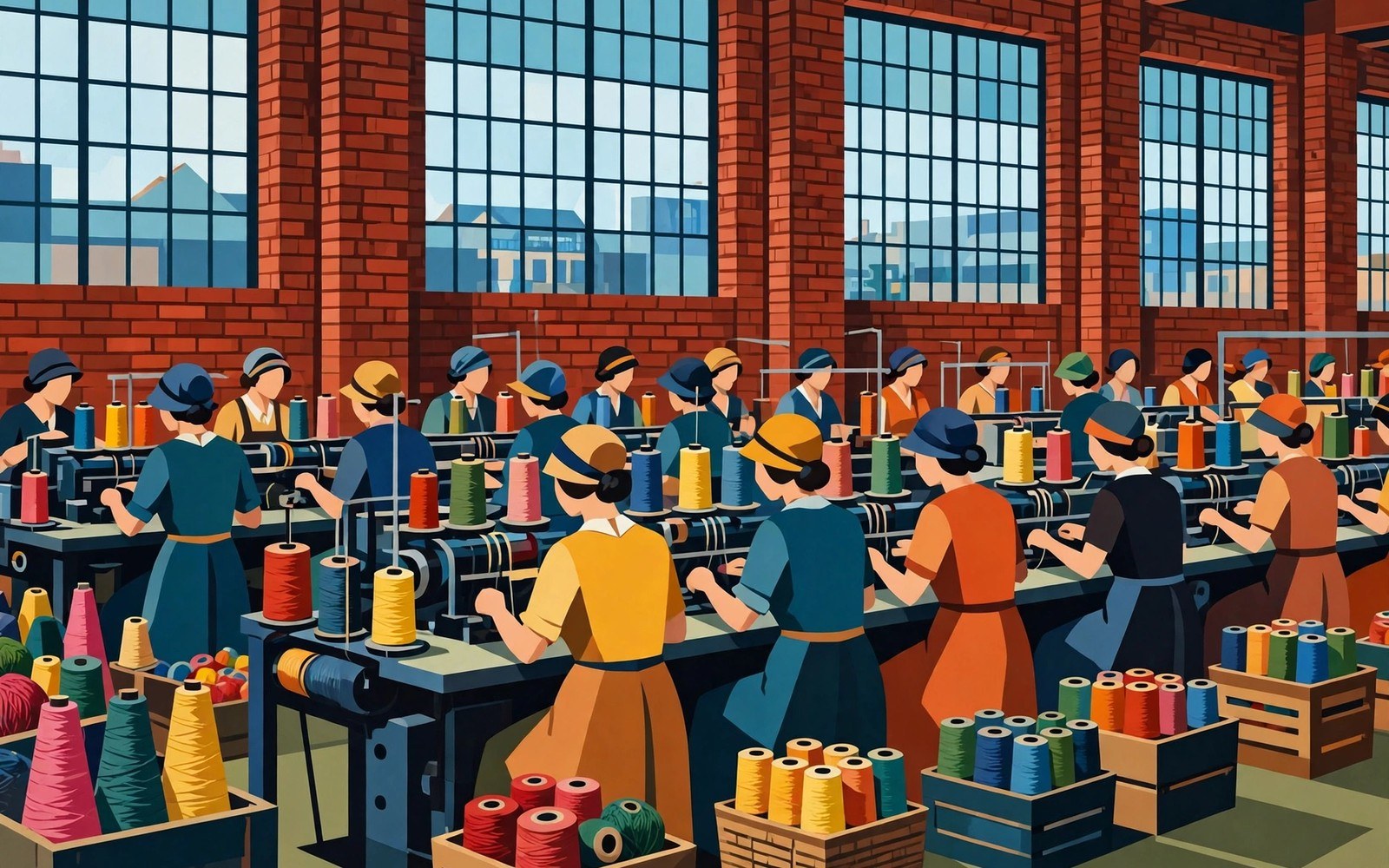
The numbers: Essential to Fort Wayne's industrial growth, Seigel's study establishes, were the 6,000 women and girls who worked in its factories: in 1920 they made up one-third of the city's industrial workforce — a higher share than Indianapolis (24.7 percent), South Bend (19.6 percent) or the nation (about 20.5 percent). They were concentrated, as women were everywhere in the era's sexual division of labor, in the "female" industries: textiles and hosiery, garments, shoes, cigars and food processing. Their wages ran to the national pattern the studies document — at best three-fourths of what unskilled men earned.
The hosiery mill as the type: Wayne Knitting Mills, founded by Theodore F. Thieme in 1891 with knitters and machines imported from Chemnitz, employed about 1,100 workers by about 1905 and some 1,500 by the 1920s — 2,500 at its height, by its founder's biography — and as early as the 1920s most of its employees were female. The division of labor inside the mill was the era in miniature: women worked as "loopers" and "transfer girls" at the less complicated machines, while the full-fashioned knitting itself remained, for a generation, men's work. The labor shortage reached even here: by 1906 the company could not find enough hands in Fort Wayne and opened branch plants at Garrett and Roanoke, each employing approximately sixty women. In the First World War the mill made 50,000 standard-issue woolen army socks. Its full record is in the Business section.
Hours and unrest, from the federal visitor: In October 1918 an investigator of the federal Woman in Industry Service came to Fort Wayne on an urgent call: there was, her memorandum records, "great unrest among the women workers" and a danger of a strike, reported by a member of the Indiana Industrial Commission and an organizer for the Central Labor Union. Her notes are the closest surviving look at the factory floor in the transformation's peak years. At the General Electric plant the working day ran from seven in the morning to five-thirty, with one hour for lunch. At the Edison Lamp works, a GE branch doing mostly piece work, women started at fifteen cents an hour. The Boss Glove Company employed 200 girls; the Perfection Biscuit Company, from 100 to 150 girls. Telephone girls — the other great female workforce — received thirty-five to forty dollars a month. The Wayne Knitting Mills she could not visit; the Italian soldiers were being entertained there that afternoon. Two years earlier a different federal eye had been less charmed: a U.S. Public Health Service inspector in 1914 cited Wayne Knitting Mills for unsatisfactory conditions — inadequate washrooms and poor ventilation among the hazards named.
Sources: Seigel, Indiana Magazine of History (2003) (the 6,000 women, the one-third share and the comparisons, the wage ratio, the concentration in female industries — citing the Fourteenth Census, Manufactures 1919, and the Fort Wayne Journal Gazette of 23 January 1920); Records of the Women's Bureau, the Woman in Industry Service memorandum of October 1918 (the unrest, the GE hours, the Edison Lamp piece rate, the glove and biscuit counts, the telephone wages), via FRASER, Federal Reserve Bank of St. Louis; the History Center's Wayne Knitting Mills record (the 1891 founding, the female majority, the loopers and transfer girls, the army socks); the Immigrant Entrepreneurship biography of Theodore F. Thieme (the Garrett and Roanoke branches, the 2,500 peak, the 1914 Public Health Service citation).