The exact page text, read by your browser's voice.

The Industrial Revolution · how Fort Wayne became a factory city
This section tells one story: the transformation. In 1840 Fort Wayne was a canal town of about two thousand people whose goods were made by masters and apprentices in shops a man could walk across. Within two generations it was a factory city of more than eighty thousand, where thousands of men and women — a third of its factory hands women — worked to the whistle in plants that made railroad wheels, electric motors, gasoline pumps and magnet wire for the whole country. The firms themselves are told in full in the Business section; here they appear only as evidence. What this section owns is the change itself: the enablers that made it possible, the numbers that measure it, the workforce it created, the labor movement it produced, its peak in the truck era, and its reversal in the 1980s, when the transformation ran backward and the city had to become something else.
Before factories · the workshop town
THE PRE-FACTORY ECONOMY · 1819 TO ABOUT 1850
Trade and craft: The economy Fort Wayne started with was a trading post with workshops attached. Samuel Hanna built his log store at Barr and Columbia in 1819, trading with the Miami at annuity time; the town's first gristmill …
The enablers · canal, wire and rail
THE ENABLING CHANGES · 1832 TO 1858
The canal first: Ground was broken for the Wabash and Erie Canal on 22 February 1832, and the opening was celebrated at Fort Wayne on 4 July 1843. A canal boat carried a passenger from Fort Wayne to Toledo for $3.25, and the…
The first big employers · the foundry and the shops
THE 1850S SHIFT · BASS AND THE PENNSY SHOPS
Two plants, one system: Fort Wayne's industrial revolution begins, in the record, with two ironworks facing each other across the Pittsburgh, Fort Wayne and Chicago tracks. The site on the north side was first developed in 1853…
The transformation measured · the census of manufactures
THE PUBLISHED FIGURES · 1899 TO 1919
The federal count: The Census of Manufactures gives the transformation a spine of numbers. For the city of Fort Wayne it counted, in 1899, an average of 6,519 wage earners producing goods valued at $11,262,672; in 1904, 7,729…
The electrical cluster · from arc light to General Electric
THE FACTORY BUILD-OUT · 1881 TO 1920
A new industry, born local: The second wave of the transformation was not an import but an invention. James A. Jenney came to Fort Wayne in 1881 with an arc lamp and a small dynamo of his own devising; on 1 November 1881 R. T.…
Pumps, wire and washers · the diversified factory city
THE BUILD-OUT COMPLETES ITSELF · 1885 TO 1930
Pumps: Sylvanus F. Bowser sold his first self-measuring pump to a Fort Wayne grocer on 5 September 1885; by the mid-1910s his company was the established leader in fuel pumps at home and abroad, and with the Wayne Pump Company…
The workforce · from artisans to wage earners
WHAT THE CHANGE DID TO WORK · 1850 TO 1920
The population curve: The factory city can be read off the census of population: 2,080 in 1840; 4,282 in 1850; 10,388 in 1860; 17,718 in 1870; 26,880 in 1880; 35,393 in 1890; 45,115 in 1900; 63,933 in 1910; 86,549 in 1920. A town…
Women in the factories · a third of the hands
THE WORKFORCE · 1900 TO 1920
The numbers: Essential to Fort Wayne's industrial growth, Seigel's study establishes, were the 6,000 women and girls who worked in its factories: in 1920 they made up one-third of the city's industrial workforce — a higher share…
Children, hours and the law
THE LIMITS THE STATE SET · 1897 TO 1909 AND AFTER
What the law allowed: Indiana's factory age was regulated late and lightly. In 1897 the state set fourteen as the minimum age for factory work. The Factory Act of 1899 went further in words: it prohibited the employment of…
Paternalism · the welfare side of the factory
COMPANY WELFARE AND ITS LIMITS · 1890S TO 1926
The show place: The other face of the factory system was welfare capitalism, and Fort Wayne's exemplar was again Wayne Knitting Mills — "the show place of the city," the federal visitor was told in 1918, its working conditions…
Labor · the union town, its defeats and its return
ORGANIZING, STRIKES AND THE LONG SETTLEMENT · TO 1980
The strong years: Before the First World War, Fort Wayne was regarded — in Mark Crouch's study of the city's labor history — as one of the strongest union towns in the country, its standing built on community support for several…
The peak · the truck era and the war plants
SCALE COMPLETED · 1923 TO 1979
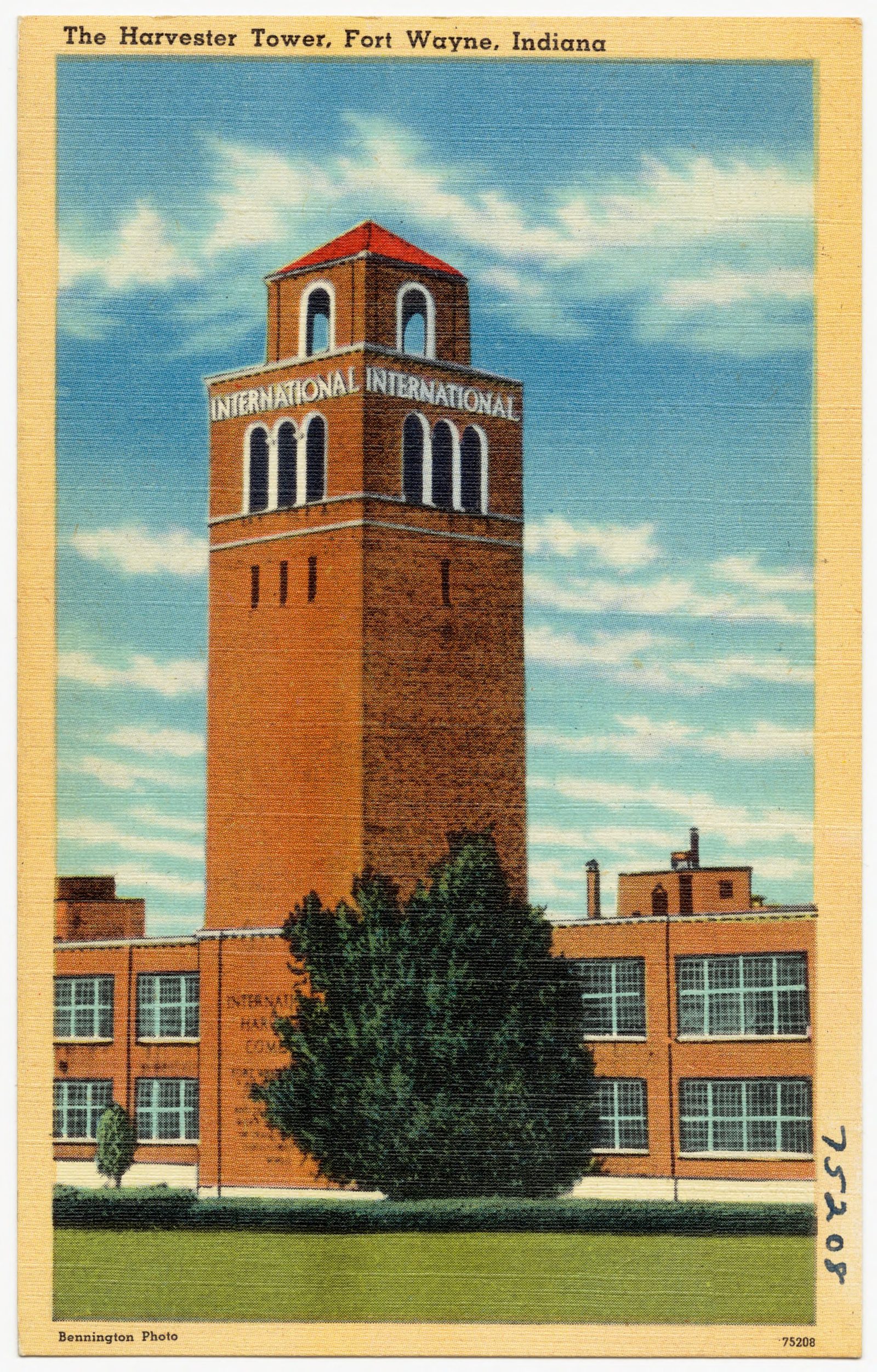
Harvester: In 1923 International Harvester built its Fort Wayne Works on the east side — a truck plant the city's historians price at five million dollars, projected at the choosing to employ 4,000 to 5,000 — and for sixty years…
The reversal · deindustrialization
THE TRANSFORMATION RUNS BACKWARD · 1969 TO 1983
The slow leak: The end began a decade before the famous closing. Between 1969 and 1982, Crouch's study counts, General Electric eliminated over 5,000 of its 6,700 bargaining-unit jobs in Fort Wayne, shifting work to the Sunbelt…
What replaced it · the diversified city
AFTER THE FACTORY CITY · 1984 TO THE PRESENT, IN BRIEF
The partial refill: The first answer was another truck plant. On 31 August 1984 Fort Wayne celebrated the coming of General Motors; its Fort Wayne Assembly opened in 1986 — some accounts give 1987 — with about 3,000 jobs, and in…


