The exact page text, read by your browser's voice.
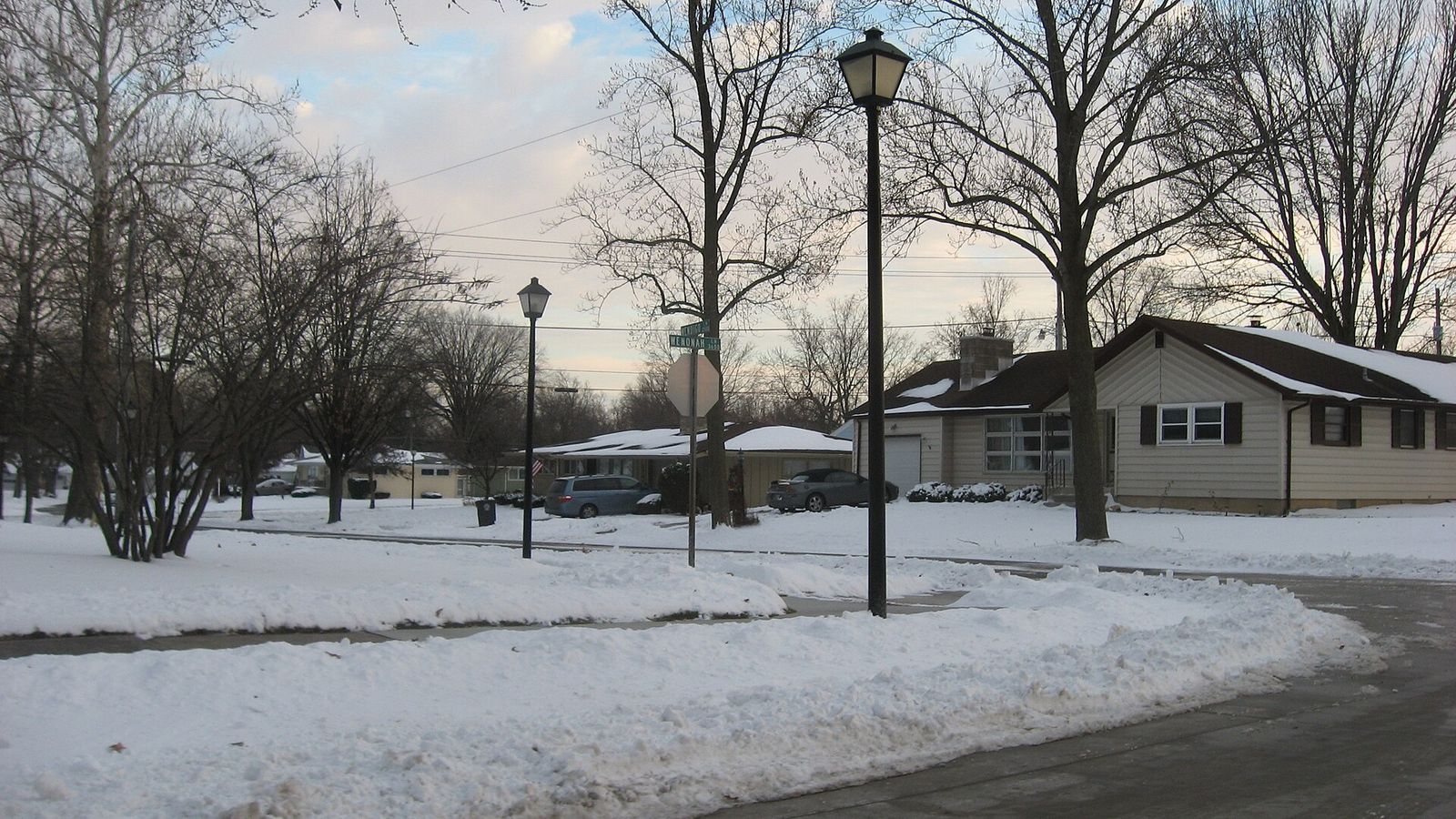

Indian Village, along the St. Marys River in the Waynedale area, was marketed from 1925 as "Fort Wayne's Super-Subdivision." In 1925 the City and Suburban Building Company bought 180 acres that had been the Allen County Farm for the Poor and the County Orphanage since 1864, traded the old orphanage grounds across Bluffton Road to the park board in exchange for the city building the suspension footbridge into Foster Park, and hired landscape architect Lawrence V. Sheridan to design the addition. A. K. Hofer platted Section A on June 16, 1927, and platted every later section through Section E in 1953. The boulevards took their street names from Longfellow's "Song of Hiawatha," and four cement tepees stood in the main entrance parkway for decades, until the city demolished them in 2023 on safety grounds, to mixed feelings in the neighborhood.
The Depression broke the first developer: the City and Suburban Building Company failed in 1930 with fewer than 20 homes built. In the mid-1940s builder John R. Worthman took control of the remaining ground, and with other builders completed the subdivision, which was built out about 1960 — 35 years after the first lots were sold. The completed district, roughly bounded by Engle Road, Bluffton Road, Nuttman Avenue, and the Norfolk Southern right-of-way, includes Psi Ote Park (1953), Indian Village Elementary School (1954), and the Pocahontas Swim Club (1959). The Indian Village Historic District was listed on the National Register of Historic Places on December 22, 2009, with 481 contributing buildings on about 150 acres. The district's buildings are treated in the Architecture section.
Sources: National Park Service, Indian Village Historic District (NRIS 09001125); Indian Village Community Association history and 2024 constitution; Randy Harter, "Indian Village circa 1950," Fort Wayne Reader, April 21, 2017; ACGSI neighborhoods page (Hofer and Davis plat records; tepee demolition, 2023).