The exact page text, read by your browser's voice.

The fortune: Bass began with $3,700 of capital in a small machine shop, and he multiplied it first in land: an Iowa land speculation from 1853 to 1857 returned $15,000 in cash and land worth more than $50,000 (the News-Sentinel's account of August 1, 1994). Griswold's telling of the same Iowa trip differs in the particulars: he dates the speculative journey 1857–59 and puts the Iowa land bought at a flat $50,000 — the two accounts stand side by side, not merged. In 1862 he bought out his partners in the Fort Wayne foundry his brother Sion S. Bass had founded on the Hanna Street site, and the Bass Foundry & Machine Works became the engine of the fortune — railroad car wheels and axles for the railroads building west. He added the St. Louis Car Wheel Company in 1869 and Chicago ironworks in 1873, and bought iron-ore mines in Alabama and Tennessee to feed the furnaces. For thirty years he was also president of the First National Bank of Fort Wayne. His business entry is in the Business section.
Its scale: By 1869, the National Park Service's history of the Baker Street Station site records, the Bass companies had become the largest manufacturers of locomotive and railroad car rolling equipment in the United States; the News-Sentinel puts it as the world's largest maker of railroad rolling equipment within ten years of the 1862 buyout. Two workforce figures survive and both are carried here: the Park Service history says the foundry employed 2,500 workers at its height, while a period account preserved by the Allen County Genealogical Society gives 1,100 men and a monthly payroll of $35,000. No published figure for Bass's personal estate has been found.
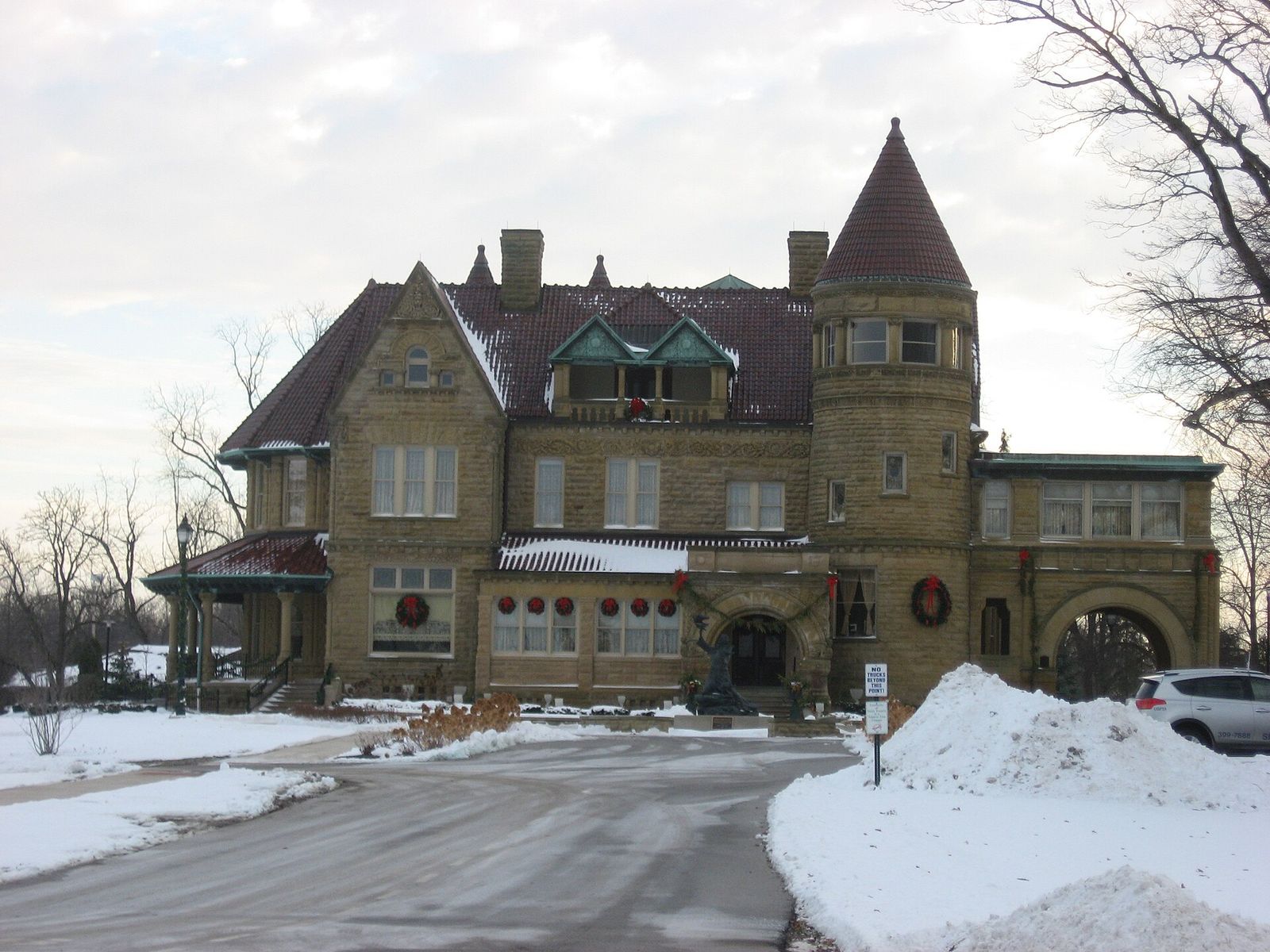
The house: Brookside, the Bass mansion on the St. Joseph River bluff, was built in 1887 and remodeled before 1895; fire destroyed it in February 1902, and Bass rebuilt it in 1902–04 — 33 rooms by Wing & Mahurin, and called the grandest home in Fort Wayne by the News-Sentinel. In 1944 the Bass family sold the house and more than 65 acres to the Sisters of St. Francis for $60,000 (the Genealogical Society's account), and the estate became the campus of the University of Saint Francis. The mansion, National Register–listed as the Bass Mansion in 1982, was restored at a cost of $4.5 million, completed in 2010; the restoration won the Cook Cup in 2013.
Sources:
- Fort Wayne News-Sentinel, August 1, 1994 — the $3,700 start, the Iowa speculation, Brookside as built 1902–03.
- National Park Service / Baker Street Station history — the Bass companies' national standing by 1869; 2,500 workers at the foundry's height.
- Allen County Genealogical Society — Brookside built 1887, the 1902 fire, the 1944 sale for $60,000; the 1,100-man payroll account.
- University of Saint Francis — Brookside restoration, completed 2010.