The exact page text, read by your browser's voice.
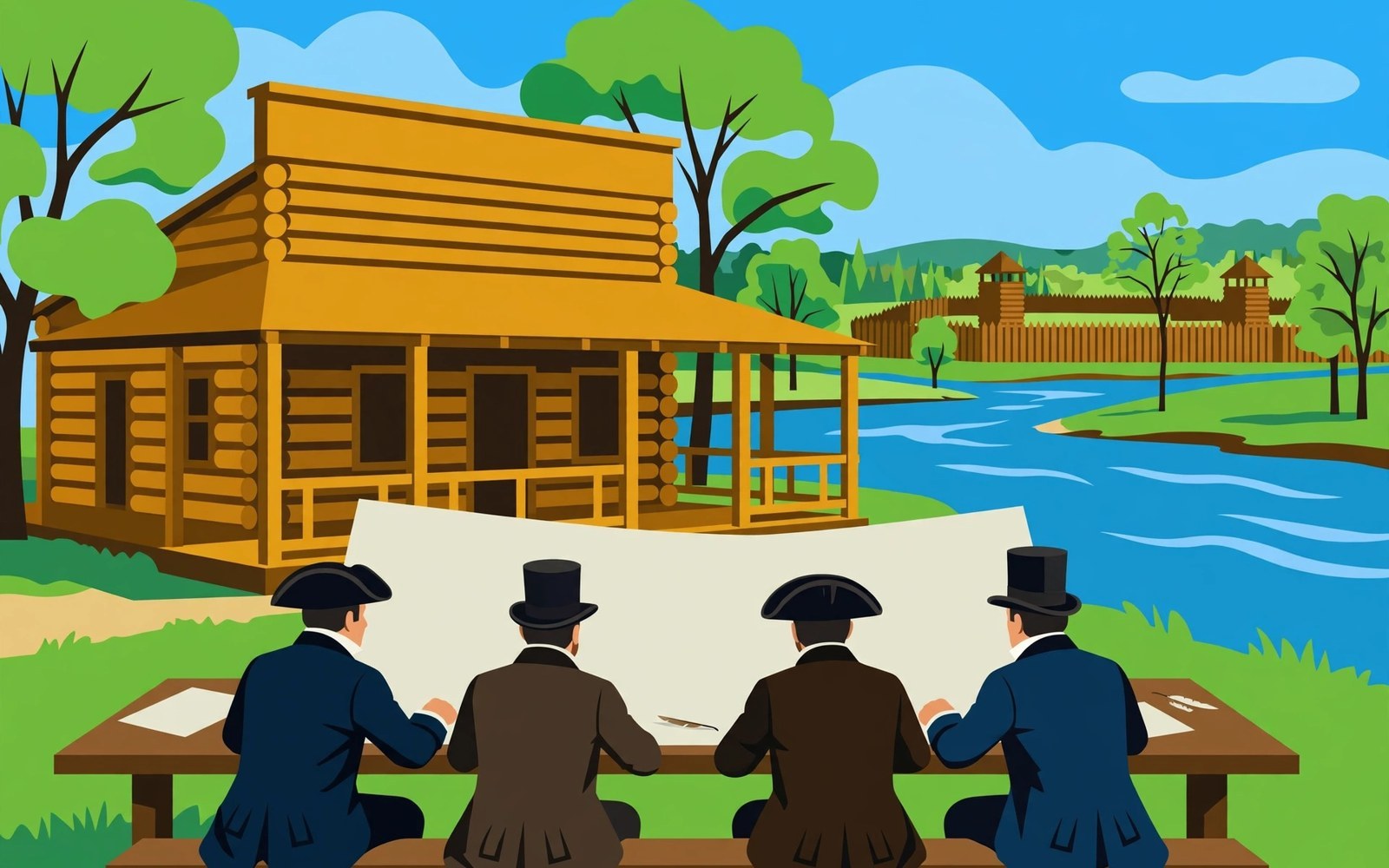
Allen County: the act, the tavern, the first officers
The county was created by an act of the Indiana General Assembly passed on 17 December 1823 and effective 1 April 1824, carved from Delaware and Randolph counties out of the "Delaware New Purchase." It was named for Colonel John Allen of the Kentucky militia — a Kentucky state senator and lawyer who had marched with the force that relieved the siege of Fort Wayne in 1812 and who was killed at the River Raisin in January 1813. At its creation Allen was the northernmost county in Indiana and took in some 660 square miles, including much of what later became Wells, Adams and DeKalb counties.
Organization followed in the spring of 1824, in and around Alexander Ewing's log tavern, Washington Hall, at Barr and Columbia streets. Four commissioners named by the General Assembly came to Fort Wayne in May 1824 to oversee the organization; the governor appointed Allen Hamilton, an Irish immigrant trader, as the county's first sheriff, to serve until one could be elected. The first election of county officers took place on 22 May 1824, and the newly elected commissioners then named the county's remaining officers, fixed the tax rate, and set fares, licenses and prices — down to hotel meals, stable rents and liquor sales. At the board's session of 24 May 1824, held at Ewing's residence, it fixed the rates of assessment on personal property for county purposes. Fort Wayne was chosen as the county seat in the spring of 1824 (a county comprehensive-plan summary dates the selection 22 March 1824; the marker record places the organizing commissioners' work in May). The plat accepted by the commissioners reserved a half-square for a courthouse, lots for a seminary of learning and for a church "free to all." The first grand jury sat at Ewing's Tavern in August 1824, followed by the first session of the circuit court; the early courts sat alternately in Ewing's tavern and William Suttenfield's rival house across the corner until a courthouse could be built. Among the first circuit judges was Samuel Hanna, who became one of the town's leading merchants and land promoters.
Sources: Historical marker, "Barr and Columbia — Where Allen County Began" (hmdb.org, marker 197324); Fort Wayne Magazine, "Allen County in 1816?" (fortwayne.com); Allen County Bicentennial pages and Allen INGenWeb timelines (acgsi.org).
The county seat was located on May 24, 1824
The act for the formation of Allen County, approved December 17, 1823, named five commissioners "to determine and locate the seat of justice" — Lot Bloomfield and Caleb Lewis of Wayne County, Abiathar Hathaway of Fayette County, William Conner of Hamilton County, and James M. Ray of Marion County — and directed them to meet for that purpose at the house of Alexander Ewing on the fourth Monday in May 1824. The 1889 county history, working from the record, states the outcome plainly: "The commission met on the 24th of May, as ordered, and had little difficulty in determining the location of the county seat."
There had been some competition. John McCorkle and John T. Barr, proprietors of the plat of Fort Wayne, offered, if the seat were located there, to pay Allen County $500 in cash and to donate the public square bounded by Main, Court, Berry and Calhoun streets, a four-rod-square lot for a church and public burying ground, a lot for a seminary of learning, and lots 8, 9, 101–118 and 92–100 of the plat. The proposition was accepted, and the land was afterward deeded to John Tipton as county agent; $174 of the cash went to pay the county-seat commissioners, at $3 a day each.
The date of March 22, 1824, carried in the Allen County comprehensive plan's summary, is not supported by the act or by the 1889 account: the locating commissioners were not directed to meet until May, and the county itself only took effect on April 1, 1824. No source for any March action was found. The date the record supports is May 24, 1824.
Source: Brant & Fuller, Valley of the Upper Maumee River, Vol. II, "Organization of Allen County," pp. 374–375 (1889), full text at archive.org (valleyofuppermau02madi).
The town: September 1829
The original section above dates the town government from the officers chosen in 1830; the instrument itself is a year older. Under a state act of January 1829 authorizing incorporation on a two-thirds vote of the citizens, Fort Wayne voted on 7 September 1829 to incorporate as a town — the vote certified to the board of county commissioners by William N. Hood, president of the meeting, and John P. Hedges, its clerk. The first town election followed on 14 September 1829, at the house of Abner Gerard, and chose five trustees for one year: Hugh Hanna, John S. Archer, William G. Ewing, Lewis G. Thompson and John P. Hedges. Under the trustees served the working officers the record names — assessor, treasurer, tax collector, marshal and street supervisor. The town's population was about 300. For eleven years, 1829 to 1840, that was the whole of Fort Wayne's municipal government: a board of trustees, a handful of officers, meager funds and, in the 1889 history's words, "of public buildings none warranting the name."
Sources: Valley of the Upper Maumee River (1889), vol. II, "Municipal and Federal"; News-Sentinel Cityscapes (egen.fortwayne.com).
The city charter of 1840 and the first city government
The original city charter was drafted by Franklin P. Randall and passed by the General Assembly on 22 February 1840. It incorporated the City of Fort Wayne and provided for the election by the people of a mayor and six members of the common council, with the general officers of the city to be chosen by the council. The town's population had reached 2,080 in the census of 1840. The first council meeting was held on 7 March 1840, and the first officers of the city, as printed in the 1889 county history, were:
| Office | First holder, 1840 |
|---|---|
| Mayor | George W. Wood |
| Recorder | Franklin P. Randall |
| City attorney | Franklin P. Randall |
| Treasurer | George F. Wright |
| High constable | Samuel S. Morss |
| Collector | Samuel S. Morss |
| Assessor | Robert E. Fleming |
| Market master | James Post |
| Street commissioner | Joseph H. McMaken |
| Chief engineer | Samuel Edsall |
| Lumber measurer | John B. Coconour |
The first common council consisted of William Rockhill, Samuel Edsall, Thomas Hanneton, William S. Edsall, Madison Smiltser and William M. Moon. Wood was twice elected mayor under the early one-year terms and resigned on 5 July 1841, by the 1889 history's date — the first mayor was also the first to quit, as the original section says. The machinery grew quickly: the city's first police force was formed in 1841 (News-Sentinel Cityscapes), its first board of health in 1842 — Dr. John Evans, Dr. William H. Brooks and Dr. Bernard Sevenick — and about 1858 Randall, by then a former mayor, designed the city seal: a pair of scales, beneath them a sword and Mercury's wand crossed, and above, in a semicircle, the word "Ke-ki-on-ga."
For its first two decades the city was policed only by the sheriff, the city marshal, deputy marshals and constables. In May 1863 the council established a regular police force — a captain, a lieutenant and two patrolmen from each ward, on duty from twilight to daylight. Its first chief was Conrad Pens, a German sailor. The chiefs in their order of service, as the 1889 history gives them, were Conrad Pens, William Ward, Fred Limecooley, Patrick McGee, Detrick Meyer, Michael Singleton, Hugh M. Diehl, Eugene B. Smith, and Diehl again; when Diehl resigned in June 1889, Lieutenant Frank Wilkinson was appointed to fill the vacancy. The first station house was a small brick building on Court Street opposite the courthouse, with three iron cages in its cell room; it later moved to the Barr Street market house.
Sources: Valley of the Upper Maumee River (1889), vol. II; Charter and Revised Ordinances of the City of Fort Wayne (1887), with its chronological roster of officers 1840–1887 (archive.org).