The exact page text, read by your browser's voice.
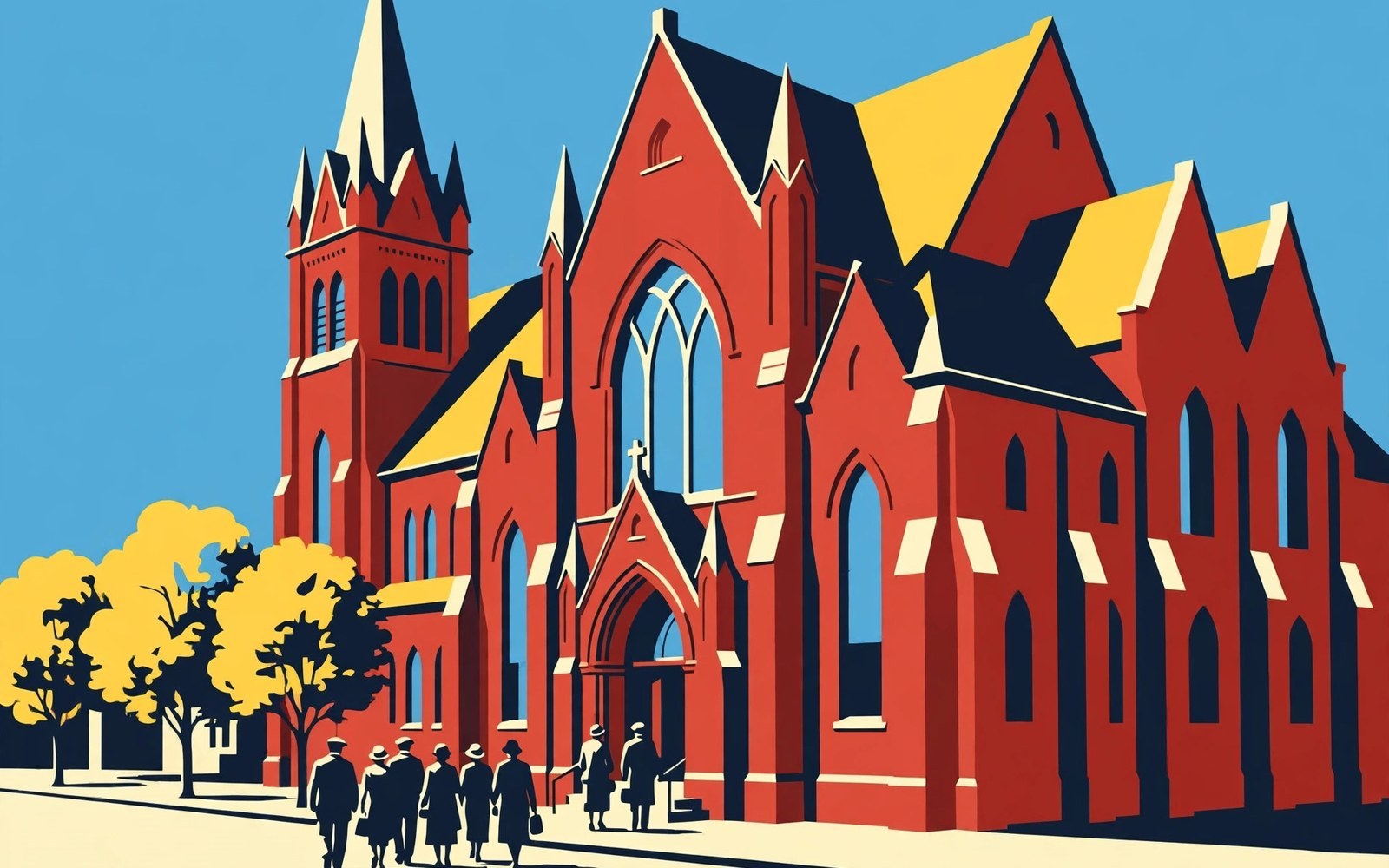
Organized 1849 — Fort Wayne's first Black church
Under the black laws: Turner Chapel traces to the first Black settlers of Fort Wayne. By 1845 the A.M.E. Church's Ohio and Western Conference had taken responsibility for the fledgling congregation, served by ministers riding the Carthagena Circuit between Van Wert, Ohio, and the Eel River; the name of the clergyman who first gathered Black Fort Wayne in worship is not known. In 1849 the trustees purchased a lot on the south side of Jefferson Street between Hanna and Francis — and could not build on it. Indiana's exclusionary "black laws," enacted in 1851, discouraged Black settlement; by 1860 the city's Black population, once over a hundred, had fallen by a third while the white population doubled.
The buildings: In 1869 the Rev. Nixon Jordan was assigned, and the congregation worshipped at Hafner's Hall until St. John's German Reformed Church offered its twenty-four-year-old frame building for sale. The A.M.E. officers bought it and moved it to a lot at Wayne and Francis streets donated by Emerine H. Hamilton, wife of the city's wealthiest man (see the Wealth record), and the chapel took the name of the Rev. Henry McNeal Turner, the Black chaplain of the Civil War who became an A.M.E. bishop. In 1888 the congregation built a larger church on the site — the first church building erected by an African American congregation in Fort Wayne. The ACGSI survey gives the Hamilton deed as 1897 and records a new church on the site in 1917; the History Center's account, written from the congregation's documents, gives 1869 for both gift and move. Both versions stand. In 1963 the congregation purchased its present church at 836 East Jefferson Boulevard, a Gothic Revival building erected in 1927 for Calvary United Brethren. Its records were destroyed by fire in 1979. The congregation made its building a locally designated historic district in October 2019, and in February 2022 the Calvary United Brethren–Turner Chapel A.M.E. Church was listed in the National Register of Historic Places. Dodie Marie Miller's African Americans in Fort Wayne: The First 200 Years treats Turner Chapel as the pillar institution of the community it chronicles.
Sources:
- Tom Castaldi, "Turner Chapel African Methodist Episcopal Church," History Center Notes & Queries (from Fort Wayne Magazine, February 2008) — the Carthagena Circuit, the 1849 lot, the black laws, the 1869 move, the 1888 building, the 1963 purchase.
- Visit Fort Wayne, "History You Can Feel: Turner Chapel A.M.E. Church" (2026) — the congregation's own historical documents, the Hamilton gift, the 2019 local district and 2022 National Register listing.
- ACGSI, "Wayne Township Churches" — the 1897 deed date, the 1917 church, the 1979 records fire, carried here against the History Center account.
- Dodie Marie Miller, African Americans in Fort Wayne: The First 200 Years (Arcadia, 2000) — Turner Chapel as the community's pillar.