The exact page text, read by your browser's voice.

Fort Wayne's money began as a branch of somebody else's bank: the State Bank of Indiana opened its Fort Wayne branch on 25 August 1835, with Allen Hamilton as president and a young lawyer named Hugh McCulloch, who had no banking experience, as cashier. This section follows the succession from that counter: the private bankers who worked alongside the state system and outlasted it, Allen Hamilton and Company chief among them; the national-bank generation, opened by the First National Bank of Fort Wayne under charter No. 11, among the earliest issued under the National Banking Act of 1863; the conversions and new charters of 1865; and the panics of 1873 and 1893, which reached this city as pressure rather than as a local failure record. The clearing house, the bank buildings and the tellers' Fort Wayne fill out a record that runs from 1835 to the modern mergers.
Banks · Fort Wayne's banking system
The State Bank branch — Fort Wayne's first money
1835 – 1857
The institution: Fort Wayne's first bank was a branch of somebody else's. The State Bank of Indiana — the parent bank's bill drafted by Samuel Hanna and enacted 28 January 1834 — opened its Fort Wayne branch on 25 August 1835…
The private bankers and the free-banking years
1838 – 1865
The private houses: Alongside the state-bank branch, Fort Wayne's early money was private. Allen Hamilton was in business as a banker by 1838 — Allen Hamilton & Co., an office of exchange and deposit whose full profile is carried…
Charter No. 11 — the First National Bank
1863
The charter: The National Banking Act of 1863 created a federal charter for banks, and Fort Wayne took one of the first. The Comptroller of the Currency's charter record gives the First National Bank of Fort Wayne charter No. 11…
The national-bank generation
1865 – 1917
The charters: The state branch converted first: in 1865 the Fort Wayne branch of the Bank of the State of Indiana took a national charter, No. 865, as the Fort Wayne National Bank, with Stephen B. Bond — Allen Hamilton & Co.'s…
Panics, and the clearing house
1873 – 1918
1873 and 1893: The national panics reached Fort Wayne as pressure, not as a local failure record. The Merchants National Bank discontinued in 1874, in the panic of 1873's long shadow, but no source found for this history ties its…
Trust companies, savings banks and the building-and-loan layer
1889 – 1922
The second system: Beside the national banks grew a state-chartered layer that took the savings of households the nationals did not court. Its anchor firms are profiled in the Businesses section: the Tri-State Loan and Trust…
1929–1933 — the failure record
1929 – 1933
The position: Fort Wayne entered the Depression rich in banks and heavy in mortgages. Iwan Morgan's study of the city in the Indiana Magazine of History counts eleven banks, and puts per-capita bank deposits at $664 in December…
The mid-century order
1933 – 1985
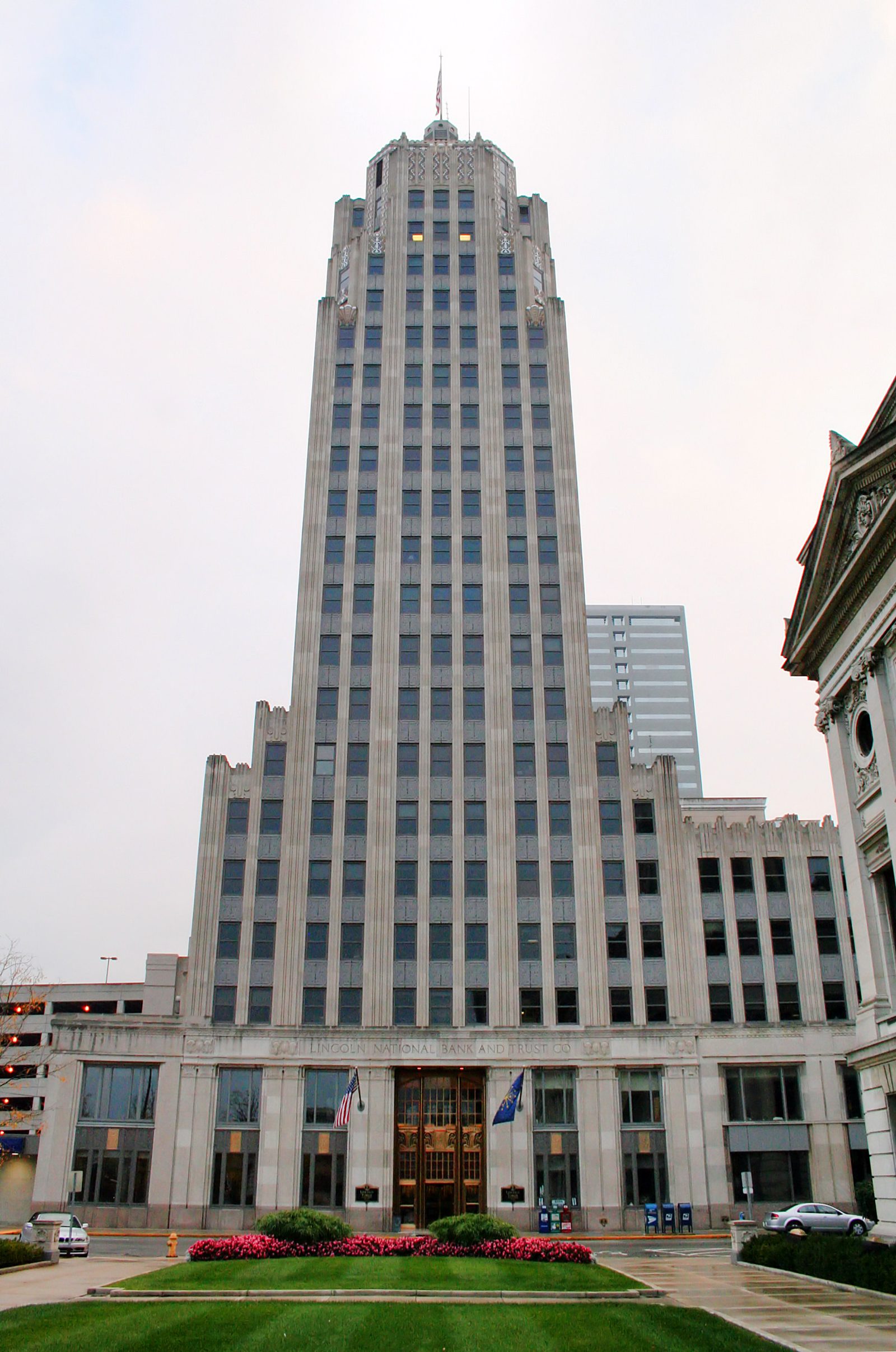
The system restated: The banks that emerged from 1933 — the new Fort Wayne National Bank at 110 West Berry, the Lincoln National Bank and Trust in its 1930 tower, the Peoples Trust and the Dime — were joined in 1933 by a thrift…
The credit unions — the working city's banks
1935 – today
3Rivers: The Federal Credit Union Act was a year old when Fort Wayne's factory workers began using it. The International Harvester Company Fort Wayne Works Employees Federal Credit Union was organised 14 February 1935 — its…
Deregulation and the loss of the headquarters
1983 – 1998
The thrifts go first: On 30 November 1983 the Federal Deposit Insurance Corporation's histories record a single day's work: the First Federal Savings and Loan Association of Fort Wayne — the city's own, established 1933 — the…
What is headquartered here now
1999 – 2024
STAR: The largest bank that still calls Fort Wayne home arrived from outside. STAR Financial Bank — founded in Upland in 1943 and profiled in the Businesses section — moved its headquarters and service centre to Fort Wayne in…
The bank buildings
1930 – 2024
The tower: The Lincoln Bank Tower at 116 East Berry Street, opened 16 November 1930 — twenty-two stories, 312 feet, $1.3 million, the tallest building in Indiana until 1962 — remains the skyline's bank: built by a German-American…