The exact page text, read by your browser's voice.


The Story of Fort Wayne section · 1690s to today
Three rivers, a portage of seven to nine miles, and everything that followed from it.
The St. Joseph and St. Marys meet here to form the Maumee, and a short portage west reaches the Wabash system, Lake Erie on one side, the Mississippi and the Gulf on the other. Little Turtle, speaking at Greenville in 1795, called this place “that glorious gate… through which all the good words of our chiefs had to pass from north to south and from east to west.” Every era below is a consequence of that geography. (The Myaamia Center publishes four different primary versions of that speech and discusses why they differ, the citation standard this record follows.)
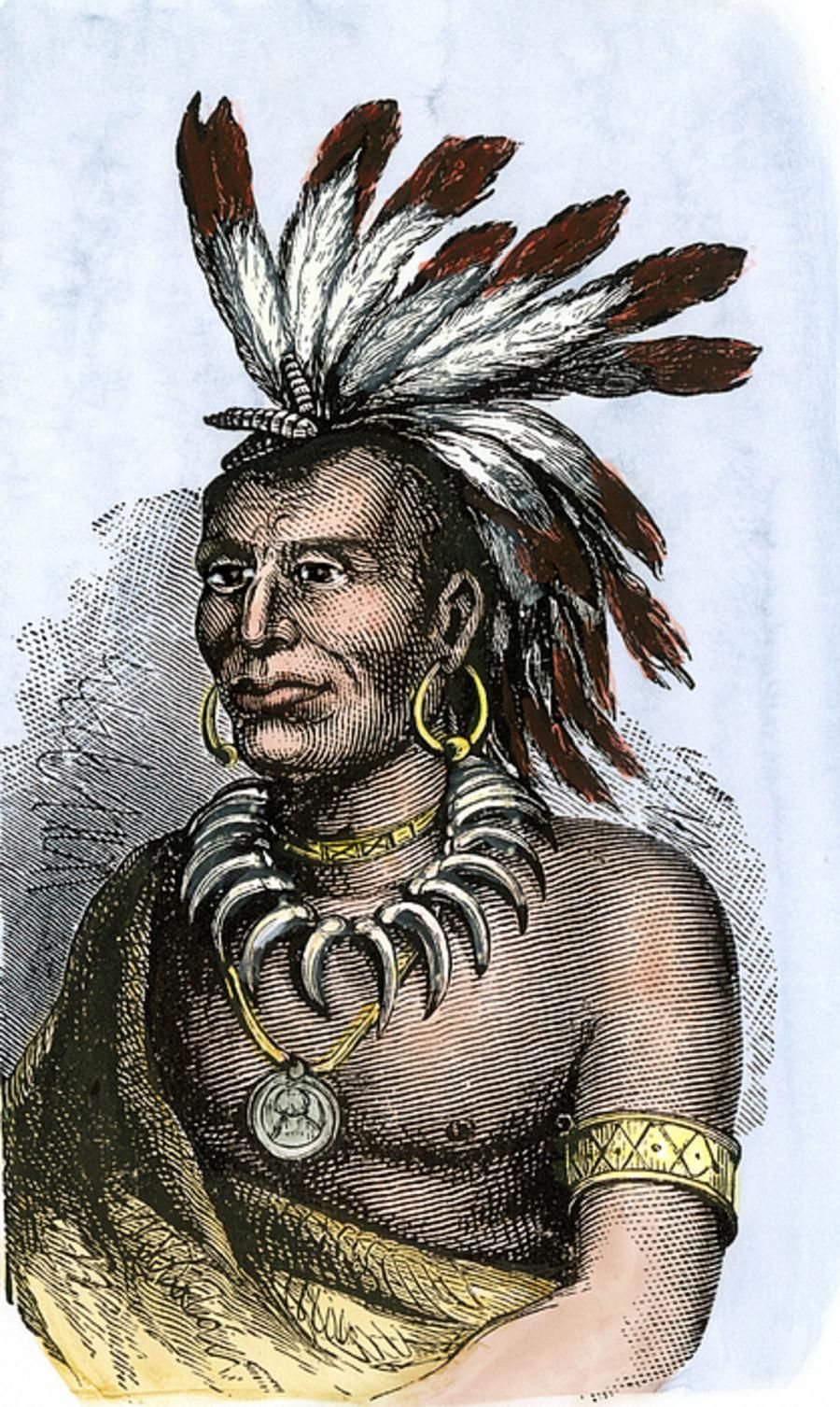
Kekionga was here first
Long before any fort bore an American name, Kekionga (Myaamia: kiihkayonki) stood at the confluence, capital of the Miami, a cluster of villages rather than a single town. A 1744 census counted roughly 40 Frenchmen and 1,000 Miamians; by the 1790s refugee Delaware and Shawnee villages stood alongside. France planted Fort Miami here (c.1697/1706–1721, then Fort St. Philippe), Britain took the post in 1760, and the Miami held it again after Pontiac's Rebellion in 1763.
Its importance is proven by behaviour: three empires and then three American armies all marched on this one river junction. What “Kekionga” means is another matter, “Kekionga was a great capital”.
The ground itself explains the town. The portage between the St. Marys and the Little River–Wabash system crossed the low divide left by glacial Lake Maumee; its length shrank and grew with the season's water, roughly six miles in the record's usual telling and nearer nine in a dry summer, which is why the same sources give different figures. Whoever held the carry held the only practical all-water route between the Great Lakes and the Mississippi watershed short of Chicago, and the wet prairie around the carrying place — the “glorious gate” — was the natural seat for a council town. Kekionga was that seat: the meeting ground of the Miami council, ringed by corn fields and by the satellite villages of allied and refugee peoples, and the depot where French traders from Detroit and Montreal exchanged cloth, tools and guns for the furs of the Wabash country.
Sources: 1744 census as cited in standard summaries; Henry Hay's 1789–90 Kekionga diary; Historical Marker Database, Kekionga marker, hmdb.org; James Madison, The Indiana Way, on Kekionga as the Miami council's meeting ground, as quoted in Indiana Policy Review's “Land of Three Rivers”
The French post at the gate
Jean Baptiste Bissot, Sieur de Vincennes, appointed to the Miami country by Frontenac in 1696, built a small trading post at Kekionga about 1706. After his death the Miami refused French pressure to move west away from British traders, so Governor Vaudreuil authorized a real fort: Capt. Dubuisson's palisaded Fort St. Philippe des Miamis, finished in 1722 on the St. Marys near the head of the portage — the first of five forts that would stand within a square mile of this ground. The Indiana Historical Bureau's marker calls it the first white settlement in Indiana, and ACGSI's reading of the marker record pushes the first French post earlier still, to about 1712 or before; the dates 1697, 1706, 1712 and 1715 all appear in print, and this record carries the range rather than pretending to a single year.
Sources: Fort Miami (Indiana), standard fort histories; Historic Fort Wayne, The Old Fort brochure (2022); Indiana Historical Bureau, Fort Miamis marker, via ACGSI
Burned, rebuilt, surrendered, destroyed
In 1747 Huron warriors allied with the English under Chief Nicholas caught the first fort undermanned — the commandant, Ensign Douville, and most of the garrison away at Detroit — and sacked and burned it. A French force under Capt. Pierre Blainville rebuilt on a new site east of the St. Joseph in 1749–50, the second Post Miami; its abandoned ground later became Coldfoot's village. In November 1760, at the close of the French and Indian War, that garrison formally surrendered the post to Ensign Holmes's British detachment. Three years later, in Pontiac's Rebellion, Native forces took and destroyed the British-held fort, and Kekionga passed back under Miami control for more than thirty years — the decades in which the town reached its greatest power.
Sources: Fort Miami (Indiana), standard fort histories; ACGSI, “1712 French Forts, Fort Wayne”
La Balme's raid
Augustin de La Balme, a French cavalry officer adventuring in the American cause, led a volunteer force down the Wabash and plundered the stores at Kekionga while its warriors were away. Little Turtle's men caught the raiders on their return, on the Eel River, and destroyed them; La Balme himself was killed. It was Little Turtle's first recorded victory over a force sent against his town, ten years before the armies started coming in earnest.
Source: Fort Miami (Indiana), standard fort histories
Henry Hay's winter
The young trader Henry Hay wintered at Kekionga in 1789–90 and kept the diary that remains the best everyday description of the town before the armies came: the councils, the dances, the comings and goings of traders and war parties at the gate. His journal, cited in the sources for the feature above, is the closest thing the eighteenth-century town has to a resident reporter.
Era I · The gate and the armies, 1790–1812
Harmar's Defeat
Gen. Josiah Harmar's 1,453-man expedition against Kekionga is mauled in detachments by Little Turtle's forces, 19–22 October, with 200+ American casualties. The disaster is documented by a printed primary record: the Proceedings of a Court of Enquiry… into Harmar's conduct, Philadelphia, 1791.
Harmar marched from Fort Washington (Cincinnati) on 7 October 1790 with 320 regulars of the First American Regiment and 1,133 militia — the largest army the young United States had yet fielded. Reaching the Maumee towns on 17–18 October, he found Kekionga emptied and burned what he could. The fighting, when it came, was piecemeal, and Harmar fed it piecemeal: a detachment ambushed near the Eel River on 19 October, and on 22 October some 400 men under Col. John Hardin sent against a force of about 1,100 warriors and beaten over three hours, expecting reinforcements that Harmar three times failed to send. Hardin's command alone lost at least 129 killed and 94 wounded. Harmar retreated to Fort Washington having lost more than 200 men and a third of his packhorses, against Native losses estimated at 120–150 killed and wounded. The court of enquiry cleared Harmar's conduct; the Miami read the result differently, and Kekionga's prestige as the town that had beaten the United States stood at its height.
Sources: campaign summaries in St. Clair's Defeat literature (Wiley Sword's President Washington's Indian War tradition); casualty figures as compiled in the standard battle accounts
St. Clair's Defeat · not here
Near modern Fort Recovery, Ohio, not at Fort Wayne, though the two are often conflated locally. A roughly 1,000-strong Northwestern Confederacy under Little Turtle, Blue Jacket and Buckongahelas destroys St. Clair's army: the worst defeat the U.S. Army ever suffered at Native hands. Congress investigates, its first investigation of the executive branch.
The objective of St. Clair's expedition was, again, Kekionga; the army never got there. St. Clair's force wasted from about 2,000 men at its peak to some 920 officers and men present on the morning of 4 November 1791, camped unfortified on the upper Wabash. The Confederacy — Little Turtle's Miami, Blue Jacket's Shawnee, Buckongahelas's Delaware, with Potawatomi and others, more than 1,000 warriors — struck at dawn as the militia broke for breakfast. In about three hours the army ceased to exist: 632 of the 920 soldiers engaged were killed and 264 wounded, a casualty rate of 97.4 percent; 39 of 52 officers were killed, among them the second-in-command, Gen. Richard Butler; nearly all of the roughly 200 camp followers died as well, bringing American dead to about 832. Only 24 men came through unharmed. Native losses were about 61, at least 21 killed. More Americans died that morning than in any other battle of the Indian wars — more than three times the number killed at Little Bighorn eighty-five years later — and roughly a quarter of the entire United States Army was wiped out in a fight for a town it never reached.
Sources: casualty compilations in the standard St. Clair's Defeat accounts; U.S. Army Center of Military History summaries
Fallen Timbers
Anthony Wayne's Legion of the United States defeats the Confederacy on the Maumee near present-day Toledo. Wayne's official reports are the record.
Wayne had spent two years doing what his predecessors had not: building a professional army, the Legion of the United States, trained at Legionville and Pittsburgh and marched north behind a chain of forts in 1793. His chief of scouts was the man who knew Kekionga best — William Wells, called Apekonit (“Wild Carrot”) for his red hair, a Kentucky captive adopted into the Miami, Little Turtle's son-in-law, who had fought against the United States at St. Clair's defeat before changing sides in 1794 and bringing Wayne the intelligence that shaped the campaign. On 20 August 1794, on a Maumee bank tangled with storm-felled trees below the rapids, about 1,500 Confederacy warriors under Blue Jacket — Little Turtle, who had counselled negotiation, serving under him — met some 3,000 of the Legion and Kentucky volunteers. The fight lasted little more than an hour: a bayonet charge and a cavalry sweep broke the Native line, and the fleeing warriors ran for the British post of Fort Miami and found its gates shut — Major William Campbell would not risk a war with the United States to save them. Wayne lost 33 killed and about 100 wounded; Native dead were counted at 19 by the British Indian Department's Alexander McKee and at 30–40 by the Americans who held the field. Wayne then spent days burning the villages and cornfields along the Maumee, and marched for Kekionga.
Sources: standard Fallen Timbers accounts; William Wells marker, Historical Marker Database, hmdb.org; ARCH Fort Wayne, “William Wells”
Fort Wayne is dedicated
Wayne reaches Kekionga in mid-September, picks a site across the Maumee from the village, and the fort is finished by about 17 October. On 22 October 1794 Col. Jean François Hamtramck dedicates and names Fort Wayne, fifteen cannon rounds for fifteen states, on the fourth anniversary of Harmar's Defeat. The city keeps 22 October 1794 as its official founding date.
Source: fort history and marker transcription, hmdb.org
Treaty of Greenville
Twelve tribes cede most of Ohio and key tracts including the Fort Wayne portage (7 Stat. 49). Visit Fort Wayne's history page dates the treaty “August 10, 1795.” The treaty text says 3 August, a small, checkable error in a secondary source, and exactly the kind this record exists to catch.
The treaty was negotiated over the summer at Greenville with William Wells interpreting for the Miami, Eel River, Wea, Piankashaw, Kickapoo and Kaskaskia delegations. Little Turtle argued the boundary hard — it was in this council season, by the versions the Myaamia Center prints, that he made the “glorious gate” speech quoted at the head of this section — but the cession line ran as Wayne demanded: most of present Ohio, a strip of eastern Indiana, and a schedule of reserved tracts around the western forts, the Fort Wayne portage among them. Greenville ended the Northwest Indian War. It did not end the pressure; it converted it from war to paperwork, and the paperwork was done, for the next forty years, largely at Fort Wayne.
Source: treaty text, U.S. Statutes at Large, via Miami University, mc.miamioh.edu; Wells's interpreter role, Greenville treaty report, Library of Congress
The later forts
Wayne's post was not the last. A replacement American fort rose in 1800, and after the War of 1812 Major John Whistler — grandfather of the painter — oversaw construction of the third and last in 1815–16: an all-wood post designed so that a garrison of only 50–75 men could hold it, remembered by its restorers as the most sophisticated wooden fort built in North America. The 1976 replica that stands in Headwaters Park copies Whistler's drawings of that last fort, not Wayne's.
Source: Historic Fort Wayne, The Old Fort brochure (2022)
The first Treaty of Fort Wayne
Before the famous one came this one: at Fort Wayne, Gov. William Henry Harrison of Indiana Territory treats with Delaware, Shawnee, Potawatomi, Eel River, Wea, Kickapoo, Piankashaw and Kaskaskia headmen, confirming tribal title arrangements around the Vincennes tract and the salt spring on the Saline River. It is the opening move of Harrison's treaty system — between 1803 and 1809 he would conclude eleven treaties transferring roughly 30 million acres — and Fort Wayne, seat of the agency and of Wells's interpretership, was one of its regular council grounds.
Sources: National Museum of the American Indian, “Nation to Nation” treaty exhibition notes (2017); Kappler, Indian Affairs: Laws and Treaties, II
The second Treaty of Fort Wayne
Nearly 1,400 Delaware, Miami, Potawatomi and Eel River people attended the council at the fort in late September 1809. On 30 September Harrison secured the cession of about three million acres along the Wabash in present Indiana and Illinois — the “Ten O'Clock Line” treaty — for $7,000 in goods and $1,750 in annuities by the standard treaty summaries; an Indiana Historical Bureau account prices the immediate cost at roughly a third of a cent an acre. The following year 1,779 Native people came to Fort Wayne for the annuity distribution and, the agent reported, “went home perfectly satisfied.” Tecumseh, whose Shawnee had not been parties, read the purchase as theft of land held in common, confronted Harrison at Vincennes in August 1810, and built the confederacy that Harrison broke at Tippecanoe on 7 November 1811. Little Turtle, a signer in the Miami interest, spent his last years counselling against that war and was ignored. The road from this treaty table runs straight to the siege three years later.
Sources: treaty text and Indiana Historical Bureau marker file, in.gov; Smithsonian NMAI exhibition notes; annuity-distribution figure from Logan Esarey, quoted by ACGSI
Little Turtle dies
The Miami leader dies at the home of his son-in-law William Wells near Fort Wayne and is buried with U.S. military honours in ancestral ground near Spy Run. What workmen found on Lawton Place a century later is “Little Turtle's grave was found on Lawton Place in 1912”.
He died of gout, in the house on the Maumee that the government had built for Wells, weeks after the United States declared the war he had spent two decades trying to keep his people out of. The garrison turned out for the burial — the republic honouring, in uniform, the general who had destroyed two of its armies. His town did not long survive him as a power; his name survived everything.
Wells rides to Fort Dearborn
A month after Little Turtle's death, William Wells led thirty Miami to Chicago to escort the evacuating Fort Dearborn garrison and its families — among them his niece Rebekah, wife of the post's commander Nathan Heald — to safety at Fort Wayne. Wells went knowing the danger, his face painted black, by the accounts, in expectation of death. On 15 August 1812, a mile and a half from the fort, Potawatomi warriors ambushed the column. Wells was killed and beheaded; the oft-told detail that his heart was cut out and eaten by enemies seeking his courage comes down in the early biographical accounts and is carried here as those accounts carry it — as the story told of him from the beginning, not as a verified fact. Wells Street and Spy Run — the creek the scouts used, by local tradition — keep his two professions in the city's street names.
Sources: William Wells marker, hmdb.org; Allan H. Dougall, “The Death of Captain Wells,” Fort Wayne Daily Gazette, 18 Dec 1887, via ACGSI; John McDonald, Biographical Sketches (1852)
The Siege of Fort Wayne
Some 500 Potawatomi and Miami under Winamac and Five Medals besiege a garrison of about 100. Capt. James Rhea is incapacitated by drink; Lieutenants Ostrander and Curtis command until William Henry Harrison relieves the fort on 12 September. Only two soldiers are killed. The garrison's own orderly book survives and is transcribed, with the honest caveat, on Ball State's exhibit page, that the warrior count comes from U.S. sources and “there is no way to verify this with surviving Native American sources.”
The siege was the western war in miniature. Hull had surrendered Detroit on 16 August; Fort Dearborn's evacuees were massacred the day Wells died; Fort Wayne and Fort Harrison were the posts left. The besiegers burned the outbuildings and agency houses around the stockade and shot fire arrows into the roofs; inside, with the commandant useless, two young lieutenants and a garrison of about a hundred regulars held the walls for a week. Harrison, marching up the St. Marys with the Army of the Northwest, fought his way past ambush at the river crossings and raised the siege on 12 September; the warriors burned the Miami villages' remaining stores as they withdrew, and Harrison's columns then destroyed the towns at the Forks of the Wabash. In December, an expedition sent out from the fort under Lt. Col. John B. Campbell marched down the Mississinewa burning the Miami towns there — the last offensive of the war fought from this ground. Fort Wayne had held, and with the war's end at Ghent in 1814 the military reason for the post was nearly gone; the agency, the annuity payments and the land hunger that followed were the garrison's real successors.
Source: Fort Wayne Garrison Orderly Book, 1812, via Ball State's Forts of Fort Wayne, digitalresearch.bsu.edu
The treaty chief and the house the treaties built
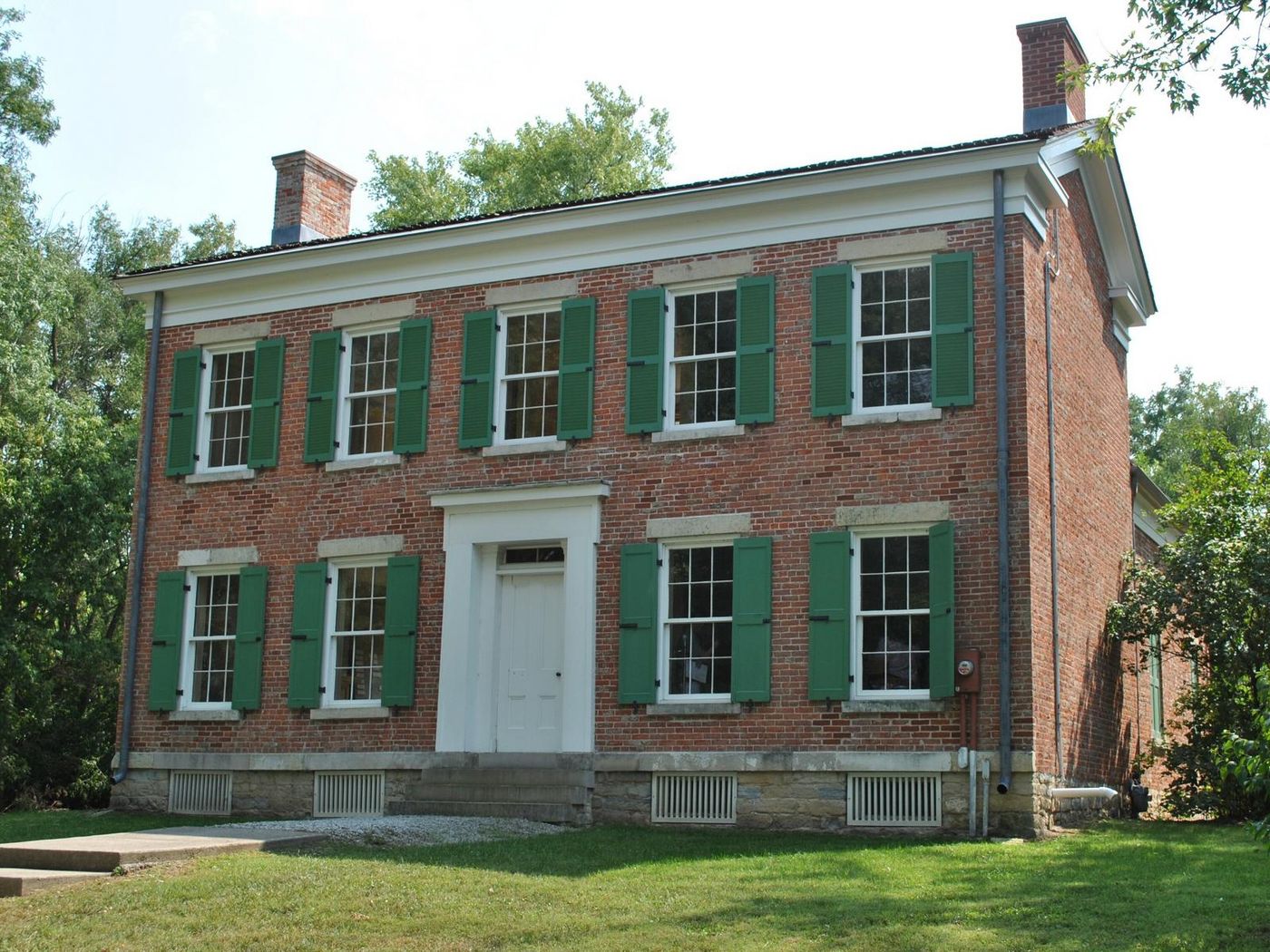
Jean Baptiste de Richardville (Pinšiwa, 1761 – 13 Aug 1841), nephew of Little Turtle's generation through his mother Tacumwah, sister of Pacanne, signed treaties from Greenville in 1795 through 1840 and accumulated 28,320 acres and $31,800 in grants along the way. In 1827 he built the house at 5705 Bluffton Road with $600 of federal treaty money and about $1,600 of his own: the first Greek Revival house in northeast Indiana, a National Historic Landmark since 2012.
The History Center calls him the richest man in Indiana at his death. The reputation is documented; the viral “$23 million in today's money” figure is not, “Richardville was the richest man in Indiana”.
Richardville's career was the treaty system made flesh. Civil chief of the Miami for four decades, he understood earlier than most that the cessions could not be stopped, only priced — and he priced them, treaty by treaty, converting communal land into personal reserves along the St. Marys and at the Forks of the Wabash, into annuity income, into the brick house on the Bluffton Road and a second seat at the Forks. What he could not convert was time: the 1840 treaty he signed ceded the last great block, the Big Reserve, and set the five-year clock that ran out in the removal of 1846. He died on 13 August 1841 at the Forks of the Wabash, five years before the deadline he had negotiated arrived for his people.
Source: The History Center, Richardville House, fwhistorycenter.org
Era II · Treaties, removal, and a town, 1809–1846
The cession cascade
Treaty of Fort Wayne (1809); St. Mary's (1818, creating the Big Miami Reserve); Mississinewas (1826, canal right-of-way); Forks of the Wabash (1838, 1840). Hundreds of the treaty scans are free in the National Archives Catalog.
Each treaty had a local machinery. At St. Mary's in October 1818 the Miami ceded their claim to the great block of central Indiana — the “New Purchase” on which Indianapolis would be platted — keeping the Big Reserve south of the Wabash and their Fort Wayne-area reserves. The 1826 treaty at the Mississinewa ceded the strip the state needed for the Wabash & Erie Canal, which is why the canal commissioners and the treaty commissioners were so often the same men. The treaties of November 1838 and 28 November 1840, negotiated at the Forks of the Wabash, ceded the Big Reserve itself; the 1840 instrument allowed named families — Richardville's, Godfroy's, Meshingomesia's and others — to keep their reserves in Indiana, and required the rest of the nation to remove west within five years. Annuity day at the Fort Wayne agency was the town's great recurring gathering: in 1810, 1,779 Native people drew the 1809 annuities; the distributions of the 1830s drew thousands more, and the traders' ledgers grew fat on them.
Sources: treaty texts, Kappler, Indian Affairs, II; annuity figure, Logan Esarey via ACGSI
Annuity day: the agency's ledger
The spine of this era is a paper trail, and much of it survives: the Indian Agency's letter book for 1809–1815, transcribed by Gayle Thornbrough for the Indiana Historical Society in 1961, and Bert Griswold's Fort Wayne, Gateway of the West, 1802–1813 (1927), which prints the garrison orderly books and the agency's account book. The agency ran two purses. The factor kept the government trading house — John Johnston, appointed factor on 1 July 1802 at $1,000 a year and three rations a day, was to draw Miami trade away from the British posts in Canada with government goods at government prices. The agent handled politics and the annuities — the yearly silver, salt and goods the treaties owed. In 1809 the two purses were joined in Johnston's hands; he resigned on 30 June 1811, worn down by the malarial fevers of the place, and after his assistant John Shaw's interim, Benjamin F. Stickney — a grand-nephew of Benjamin Franklin — held both offices from 1811 to 1819. The scale of annuity day is best seen in 1810, the year after the second Fort Wayne treaty: 1,779 Native people came in for the distribution, and Johnston wrote to Governor Harrison that they “went home perfectly satisfied.” Not all did: the Mississinewa Miami, in council, told Johnston their chief Pacanne had refused any part of the annuity and demanded the 1809 treaty be broken — the refusal is in the letter book beside the satisfaction.
The war made the ledger a logistics problem. In July 1812 Stickney wrote the Secretary of War that he was out of supplies and needed government money to provision 1,000 Indians travelling to the great council at Piqua; Johnston, by then the agent at Piqua, had $30,000 to $40,000 in goods stacked in his barn for that council and one rifle, a fowling piece and a musket to guard them. Stickney left Fort Wayne for Piqua on 12 August 1812, ill with fever, and missed the council; three weeks later he was back and sharing command of the fort through the September siege, when the Potawatomi chief Winamac, admitted to a council inside the walls, drew a hidden knife on him. After the war the succession ran John Hays — appointed 24 May 1820 in place of Dr. Turner, at $1,200 a year — and then, from May 1823, John Tipton. Hays's Fort Wayne was still a place of throngs: the Miami and Potawatomi came in parties of three or four thousand, and the annual payments ran above $18,000. His inherited headaches included a contractor named Benjamin Levell, engaged under Turner to build the sawmill and gristmill the Treaty of St. Mary's had promised the Miami and not yet built. Calhoun asked the resigning Hays to stay on through one more annuity payment; Tipton reached Fort Wayne by 16 May 1823 to take the office from him.
Tipton's payments can be read receipt by receipt in his papers, now the John Tipton Collection at the Indiana Historical Society. On 12 August 1823, nine Miami chiefs signed by their marks a receipt for 190 bushels of salt due the Miami and Eel River tribes for 1823 under the treaties of 1803 and 1818. The full Miami annuity receipt of 27 August 1824 is the era's single most concrete document: $18,400 in silver and 190 bushels of salt for the year 1824, under the treaties of 1795, 1803, 1809 and 1818, signed by Jean Baptiste Richardville, Macheckelaouta (Big Body), Osage, Natawonsaw, Nagotacupwah, Waupassippon, Pingquahwhah, Macatmongquah, Pappekechah and Little Beaver. The chiefs also spent the annuity before it arrived: on 7 April 1824 they asked Tipton to hire W. G. Ewing to fence their land and to hold the payment out of that year's annuity — Tipton's endorsement on the memorandum counts 46 persons in Metociny's village. At the individual scale, the 1825 annuity list gave Chief LeGros $175 to divide among the 15 people living with him, and Tipton's ration memorandum of October 1826 counts LeGros's band at 18 and his son's at 12. The Treaty of Mississinewa (16 October 1826), which Tipton negotiated with Lewis Cass and Governor Ray, wrote Fort Wayne into the Potawatomi's purse as well: $2,000 in silver a year for twenty-two years, a blacksmith, $2,000 a year for education, a mill on the Tippecanoe with a miller, and 160 bushels of salt annually — every item “paid by the Indian Agent at Fort Wayne” — beside $30,547.71 in goods delivered at the treaty ground and $9,573 allowed for the tribe's debts to its traders. In the spring of 1828 Tipton moved the agency to Logansport — in the History Center's summary, acting to separate the Indians receiving annuities from the traders who waited on them — and Fort Wayne's thirty years as the annuity capital of the upper Wabash ended.
Sources: Indiana Memory / Indiana Historical Society, John Tipton Collection: receipts of 12 Aug 1823 and 27 Aug 1824; memorandum of 7 Apr 1824; Nellie A. Robertson, “John Hays and the Fort Wayne Indian Agency,” Indiana Magazine of History XXXIX (Sept 1943); Kappler, Indian Affairs, II, Treaty with the Potawatomi, 1826, Arts. 3–5; Gayle Thornbrough, ed., Letter Book of the Indian Agency at Fort Wayne, 1809–1815 (1961); ACGSI, John Johnston family and Chief Richardville pages, and the Johnston chronicles (Johnston Farm & Indian Agency records); The History Center, Notes & Queries, “Indian Agents a Factor in Early Fort Wayne” (Tom Castaldi, Fort Wayne Monthly, Aug 2016); Siege of Fort Wayne, compiled sources
Garrison out, town in
The Army withdraws in 1819; a federal land office follows. The town is platted in 1823, Allen County is organized in 1824, Fort Wayne incorporates as a town in 1829 (population ~300) and as a city on 22 February 1840 (population over 2,000). First mayor: George W. Wood, see § 04, Government.
The sequence, precisely: the last soldiers left on 19 April 1819, and the empty post stood over the townsite for three more decades before it was torn down. Congress authorized the Fort Wayne land district by the act of 8 May 1822; the office opened in the old fort itself, and the first public sale began on 22 October 1823 — twenty-nine years to the day after the fort's dedication — with Joseph Holman as receiver and Samuel C. Vance as register. In the same season the town was platted: 118 lots over 109 acres, streets angled to Columbia Street rather than the compass, with a public square where Court Street runs. The Indian agency, the town's other federal institution, was removed to Logansport in the spring of 1828 on Gen. John Tipton's suggestion. By the mid-1830s the land office was doing boom business — its receiver wrote in July 1836 that he was taking in $25,000 a day.
Sources: Historic Fort Wayne, The Old Fort brochure (decommissioning date); Valley of the Upper Maumee River (1889), land office chapter; The History Center, “Plat: LD 18” (original plat)
The trading houses
The town the garrison left behind lived on the trade, and three names ran it. Alexander Ewing, an Irish immigrant who had first seen Fort Wayne in 1812, in the column that broke the siege, settled his family here in 1822, kept the Washington House tavern at Barr and Columbia, and bought heavily at the first land sales — including the eighty acres west of the plat that became Ewington, the town's first westward addition. His sons William G. and George W. built the W. G. & G. W. Ewing company into one of the great fur houses of the West; Hugh McCulloch, who knew them, wrote that he had “rarely met their equals in business capacity.” Samuel Hanna, trader and judge, promoted everything the town needed next, the canal above all. And Allen Hamilton, arrived from Ireland in 1823, turned a trader's stake into the town's first banking house and the largest fortune of its founding generation. Francis Comparet and the smaller traders filled the ledgers between them; it was the trade money, as the History Center's Ewing history concludes, that carried the community through the thin decades to cityhood.
Sources: The History Center, “The Ewings and the Indian Trade on the Midwestern Frontier” (Fort Wayne Magazine, Sept 2006); Valley of the Upper Maumee River (1889)
Hugh McCulloch's ladder
One of the land-office generation climbed out of Fort Wayne to the top of American finance. Hugh McCulloch settled here in 1833, practised law, and from 1835 ran the Fort Wayne branch of the State Bank of Indiana; three decades later he was Abraham Lincoln's Comptroller of the Currency and then, from March 1865, Secretary of the Treasury — the man who signed the nation's wartime money into being, out of a career that began in a frame town of a few hundred people. His memoir, Men and Measures of Half a Century (1888), remains a first-hand source on the town's trading years, quoted in this record on the Ewings.
Sources: McCulloch, Men and Measures of Half a Century (1888); standard Treasury biographies
The newspaper record begins
Tigar & Noel found the Sentinel, the start of the continuous local newspaper run against which most claims on this page are checked. The Daily News follows in 1874; merged papers become the News-Sentinel (1918) and the Journal Gazette (1899 lineage), the latter still publishing.
Johnny Appleseed dies here
John Chapman dies in Fort Wayne, the best-proven famous death in the city's record, and the least-proven famous grave. Full account: “Johnny Appleseed died in Fort Wayne and lies under the marker in Johnny Appleseed Park.”.
Chapman had worked the Maumee valley for years, planting his fenced nurseries of apple seedlings ahead of the settlers — including ground in this county — and he died at the cabin of William Worth, northeast of the town, in March 1845; the Fort Wayne Sentinel of 22 March 1845 carried the obituary of “Johnny Appleseed,” dead at 71 (by the paper's reckoning). The nurseries explain the death: he was in the county, as he had been season after season, looking after his trees.
Source: Fort Wayne Sentinel, 22 Mar 1845, Appleseed obituary; “Johnny Appleseed died in Fort Wayne and lies under the marker in Johnny Appleseed Park.” for the grave question
The Miami Removal
After the 1840 treaty's five-year deadline and six years of resistance, the Richardville, Godfroy, Meshingomesia, Slocum and LaFontaine families held exemptions, the Army and its contractors load hundreds of Myaamia onto canal boats at Peru (6 Oct) and at Fort Wayne/Kiihkayonki (7 Oct). Five boats to Cincinnati, a steamboat to Kansas; the party reaches Sugar Creek on 5 November 1846, and several die on the way. The canal that made Fort Wayne carried its founders away.
The exempted families did not vanish: their reserves, held in severalty, became the nucleus of the Indiana Miami community that persists today, and the legal fight of their descendants over federal recognition runs into the present century. The removed community's descendants are the Miami Tribe of Oklahoma. Fort Wayne's founding story therefore has two endings, and both are still being written — one of them in this state, in the counties around the old reserves.
Source: Myaamia Center teaching history, teachmyaamiahistory.org
Era III · Canal and rail, 1832–1880s
Canal groundbreaking
Ground breaks at Fort Wayne for the Wabash & Erie Canal, at Fort Wayne because it is the highest point on the route, the summit between the Maumee and the Wabash. That summit is the documented root of the “Summit City” nickname (see “Fort Wayne is the Summit City because the canal crested here.”).
The ceremony was held on Washington's birthday where the feeder canal met the main line, behind the present site of the old Wayne Knitting Mills ground; Charles W. Ewing gave the principal address, and the first construction contract went to William Rockhill, lately of New Jersey. The engineering fell to a 24-year-old North Carolinian, Jesse Lynch Williams, named chief engineer of the canal in 1832 and within five years engineer of all Indiana's public works. The summit dictated the hydraulics: the level here stood 198 feet above Lake Erie, 790 feet above the sea, and would not stay wet by itself. So the first work was not the main ditch at all but a feeder — a dam across the St. Joseph near present Shoaff Park, a wall of trees, sand, boulders and gravel 17 feet high and 230 feet across the river, finished in 1834 after floods twice delayed it, and a five-mile feeder channel down the St. Joseph's west bank (its trench still shows in Johnny Appleseed Park) into the summit pound. The main channel the men dug averaged fifty feet wide and six deep, built by gangs in the thousands, mostly Irish and German immigrants hired at ten to thirteen dollars a month with passage advanced, under “jigger bosses” who issued whiskey, the accounts say, “to ward off fever and protect them from snakebite.” A grim figure circulates in the canal literature — a death for every six feet of ditch — which cannot survive arithmetic across 452 miles and is carried here as the period's way of saying the work killed men steadily, not as a count.
Sources: ARCH Fort Wayne, “Wabash and Erie Canal”; News-Sentinel canal history (12 Sept 1994); Fort Wayne in Canal Days (Indiana Historical Society)
First boats
The canal boat Indiana reaches Huntington: the Fort Wayne–Huntington stretch is the first Indiana section in traffic.
The section ran southwest from the summit, and for the next eight years Fort Wayne was the canal's working western end — the place boats were built, loaded and turned, and where the state's canal land office did its business. Construction pushed on in both directions at once: west to Logansport by 1838 and Lafayette by 1841, east from Fort Wayne to the Ohio line beginning in 1837 and finished by 1840, twenty-nine locks climbing the 108 miles from the Maumee at Manhattan to the summit. Indiana had bet the state on it — the Mammoth Internal Improvement Act of 1836 committed some $13 million across the canal system and its sister works — and the Panic of 1837 broke the bet: work stalled, the state's credit collapsed, and the canal finished the 1840s as a ward of its bondholders. The boats, meanwhile, kept coming.
Sources: Canal Society of Indiana, Wabash & Erie construction chronology; The Wabash-Erie Canal (Illinois Historical Survey)
Grand opening
Through navigation, Toledo to Lafayette by way of Fort Wayne, celebrated at the Swinney homestead with Lewis Cass speaking. At its full 1853 length to Evansville the canal runs 468 miles, the longest in North America. It is abandoned in 1874, sold in 1877; the Nickel Plate takes the Fort Wayne roadbed in 1881 and the last boat is seen in 1882.
The first boat to travel the whole line reached Evansville on 22 September 1853, twenty-one years after the groundbreaking. The canal's heyday in Fort Wayne was scarcely a decade, but it remade the town's geography: the warehouse row along Columbia Street at the canal's edge — the Landing — became its commercial heart, packet and line boats ran to Toledo in season, and the population the census found in 1850, 4,282 (Griswold's handbook prints 4,882; the federal figure is 4,282), had more than doubled the town of 1840. By 1860 the sections south of Terre Haute were already closing; the summit-level trade to Toledo and the Wabash towns lasted longest, and it was the canal's corpse — a level, graded roadbed straight through the city — that the Nickel Plate Railroad bought in 1881.
Sources: Canal Society of Indiana; Fort Wayne in Canal Days; census figures, U.S. Census Bureau, with the Griswold-Phelps handbook variant noted
Working the canal: tolls, packets, and the Dock
What the canal earned can be followed in its toll receipts, and the early numbers are sobering. The first section out of Fort Wayne, to Huntington, opened in the first days of July 1835 (the public library's canal history gives 4 July; other summaries give 3 July), and boatbuilding started with the traffic: the first boat constructed at Fort Wayne was the Indiana, built in 1834 by F. P. Tinkham. In 1838 the whole canal took in $1,398 in tolls — “scarcely enough to pay the salary of one canal commissioner.” The completion of the Ohio end to Toledo changed the arithmetic: tolls in 1843 jumped to $60,000 for Indiana and $35,000 for Ohio, even as a disastrous flood closed the canal for two months in 1844. The freight tariff of 1843, preserved by Griswold, ran by weight and distance: flour, pork, lard, bacon and meats paid 7½ mills per mile per 1,000 pounds for the first hundred miles, 5 mills for the second hundred, and 3 mills beyond; corn, rye, oats, barley and buckwheat paid 3 mills, then 2. Behind the Columbia Street warehouses lay the strip between the buildings and the water that Fort Wayne simply called “the Dock,” where every boat landed freight and passengers and the boat horn announced arrivals and departures to the town.
The passenger trade ran on timetable. From 1844 a fast packet service linked Toledo and Fort Wayne, carrying passengers and the daily mail — the canal gave Fort Wayne its first daily mail — and Griswold names the operators: the through line of Samuel Doyle and William Dickey ran eleven boats and one steam propeller, and D. F. Comparet operated six boats and two steamers. The first steam-propelled boat on the canal, the Niagara, was built for William Doyle at a cost of $10,000. A surviving advertisement fixes the service in print: “Doyle and Dickey's Daily Packet Line” would start from Lafayette on Monday, 27 March 1848, at 10 o'clock in the morning, arriving at Fort Wayne at 6 in the evening; the line then had four boats, with three new packets to be added on 1 May to form a daily line between Covington, Indiana, and Toledo. The canal worked for the army as well as the mails: by 1845 the government was moving soldiers down the Wabash–Erie and the connecting canals toward Cincinnati for the Mexican War, commissioned officers riding the packets and the enlisted men the freight boats, and until 1856 the canals were carried on the books as part of the national military highway between New York and New Orleans.
Sources: The Wabash–Erie Canal (Public Library of Fort Wayne and Allen County pamphlet history; Internet Archive text); Griswold, The Pictorial History of Fort Wayne (1917), canal chapters — freight rates of 1843, the Doyle & Dickey and Comparet lines, the Niagara, and the Dock, via the LDS Genealogy transcription, Part 42
The railroad era opens
The Ohio & Indiana completes its line to Fort Wayne (excursion 15 November). The Pittsburgh, Fort Wayne & Chicago consolidates in 1856 and runs through to Chicago by 1858–59. In 1857 the railroad picks Fort Wayne for its construction and repair shops on Samuel Hanna's donated land, the Pennsy Shops, employing some 3,950 by 1913, building locomotives until after the First World War and rebuilding them until 1933. Nickname earned on the shop floor: “Altoona of the West.”
The transition has a perfect emblem: in late January 1852, two years before the rails arrived, Fort Wayne's first locomotive reached town by canal boat. The shops that made the city a railroad town grew from the Wayne Car & Engine Works of Jones, Bass & Co., bought by the Pittsburgh, Fort Wayne & Chicago in September 1857; major shop buildings rose in 1863, and over the following decades the works built some 300 locomotives and 12,000 cars by the count on its commemorative marker, among them passenger cars remembered as some of the most ornate ever made. The line was leased to the Pennsylvania Railroad in 1869 and became the Pennsy's main street to Chicago. Other roads followed — the Wabash, the Grand Trunk, the Nickel Plate in 1881, the Lake Shore, the Cincinnati, Hamilton & Dayton among them — until seven railroads entered the city, and the census tells the result: 10,388 people in 1860, 17,718 in 1870, 26,880 in 1880.
Sources: National Register nomination, Baker Street Station, npgallery.nps.gov; ACGSI railroad history; History of the Pennsylvania Railroad's Fort Wayne Shops (1897, Allen County–Fort Wayne Historical Society reprint); News-Sentinel Cityscapes, “The Pennsy Shops” (26 Dec 1981)
Camp Allen and the Civil War
When the war came, Fort Wayne's volunteers had at first to travel 125 miles to Indianapolis to be mustered; the state fixed that by opening Camp Allen, a rendezvous and training ground on the west bank of the St. Marys off West Main Street, named for Col. John Allen, the Kentucky officer killed at the River Raisin. Col. Hugh B. Reed, the town's druggist-soldier, was its first commandant. The Indiana Historical Bureau's marker lists what the camp made: the 30th, 44th, 74th, 88th and 100th Indiana Infantry and the 11th Indiana Battery; the 142nd Indiana rendezvoused at Fort Wayne in 1864 as well. Allen County sent about 4,000 citizens to war and buried nearly 500 of them. The 44th, Reed's own, fought at Fort Donelson in February 1862. The 30th was commanded by Col. Sion S. Bass — partner in the iron firm of Jones, Bass & Co. — who was mortally wounded leading it on the second day at Shiloh, 7 April 1862, and died at Paducah seven days later; he lies in Lindenwood under one of the city's great soldier monuments. Beside him in Lindenwood rests the county's other emblematic figure of the war, the army nurse Eliza E. “Mother” George, who died of typhoid in a camp at Wilmington, North Carolina, in 1865, a month after Appomattox. The women of Fort Wayne had made and presented the 30th's silk colour in 1861; it is in the History Center's collection today.
Sources: Indiana Historical Bureau, Camp Allen marker (02.1963.1) and its 2010 review file; ACGSI, Civil War information for Allen County; Pioneers Resting in Historic Lindenwood (1989); The History Center, 34-star flag record
Iron: Bass, Olds, and the wheel trade
The railroads made an iron town. The Bass works, established in 1853 as Cooper, Bass & Co., reorganized as Bass & Hanna in 1868 and incorporated by John H. Bass as the Bass Foundry & Machine Company in 1873, grew out of the Fort Wayne Machine Works, which was casting rail iron by 1857 and which John Bass took over in 1862 on his brother Sion's death at Shiloh. At the century's turn Bass was the largest maker of railroad car wheels in the world — the 1889 county history boasted that more car wheels were cast at Fort Wayne than in any city on earth — employing some 1,100 men on a $35,000 monthly payroll, with sister works at St. Louis, Chicago, Atlanta and in Tennessee. Beside it stood N. G. Olds & Sons, whose wagon and carriage wheels the same history credits with 90,000 sets a year, cut from 7,000,000 spokes; and around them the Kerr Murray iron works and the Kunkle valve works, feeding the same trade. John H. Bass died in 1922; the foundry, its market gone with the wooden car, filed for reorganization in 1939.
Sources: ACGSI, “Bass Foundry and Machine Works”; Valley of the Upper Maumee River, Vol. II (1889), manufacturing chapter; News-Sentinel Cityscapes, “The life of the Bass Foundry” (28 Nov 1981)
Streetcars, telephones, water
The modern city's services arrive in a twenty-year rush. Gas had lit the streets since the 1850s, but drinking water came from cisterns and the courthouse-square artesian well until the municipal water system was begun in 1879; the fire companies had drawn on downtown cisterns. In 1872 the Citizens Street Railway put horse-drawn cars on Calhoun Street, running from the Pennsylvania depot to Main Street, with branches following. Western Union's Edison telephone exchange opened in July 1879 in the Nill building; the telephone became a fixture in 1881, when the Fort Wayne Telephone Company strung its wires, and in 1895 the Bell company let Fort Wayne hear voices and music from nine hundred miles away at the Aveline House. The streetcars electrified last and fastest: Marmaduke Slattery, Jenney's chief engineer, built an experimental electric car in 1891 that proved too costly and unreliable, horses returned for a year, and in July 1892 the Fort Wayne Electric Railway electrified the system for $100,000. By 1900 the interurbans were reaching out of the Traction company's depots toward Huntington, Lima and Lafayette — several of them running, fittingly, on the towpath of the dead canal.
Sources: The Gilded Age in Fort Wayne, 1870–1900 (Public Library of Fort Wayne and Allen County, 1955); Griswold, The Pictorial History of Fort Wayne (1917), telephone chapter; ACGSI, Interurban Railways of Allen County; News-Sentinel Cityscapes, “Light of the world” (19 Dec 1982)
Era IV · The factory city, 1881–1983
Jenney Electric becomes General Electric
James A. Jenney arrives in 1881 with his arc lamp and dynamo; Jenney lights the New Orleans World's Fair in 1884; Thomson-Houston buys control in 1888; James J. Wood arrives in 1890; GE absorbs the works in January 1899. At its late-1940s peak, GE employs roughly 40% of the city's workforce. The lineage is documented; the exact corporate date is disputed between 1892, 1898 and 1899 in the sources, the record carries the lineage, not a single date.
The founding details are worth keeping. Jenney set up in a cramped brick building at Wells and Superior, and within two weeks of his arrival drew 2,000 people to a public demonstration of his arc lights — the first electric light most of the crowd had ever seen; the Home Billiard Parlor took the first commercial installation. On 1 November 1881 Ronald T. McDonald organized the Fort Wayne Jenney Electric Light Company with $100,000 of authorized capital and H. G. Olds of the wagon-wheel works as president. Jenney lamps lit the New Orleans World's Industrial and Cotton Centennial in 1884, and the company's lamps were, by the News-Sentinel's account, the first ever to light the Statue of Liberty in 1885. Thomson-Houston bought the works in 1888 and renamed it the Fort Wayne Electric Light Company; in December 1890 a young chief electrician named James J. Wood arrived, whose motor and generator designs would make the Broadway works famous and who lies honoured in the industry histories as one of the founders of practical electrical manufacture. General Electric — itself formed in 1892 from Thomson-Houston and Edison — absorbed the Fort Wayne works in January 1899.
Sources: Griswold, The Pictorial History of Fort Wayne (1917), “The General Electric Works”; News-Sentinel Cityscapes, “Light of the world” (19 Dec 1982)
Baseball under lights
Seventeen Jenney arc lamps light League Park for Quincy vs. Methodist College (Quincy wins 19–11 before ~2,000). A famous first that isn't, “Fort Wayne hosted the first night baseball game, in 1883.”. Three years earlier and eighteen days later, on 4 May 1871, the Fort Wayne Kekiongas had already played the first game of the first professional league, beating Cleveland 2–0, “first” only because Boston–Washington was rained out the day before.
The 1871 game deserves its details: at the Kekionga Ball Grounds, Fort Wayne's professional nine — named, in the city's first act of historical branding, for the Miami capital — beat the Cleveland Forest Citys 2–0 behind pitcher Bobby Mathews, in what remains one of the lowest-scoring games of the National Association's first season. The Kekiongas folded by August; the league, and the city's claim on its first game, survived them.
Bowser sells his first pump
S. F. Bowser sells a self-measuring pump to a Fort Wayne grocer, for kerosene, not gasoline (see “Bowser invented the gasoline pump in 1885.”). With Wayne Pump and Tokheim, Fort Wayne becomes a national centre of fuel-pump making.
The knitting mills
Theodore F. Thieme, a Fort Wayne druggist, decided in 1891 that Americans depended too much on Europe for hosiery; he sold his store at Wayne and Calhoun, imported knitting machines — and knitters — from Germany, and after a year in rented quarters at Main and Clinton moved the Wayne Knitting Mills to West Main Street at Growth Avenue. The mills made “full-fashioned” hosiery knitted to the leg's shape, produced what ACGSI's mill history calls the nation's first line of fashion hosiery, and took top honours at the 1904 St. Louis exposition. By 1905 some 1,100 workers, most of them women, made the plant the largest maker of knitted hosiery in the world; the Nebraska neighborhood grew up around it. In the First World War the mill turned out fifty thousand pairs of standard-issue wool army socks, and kept morale with its own drum corps, marching bands and a girls' chorus remembered as the “Knittingales.” Thieme's abrupt 1923 decision to sell to Munsingwear — and equally abrupt change of mind — was one of the city's celebrated financial episodes. Fashion moved on; the mills closed in 1960 after seventy years, operations transferred to Humboldt, Tennessee, and the great sheds on Growth Avenue passed to warehousing.
Sources: ACGSI, “Wayne Knitting Mills”; News-Sentinel Cityscapes, “Fort Wayne Knitters” (14 Nov 1982)
Refrigerators and magnet wire
GE begins Fort Wayne manufacture of the French Audiffren home refrigerator, first unit sold 1911 at about $1,000 (see “Fort Wayne invented the refrigerator, in 1913.”). The same year, ex-GE chemist George Jacobs founds Dudlo, and Fort Wayne becomes the world's leading magnet-wire producer: the factual root of “Magnet Wire Capital of the World.”
The Great Flood
4.75 inches of rain fall on 23–25 March. The Maumee goes from 6.7 ft on Easter Sunday to 19.6 ft the next morning and crests at 26.1 ft at 11 p.m. on 26 March, eleven feet above flood stage. The Lakeside dike breaks in four places; the power plant floods and the city goes dark. 5,500 homes and businesses damaged, ~15,000 people homeless, ~$4.8 million in damage, relief given to 11,187. The death count is “The 1913 flood killed seven people in Fort Wayne.”.
The Fort Wayne flood was one city's share of the Great Flood of 1913, the Easter-week storm system that drowned Dayton and much of the Ohio valley. What followed here, beyond the cleanup, was a permanent change in how the city treated its rivers: levee and dike work along the Maumee and the St. Marys in the years after, a standing civic understanding that the three rivers were infrastructure and not scenery — and, when the water came back in force sixty-nine years later, a population that had been told the story. The argument the flood left behind was not about whether to fight the rivers but about the numbers, and it is set out below.
Source: Jarosh's record-by-record reconstruction for the News-Sentinel, built from three 1913 dailies plus birth, death, funeral, cemetery, census and directory records, egen.fortwayne.com
The Lincoln Highway and the First World War
The automobile got its road the same year the rivers rose. The Lincoln Highway, Carl Fisher's coast-to-coast “Main Street Across America,” dedicated in 1913, entered Allen County from Ohio and ran through New Haven and downtown Fort Wayne, crossing the St. Marys on the Harrison Street bridge — whose plaque still reads “Lincoln Highway Bridge: New York 724 miles – San Francisco 2,660 miles.” The 1915 route carried the Army's great transcontinental motor convoy through the city in the summer of 1919. The war itself was a factory war here: the knitting mills' army socks, the shops' and foundries' war orders, and Camp Allen's ground turned fairground-quiet while a new generation went to camps farther away. The Anthony Wayne statue that greeted motorists at Hayden Park was dedicated on 4 July 1918, mid-war; the city's German institutions, the largest ethnic establishment in town, spent the war years renaming themselves — the German-American Bank became the Lincoln National Bank in 1918, a name that would soon stand over the city's skyline. The census found 86,549 people in 1920, up from 63,933 in 1910: the factory city at full stretch.
Sources: FortWayne.com, “Lincoln Highway”; Jan Shupert-Arick, The Lincoln Highway Across Indiana; ACGSI, Lincoln Highway in Allen County; Lincoln Bank Tower building history
The war's rolls, and the flu
The First World War's Fort Wayne numbers survive because a librarian counted them. Isabelle H. Taylor's History of Allen County in the World War (Public Library of Fort Wayne and Allen County, 1920) runs to sixteen volumes: a narrative volume of the county's war work, and fifteen volumes of individual service records covering 3,500 soldiers, sailors and marines from Allen County. The dead were gathered separately into the state Gold Star Honor Roll (Indiana Historical Commission, 1921), where the Allen County entries begin at page 18; the Allen County Genealogical Society's summary of the record puts the county's loss at over 100 who did not return. Fort Wayne's own battery went early: Battery D of the 150th Field Artillery, an Indiana National Guard battery enlisted at Fort Wayne, sailed with the 42nd (Rainbow) Division in October 1917 — Private Albert Brintzenhofe of that battery was killed by a shell near Dôle, France, on 10 August 1918, and Leslie C. Kayser, a Journal-Gazette employee in the same battery, died of measles and pneumonia on 23 November 1917, days after reaching France. In September 1918 the city raised a temporary Liberty Memorial Arch on the southwest corner of the courthouse square, designed by Marshall Mahurin and carrying the names of the local dead; it came down in 1921 with a promise, made to the Gold Star parents, of a permanent memorial to follow.
Then the war's second killer arrived, and it is the reason so many of those names are camp names — Camp Taylor, Camp Grant, Great Lakes — rather than battlefields. By the reckoning preserved in the Emmanuel (Soest) Lutheran history notes from the local newspaper record, half of Allen County's war casualties died of the flu. The influenza reached Fort Wayne in September 1918. A 1 October newspaper named Fireman William Rudolph Hilgeman, U.S. Navy, at the Great Lakes training station, as Fort Wayne's first victim; the News-Sentinel's later retrospective, drawing on Maureen Gaff's university research, gives the first Fort Wayne flu deaths as two soldiers stationed in Michigan, reported 4 October. The reports differ in detail and are carried here as they stand. On 6 October the Indiana Board of Health ordered every school, church and place of amusement in the state closed and all public meetings banned, factories and stores excepted. The order took effect in Fort Wayne on 8 October — and came off two days later, after the Allen County health commissioner and leading businessmen asked the state board to relent. Two days after that, with adjoining counties reporting hundreds of cases, the city reversed itself and shut down again. The shutdown ran through October and was extended into November over the protests of the idle: on 10 November, seventy labor representatives speaking for some 12,000 men met the county Board of Health about workers who had not drawn wages in five weeks.
The case reports that survive run by month: 2,316 cases in December, 722 in January, 960 in February, 663 in March, and 8 in April, when it ended as suddenly as it came. (One local compilation of the newspaper record gives only 109 recorded cases by the end of October — a figure that cannot be squared with December's thousands and is best read as the count of the epidemic's first, under-reported weeks.) A survey by the local Influenza Commission estimated 5,000 people ill in Allen County. What was never produced, then or since, is a Fort Wayne death toll: the contemporary compilation states plainly that it was never determined exactly how many died here, and Gaff's research confirms that totals are not available for Fort Wayne or Allen County — the deaths are recoverable name by name, from the city and county death records the Genealogical Society has listed for April 1918 to August 1920, but they were never summed into an official figure. That number remains open. The state's figures are firmer: Indiana lost 3,266 people by the end of November 1918, and 8,845 in the last quarter of the year, by the State Department of Health's count. One institution did come out of the epidemic: the Allen County Board of Health grew from it.
Sources: ACGSI, World War I Resources for Allen County (Taylor, History of Allen County in the World War, 1920; Gold Star Honor Roll, Indiana Historical Commission, 1921); ACGSI, “1918 Influenza” and Spanish Influenza Deaths, Allen County, 1918–1920; Emmanuel (Soest) Lutheran Church, History Notes #27–28 (2020), from Fort Wayne newspapers; News-Sentinel, “Spanish flu's effects were devastating in 1918” (egen.fortwayne.com history series)
International Harvester's sixty years
Construction starts 1922 on East Pontiac/Bueter; truck production runs 1923 to the end. The plant builds 1,527,299 trucks, including 532,674 Scouts (Nov 1960–Oct 1980), and peaks at 10,600 employees in early 1979. The closure is announced on the Journal Gazette's front page on 28 September 1982, the city's $31 million retention package loses to Springfield, Ohio, and the last truck rolls out 15 July 1983.
Source: ACGSI, with newspaper citations, acgsi.org
GE at war: Broadway, Taylor Street, and Decatur
The war reached the Broadway works before it reached the country. As early as 1938 the Fort Wayne Works was being asked to develop motors for military aircraft; in 1939, fearing German bombing of its English factory, Rolls-Royce chose Fort Wayne to build starter motors for military aircraft — the sequence is in Clovis Linkous's history of GE's Fort Wayne operations, retold in the News-Sentinel's war-industry retrospective. The biggest commitment came at the very edge of peace: the government picked Fort Wayne for a new plant to build the turbo superchargers that let fighters and bombers perform at altitude. The News-Sentinel dates the announcement to two days before Pearl Harbor; the Quest Club history of Electric Works, working from Linkous, dates the groundbreaking for the Taylor Street plant to 6 December 1941, the day before the attack. That night the great GE sign on Broadway — lit since 1928 — was switched off, and it stayed dark until the war ended. The Taylor Street plant was rushed into production by the summer of 1942 and given the highest priority; by 1944 it had produced more than 50,000 turbo superchargers, the highest supercharger output of any factory in the country. Broadway, meanwhile, built electric motors for ships and submarines, weapons-control systems, refrigeration equipment, and motors and superchargers for aircraft. The workforce changed shape to do it: women were hired in masses, under a job classification of GE's own devising — women, men, and women doing men's jobs — and the female share of the works rose from 20 percent in 1940 to 40 percent in 1944. Employees worked seven-day weeks and put 10 percent of pay into war bonds.
The headcounts need care, because the sources count differently. Linkous puts GE's Fort Wayne employment at the end of the war at more than 20,000 people — 36 percent of the city's workforce. GE's own postwar promotional booklet said nearly 40 percent of the city's workforce was on the GE payroll at the wartime peak, and the 1944 peak figure of some 20,000 is the one the Electric Works developers and the National Register nomination also carry (“at its peak in the late 1940s, GE employed roughly 40 percent of the city's workforce”). Against those totals, a manufacturing-payroll series puts the plant at nearly 12,000 at the end of the war — production hands only, the likeliest reading of the difference. The campus those workers filled covered 39 acres along Broadway, some 1.2 million square feet in eighteen buildings. The works system reached beyond the city line: since 1920 GE had run a branch at Decatur, in Adams County, planted there by the Fort Wayne Works (its general manager F. T. Hunting closed the deal in November 1919) to make fractional-horsepower motors — a first unit of 75,000 square feet meant to turn out 500 motors a day and employ 400 to 500 people, its first girls sent to Fort Wayne to learn the work in Building 4-5 before production started. Decatur ran at war speed too: a GE notice in the Decatur Daily Democrat of 10 July 1943 thanks the town for keeping its plant's equipment “speeding to our fighting men at the battle front” through overtime and night shifts. No Decatur wartime headcount has been found in the sources used; that figure remains open, and the plant's own arc — general-purpose motors until it closed about 1990, its work going to Mexico and in part to Fort Wayne — belongs to the business record.
Sources: News-Sentinel, “City industry contributed to war effort” (egen.fortwayne.com history series), citing Clovis Linkous, General Electric of Fort Wayne; Carol Young Lindquist, “Electric Works,” Quest Club paper (17 Mar 2023), from Linkous; Our Towns Foundation, “Fort Wayne Makes Its Own Luck”; Electric Works development history (RTM Ventures); Whatzup, “Electric Works receives historic designation” (National Register summary); Decatur Daily Democrat, 20 and 29 Nov 1919, 29 Apr 1920, 10 July 1943 (Hoosier State Chronicles); Multinational Monitor, May 1988 (Decatur closure)
A movie palace and a skyscraper
On 14 May 1928 the Emboyd Theatre opened at Jefferson and Harrison — 2,970 seats, a Grande Page pipe organ, air conditioning among the first in the city, and the seven-story Indiana Hotel wrapped around it — built by theatre operator Clyde Quimby and named for his mother (the papers spell her Emma Boyd; later accounts give Emilie). Designed by A. M. Strauss with theatre architect John Eberson, it was the largest of Fort Wayne's movie palaces and cost $1.5 million; a young Bob Hope worked three weeks as its master of ceremonies in the spring of 1929. Renamed the Embassy in 1952, it outlived every rival house downtown, was bought by a citizens' foundation in the 1970s to save it from demolition for a parking lot — the citizens' foundation incorporated in late 1972 to buy it; the purchase agreement followed in 1974 and the purchase was completed in June 1975 (the Heritage section carries the campaign in full) — and entered the National Register of Historic Places on 5 September 1975. Two years after the Emboyd, Strauss gave the city its vertical landmark: the Lincoln Bank Tower, begun weeks before the October 1929 crash and opened on 16 November 1930 — 22 stories, 312 feet, $1.3 million, Indiana limestone over a granite base, built for the bank that had begun in 1905 as the German-American National Bank. More than 38,000 people visited on opening day. It was the tallest building in Indiana until 1962 and in Fort Wayne until 1970, and it remains the city's signature: the factory city's one skyscraper, finished in the first year of the Depression.
Sources: The History Center, Embassy Theatre records; Embassy Theatre Foundation history; Cinema Treasures, theatre 219; Journal Gazette historical anniversaries (Lincoln Tower opening); Lincoln Bank Tower National Register materials
Baer Field and the war plants
Fort Wayne asked for its air base. In January 1941 the War Department told the city it would build one of thirty-eight new bases here if the land were in hand by 1 February; local businessmen borrowed $125,000 from four banks, the city bought some 700 acres southwest of town and donated it on the condition the field revert to the community after the war. The Army built a $10 million base in about 150 days and named it for Paul Baer, the Fort Wayne World War I ace. The 31st Pursuit Group, first unit equipped with the Bell P-39 Airacobra, arrived on 6 December 1941 — the day before Pearl Harbor, where five Fort Wayne men were killed: Seaman Raymond Boynton, Machinist's Mate Arthur Glenn and Seaman Maurice Spangler aboard the Oklahoma, and Gunner's Mate Marshall Coffman and Seaman Harold Summers aboard the Arizona. (Two months earlier, on 3 October 1941, Charles Lindbergh had addressed 10,000 people at an America First rally at the Gospel Temple — the isolationist city's last big night.) Baer Field became a First Troop Carrier Command station: C-47 and C-46 transports were processed, equipped and flight-checked there for overseas service, and about 100,000 military personnel passed through its hundred buildings. On the ground, the conversion was total — GE's works on war contracts, Harvester building military trucks, Bowser and the pump works on fuel systems, Magnavox's Fort Wayne plants on military communications and electronics work that seeded a defense-electronics business anchored here for the next half-century, Eckrich packing rations. After the war the field came back to the city for the promised dollar — the transfer completed in stages between 1946 and 1949 — as Fort Wayne Municipal Airport, today's Fort Wayne International; the Indiana Air National Guard's 122nd Fighter Wing has been based there since 1952. The census of 1950 counted 133,607 people, and the city they came home to was the largest in its history to that day by a wide margin.
Sources: News-Sentinel 1940s history series, “Government built airport for city,” and the paper's 1940–49 timeline as compiled by ACGSI; Fort Wayne Air National Guard Base history; U.S. Census Bureau
The home video game, productised here
Magnavox releases the Odyssey, the first commercial home video-game console. It was invented in New Hampshire; Fort Wayne's role was the decision and the engineering that made it a product (see “The Magnavox Odyssey was invented in Fort Wayne.”).
By Ralph Baer's account the Odyssey sold about 100,000 units in its first year and some 350,000 in all — respectable numbers that Magnavox's Fort Wayne management read as a ceiling rather than a floor, shelving the follow-ups until the market it had created was taken by others. The defense side of the house, meanwhile, kept Fort Wayne engineers on Navy sonar and communications programs for decades, long after the television lines went quiet.
Classrooms for the factory city
The factory city built colleges to match. Indiana Technical College — today's Indiana Tech — was founded in 1930 by John A. Kalbfleisch to train engineers for the plants. Saint Francis College, founded by the Sisters of St. Francis of Perpetual Adoration at Lafayette in 1890, moved to Fort Wayne in 1944 onto the estate of John H. Bass, the ironmaster: the sisters bought part of the Bass estate and 65 acres for $65,000 (the university’s figure for part of the estate plus the 65 acres; ACGSI gives $60,000 for the mansion alone), and held their first Fort Wayne commencement in June 1945 — the foundry king's grounds become a college, a fair emblem of the city's second half-century. The public piece came last and biggest: Indiana University had run extension classes downtown since 1917 and Purdue a center since 1941, and on 17 September 1964 the two opened their joint campus, IPFW, on 114 acres northeast of downtown, awarding its first four-year degrees in 1968.
Sources: University of Saint Francis, official history; Indiana Tech institutional histories; Indiana University Fort Wayne, “History” (1917–1964)
The Coliseum
The Allen County War Memorial Coliseum was dedicated on 28 September 1952 before 10,000 people and delegations from twenty-four veterans' organizations — the county's memorial to its war dead, built as an arena. The idea had come from the Junior Chamber of Commerce in 1944, while the war was still on; ground was broken on 24 January 1950 on farmland at Parnell Avenue and California Road, and A. M. Strauss — the Emboyd's and the Lincoln Tower's architect — designed it for $3 million. The Fort Wayne Komets of the International Hockey League were founded the same year to play in it, beginning a tenancy that has outlasted every other in the city's sports history. The Coliseum's later roof-raising of 2002 — the arena lifted 41 feet 10 inches for new seating — belongs to the current section's story; the building's place in the Story of Fort Wayne section is as the postwar city's first great public room, raised by the generation that had filled Baer Field.
Sources: Allen County War Memorial Coliseum history, via ACGSI; Journal Gazette History Journal, Coliseum dedication (28 Sept 2017)
The mall decades, and downtown's slide
The postwar city grew outward and its center thinned. Preservation scored an early win on the old canal ground: The Landing, the Columbia Street warehouse row, was dedicated as a protected historic district on 23 October 1965 after a citizen campaign in which Mayor Harold Zeis and local advocates beat back clearance plans. But retail voted with the car. Glenbrook Center, the city's first enclosed mall, opened on the north side in October 1966 with Sears and L. S. Ayres; Southtown Mall followed on the south side in 1969, developed by Indianapolis's Melvin Simon & Associates and dedicated 16 September with Wolf & Dessauer — the downtown flagship itself — among its anchors. The downtown W&D, by then an Ayres store, closed in 1979. Downtown answered with height: One Summit Square, finished in 1982 at 442 feet, remains the tallest reinforced-concrete building in Indiana. It opened the same year the flood came back and the Harvester closure was announced; the decade's story is in Era V. Southtown, expanded in 1982 to nearly a million square feet just as the Harvester plant beside its trade area shut down, began the long decline that ended with its closure in 2003 — told at its place in the next era.
Sources: Mall Hall of Fame, Southtown Mall file (from News-Sentinel accounts); Glenbrook Square histories; Sturges Property Group, “Then vs. Now: Southtown Centre”; tallest-buildings listings for One Summit Square
The Lebamoff years
The 1970s opened with the third straight change of party at City Hall. Ivan A. Lebamoff (born 20 July 1932 in Fort Wayne, of Macedonian descent; Indiana University 1954 and its law school 1957; chairman of the Allen County Democratic Party from 1968) beat the incumbent Republican Harold Zeis in 1971 by more than 3,500 votes and took office in 1972 — the city's list of mayors dates his administration 1972–1975, his obituary 1972–1976, the difference being the 1975 election that ended it and the January handover that followed. He inherited a downtown already mid-demolition: the City-County Building had been completed in September 1971 on 24 acres of cleared canal-era blocks, and through his term the clearing continued — the Ewing homestead of 1838 had gone for a parking lot in 1970, and the thirteen-story Hotel Anthony was among the downtown hotels demolished in these years, most of their lots surfacing as parking. The Fort Wayne Home Builders Association estimated that more than 80 percent of new home construction in the 1970s went up outside the city limits. Lebamoff's answer ran on two tracks: federal money and neighborhoods. His administration is credited in the Historical Society's biographical summary with bringing in more than $80 million in federal funds, starting the city's emergency medical services, and working neighborhood renovation alongside the downtown effort; when Reservoir Park on the south side was rebuilt in the mid-1970s, Lebamoff found the money and moved the ground from City Utilities to the parks department.
His biggest transaction was the City Light lease. The municipal electric utility needed capital its remaining customers could not carry — the city was already buying 85 percent of its power from Indiana & Michigan Electric — and on 6 May 1974 the voters approved leasing the system to I&M, 17,589 to 10,386. In August I&M asked the Public Service Commission for a 26 percent emergency fuel-cost increase, lease or no lease. On Friday, 13 September 1974, a special session of the Common Council approved the lease 6–1 — the lone no vote was Councilman Winfield Moses, who argued it created an electric monopoly and doubted the promised downtown office building; councilmen Schmidt and Kraus were absent, Schmidt wiring his support from out of town — and Lebamoff signed it that night with I&M executive vice-president Robert M. Kopper. “Tonight, we have left a legacy for the citizens of Fort Wayne,” he told the Journal Gazette. “There is no place in the world where we could find $55.6 million as easily and readily as we did with this transaction.” The city petitioned to intervene against I&M's rate request the following Monday; the first increase was denied. I&M took over operations on 1 March 1975. The thirty-five-year lease paid the city $270,000 a year into a community trust fund that accumulated to roughly $40 million by the time the lease ran out on 28 February 2010 — the ancestor of the Legacy Fund that appears later in this record.
Two smaller creations outlasted him. In 1975, following his own Mayor's Commission on the Status of Women, Lebamoff set up a Fort Wayne Women's Bureau inside city government — annual budget $16,000, Harriet Miller its first executive director. And on 8 August 1975 he signed a recognition agreement with the Patrolman's Benevolent Association, which the council approved on 7 October; a full police collective-bargaining agreement followed on 25 November 1975, in the last weeks of his term. That agreement became his successor's first fight. Lebamoff, the generally popular incumbent, lost the 1975 election to Republican Robert E. Armstrong by 384 votes (27,145 to 26,761). No scandal attaches to the defeat in any source used here: it was an election, closely lost. In 1979 he gave his administration's papers to the Allen County–Fort Wayne Historical Society, went back to law practice, chaired the parks board from 1983 to 1987, presided over the Macedonian Patriotic Organization from 1983 to 1994, and died on 18 May 2006, aged 73; Reservoir Park was renamed for him in 2009.
Sources: Allen County–Fort Wayne Historical Society biographical summary and obituary, via ACGSI, “Lebamoff, Ivan,” Allen County people; The Political Graveyard, Allen County; Lebamoff obituary, Fort Wayne Newspapers, 19 May 2006; AroundFortWayne, “35 years ago tonight…” (13 Sept 2009), from Journal Gazette and News-Sentinel reports of Sept 1974; City of Fort Wayne, “Fact Sheet: City Light Lease Settlement History”; IURC Cause No. 43980 (2011), reciting the lease of 13 Sept 1974 and Cause No. 33638; CITACT, “Fort Wayne's Community Trust Fund” (2008); Proceedings of the Common Council in special session, 13 Sept 1974 (Internet Archive); StoryCorps interview with Harriet Miller and Monica Wehrle (2010); City of Fort Wayne, Mid-Century Modern in Fort Wayne (Engage Fort Wayne); ACGSI, City-County Building
The Armstrong years
Robert E. Armstrong (24 September 1925 – 21 August 2008) was a Fort Wayne schools man before he was a mayor: a guard on Central High School's 1943 state championship basketball team, then athletic director at Snider High School from 1964 — a post he held, the mayoralty excepted, until 1991. He had run for council in 1971, the year Lebamoff won the mayor's office; four years later he took the office from him by 384 votes and served 1976–1979, the city's list reads, as the 30th mayor. His first public act was a refusal: in January 1976 his administration formally disaffirmed the police contract Lebamoff had approved the previous November, before it had gone to the Board of Safety, and the city fought the Patrolman's Benevolent Association through the courts. The trial court voided the agreement on 20 April 1977, holding that the mayor had had no authority to bind the city; the Indiana Court of Appeals affirmed on 25 August 1980 (Fort Wayne Patrolman's Benevolent Ass'n v. City of Fort Wayne, 408 N.E.2d 1295) — a ruling that landed after Armstrong himself had left office, settling his predecessor's signature against him.
The Armstrong themes, in the News-Sentinel's later summary, were the budget and the shelf of studies: he “took a 'pile of studies' on downtown revitalization that languished on shelves and put them to use,” while making the city's finances his administration's large focus. His term held the Bicentennial. President Gerald Ford arrived in Fort Wayne on 2 May 1976. The Bicentennial Commission, chaired by Ladonna Huntley James — who in 1975 had co-founded the Johnny Appleseed Festival and who became Armstrong's director of communications — launched the city's Sister Cities program, and in the summer of 1976 Fort Wayne formed its first sister-city relationship with Takaoka, Japan: Hisako Tanabe brought ten Takaoka high-school girls to live a month with Fort Wayne families, a Takaoka delegation dedicated a friendship garden beside the Performing Arts Center, and the formal agreement was signed on 8 April 1977; that spring Armstrong led a party of more than forty to Takaoka for the official recognition. Armstrong proclaimed 9 July 1976 “Ladonna Huntley Day.” Matt Vogel came home from the Montreal Olympics that summer with two swimming gold medals. The decade's weather closed the term: the blizzard of January 1978 piled some 18 inches of wind-whipped snow on the city and all but stopped circulation. In 1979 Democrat Winfield Moses unseated Armstrong — the 1970s' third straight mayoral upset, each party taking the office from the other in turn. Armstrong stayed in public life as an Allen County councilman, and on 15 December 1980 he sat as one of Indiana's thirteen presidential electors and cast his vote for Ronald Reagan.
Sources: Robert E. Armstrong obituary, Legacy (21 Aug 2008); City of Fort Wayne, Fort Wayne Mayors; Fort Wayne Patrolman's Benevolent Ass'n v. City of Fort Wayne, 408 N.E.2d 1295 (Ind. Ct. App. 1980); News-Sentinel retrospective (2000), as quoted in the reference biography of Armstrong; Margaret A. Davidson, “While There Are Sister Cities There Will Be No Wars” (Discovery Institute), a participant's account; Mayor Thomas C. Henry's letter to the Mayor of Takaoka, 11 Sept 2009 (AroundFortWayne); Ladonna James obituary, Dignity Memorial; Gerald R. Ford Presidential Library, exchange with reporters on arrival at Fort Wayne, 2 May 1976; Concordia Lutheran High School, The Luminarian 1980, “Reviewing the 70s: local”
A recording studio in a VW bus
One durable company of the next era began in the factory city's last decade: in 1979 Chuck Surack, a touring musician come home, started Sweetwater Sound as a four-track recording studio in the back of a Volkswagen bus, moving it into his house on Getz Road. The studio's sideline — programming the Kurzweil K250 sampler in the mid-1980s — became the business; by 1990 Sweetwater had six employees, $6 million in sales and its own building on Bass Road, on its way to becoming the largest online retailer of musical instruments in the United States, headquartered on the city's northwest side. It is carried here, in the Story of Fort Wayne section, because its founding year falls in this era; its growth belongs to the current section.
Sources: Sweetwater, “The Sweetwater Story”; Sweetwater Sound company history
Two floods, one argument about numbers
The 1913 flood and the 1982 flood fight are the city's two defining emergencies, and both turn on figures that sources state differently. In 1913 the argument is a death count: six drownings, or seven flood deaths counting the rescuer who collapsed. In 1982 it is the crest itself: the National Weather Service series and the History Center's own artifact label disagree by a full foot.
This record prints both numbers every time, with the gauge or the estimate named. The full workings are “The 1913 flood killed seven people in Fort Wayne.” and 15, and the crest chart in § 03.
Era V · The city that saved itself, and after, 1982–today
The flood fight
A record winter's snowmelt (81.2 inches of snow, the most since 1911) plus rain on frozen ground. The Nebraska dike breaks and ~3,000 are evacuated there alone; the Pemberton dike is saved, and with it Lakeside. Sandbagging centres on Memorial Coliseum; President Reagan joins the line on 16 March. About 9,000 evacuated, ~2,000 buildings damaged, no deaths in most accounts. The city takes the All-America City award in 1983 largely for the fight, and builds the flood-control system and Headwaters Park — broken ground on 26 October 1993 and dedicated and opened on 22 October 1999 — on the ground it defended.
The damage was reckoned at $56.1 million. The award followed in the National Civic League's 1982–83 cycle — the League's own roll of winners prints “Fort Wayne 1982-83,” while the city's accounts usually say 1983 — the first of four All-America City titles (1998, 2009 and 2021 followed). The flood fight became the hinge of the modern city's self-story: the moment the factory city's habits — shifts, lines, logistics, everybody on the bags — were turned on the river and worked. It is also the moment the city's politics changed key. The mayor in the sandbag photographs was Winfield Moses Jr., three years from the strangest episode in the office's history.
Source: University of Delaware Disaster Research Center Working Paper #73, The Fort Wayne Flood: A Case Study (Oct 1984), udspace.udel.edu; National Civic League, All-America City winners roll, 1949–2014; flood damage figure as compiled in the city's flood summaries
The Grand Wayne Center opens
This one can be taken out of the “verify before use” column: the date is firm, and the center's own anniversary account supplies the circumstances. The Grand Wayne Center rose at 120 West Jefferson Boulevard, on the site of the old Jefferson Theater — ground was broken in April 1983, in a season of 20 percent interest rates with the 8,000-employee International Harvester plant in the act of closing — under the Fort Wayne–Allen County Convention and Tourism Authority, after five years of planning and construction and a $12 million investment. The Allen County place record says the building was finished in December 1984 and held its first convention in January 1985; the center's own 40th-anniversary release gives the formal opening: a gala on 18 January 1985 that brought 1,500 people downtown, Lieutenant Governor John Mutz cutting the ribbon and Tony Bennett singing in the Anthony Wayne Ballroom. Both dates are carried here as they stand — completed December 1984, opened 18 January 1985. In its first year the center drew an estimated 250,000 guests, with roughly 25,000 square feet of event space beside the new 250-room Hilton. The Journal Gazette's 30th-anniversary history calls the downtown icon “controversial in the beginning,” which the timing explains: the city bet on conventions in the same winters it was losing the truck plant. The bet was doubled a generation later — an expansion begun in the spring of 2003 (the center's account prices it at $26 million; the full renovation-and-expansion programme is elsewhere put at $42 million) reopened the building in May 2005 at 225,000 square feet.
Sources: Grand Wayne Convention Center, “GWCC celebrates 40 years!” (21 Jan 2025), grandwayne.com; ACGSI, “G Named Places in Allen County” (Grand Wayne Center), citing Sherry Slater, “Grand Wayne 30 years old: downtown icon controversial in the beginning,” Journal Gazette, 8 Feb 2015; Grand Wayne Convention Center reference entry (built 1983–1985, opened January 1985, expanded 2003–2005)
Eleven days of Mayor Simon
On 8 July 1985 Mayor Winfield Moses Jr. resigned, having pleaded guilty to three misdemeanor violations of the campaign-finance laws arising from his re-election campaign. City Controller Cosette Simon succeeded as acting mayor — Fort Wayne's first woman mayor — and served eleven days, still the shortest mayoralty in the city's history. Then the Democratic precinct organization held a caucus and voted, 86 of 99 members present, to reinstate Moses himself; he resumed the office on 20 July 1985 and served out his term to 31 December 1987. Simon returned to the controller's office and later worked for Governor and Senator Evan Bayh. The episode is stranger than any summary, and it is the whole of the city's first woman mayoralty until 2024: eleven days, by appointment, between a resignation and a reinstatement.
Sources: List of mayors of Fort Wayne, with the Journal Gazette caucus reporting; Aim Indiana, “Indiana makes history” (2024), recounting the 1985 succession; Associated Press, 20 Apr 2024
General Motors arrives
Three years after the last Harvester, the replacement landed. General Motors began construction of its Fort Wayne Assembly plant in 1984 — a $500 million commitment on greenfield ground southwest of the city at Lafayette Center Road and I-69, technically in Roanoke — and the first pickup, a GMT400, rolled off the line on 8 December 1986, with nearly 3,000 employed and an annual payroll over $100 million. A second shift followed in July 1987. The plant took over the full-size truck mission of GM's Pontiac operations and settled into three-shift production of Chevrolet and GMC pickups; its seven-millionth vehicle was built on 6 December 2015. Where Harvester had been the city's company, GM was the region's tenant — a distinction the next decades would test — but in 1986 the arithmetic was simple: the truck jobs were back.
Sources: KPC News Service, “30 years and counting” (27 Dec 2016), with the plant's own timeline; C. James Owen, “Microgeographic Decisions in an Industrial Plant Location: The Fort Wayne General Motors Case,” Economic Development Quarterly 4(2), 1990
The Helmke years
Paul Helmke, a Republican in a Democratic city, won three straight terms (1988–1999) — the last Fort Wayne mayor to do so. His twelve years were an argument about money and growth: state and federal aid falling, the 1982 and 1985 floods' bills still open, a police budget that grew from $10.9 million in 1988 to $29.4 million by 1999. His signature fight was the county option income tax — refused by a 7–2 Democratic council in his first year, then passed 5–4 the next after a hard campaign — and his signature habit was annexation, pushing the city's boundaries out after the suburbs. The decade closed well: the city celebrated its bicentennial in 1994, unemployment hovered at 2.4 percent in 1998 with crime reported at its lowest since 1974 by 1999, Fort Wayne took its second All-America City award in 1998 and a U.S. Conference of Mayors livability award in 1999. Helmke lost a U.S. Senate race to Evan Bayh in 1998 and left office at the end of 1999 as the dominant figure of the post-Harvester city.
Sources: News-Sentinel, “Helmke took risks as mayor” (Jonathan Maze, 1999 decade retrospective); National Civic League winners roll; city summaries of the 1990s
Headwaters Park
The flood-control project remakes the old “Thumb” between the rivers as Headwaters Park, the city's festival ground, on the land where Kekionga's portage began.
The census line
The city's whole demographic story in one entry, from the federal censuses: 2,080 in 1840 (cityhood); 4,282 in 1850; 10,388 in 1860; 17,718 in 1870; 26,880 in 1880; 35,393 in 1890; 45,115 in 1900; 63,933 in 1910; 86,549 in 1920; 114,946 in 1930 — the Depression decade then nearly stops the clock: 118,410 in 1940 — before the war boom: 133,607 in 1950 and 161,776 in 1960. The first decline in the city's history comes in 1980: 172,196, down from 178,269 in 1970, the factory closures written in census ink. Thereafter the count grows by boundary as much as by birth: 173,072 in 1990, 205,727 in 2000, and 253,691 in 2010 after the great annexation of 1 January 2006 carried in 12.86 square miles of Aboite Township and 22,587 people — a step that would once have made Fort Wayne a first-class city under Indiana law, had the legislature not raised the threshold from 250,000 to 600,000 in 2004. Two source conflicts ride with the line and are carried openly: Griswold's handbook prints the 1850 figure as 4,882 against the federal 4,282, and some modern tables print 7,000 for 1860 against the 10,388 given by the period Cyclopædia and the census compilations. The 2020 count and today's estimates belong to the current section.
Sources: U.S. Census Bureau decennial censuses and QuickFacts (2010: 253,691); Griswold-Phelps Handbook and Guide to Fort Wayne (1913–14), “Fort Wayne's Progress”; The American Cyclopædia (1879), “Fort Wayne”; annexation figures, City of Fort Wayne Southwest annexation records
The Richard years, and the south side's wound
Mayor Graham Richard (2000–2007) governed the stabilized city Helmke left: the agenda was quality-of-place and the long attempt to pull investment back downtown and to the south side. The south side's symbol failed on his watch and by his hand: Southtown Mall, emptied through the 1990s, closed on 1 February 2003; the city condemned the 113-acre property, took it by eminent domain in 2004, and demolished it the same year, an extraordinary municipal act that eventually produced the Southtown Centre retail district on the site. In 2000 Richard had already empaneled the task force for south-central Fort Wayne's revival. His administration's largest single bet was downtown: Harrison Square, a roughly $120–130 million public-private development — ballpark, hotel, condominiums, retail — approved by the City Council 6–3 on 24 April 2007 over loud opposition, with the ballpark as its anchor. It was the first time since the Coliseum that the city had wagered on a single downtown project at that scale, and it was placed deliberately on the bet that a ballpark could do for the 2000s what the canal and the shops had done for earlier centuries: give the center a reason to exist.
Sources: Southtown Mall histories (Mall Hall of Fame; Sturges Property Group, Southtown Centre history); BaseballParks.com, Parkview Field review (Harrison Square approval, 24 Apr 2007)
Parkview Field
The bet paid its first dividend on 16 April 2009, when Parkview Field opened downtown before a sellout crowd of 8,208: the Fort Wayne club — renamed the TinCaps, for the tin pot of Johnny Appleseed legend — shut out the Dayton Dragons 7–0. The ballpark itself had cost $30.6 million of the Harrison Square total, $25 million of it public money and the balance from the club's owners, Hardball Capital; Parkview Health paid $3 million over ten years for the name. The TinCaps drew 404,418 fans in the first season — 378,529 of them in the regular season — and won the Midwest League championship that fall, and set a league record by sending nineteen players from the 2009 roster to the major leagues. The ballpark replaced a sixteen-year-old stadium four miles out (Memorial Stadium, opened 1993 for the Wizards) and reversed thirty years of civic geography: the region's biggest recurring crowd now gathered downtown, at Ewing and Brackenridge, a few blocks from the Landing. Fort Wayne's third All-America City award followed in June 2009. The ballpark's second decade — the apartment blocks, the hotels, the Ash Skyline Plaza rising beside it — belongs to the current section; the Story of Fort Wayne section records the opening as the reinvention's founding event.
Sources: Parkview Field records (opened 16 Apr 2009; cost $30.6M; first game 7–0 over Dayton, crowd 8,208); MiLB.com, “TinCaps spark a Fort Wayne renaissance” (12 July 2018) and “Recalling the TinCaps' remarkable '09 season”; Journal Gazette, “City reaches summit: 3rd All-America title” (20 June 2009)
The Legacy Fund and the rivers, again
The next wager was financed by the city's oldest asset. When Fort Wayne leased out its municipal electric utility — City Light, descendant of the Jenney works' world — the transaction banked roughly $75 million in the Legacy Fund, reserved for “transformational” projects. Its first great use was the rivers. In December 2012 the Legacy process funded a Riverfront Action Plan; the city's first comprehensive riverfront study followed, with consultants SWA Group hired in November 2013 and a consensus plan presented in the fall of 2014 for three miles of the St. Marys, St. Joseph and Maumee through downtown — promenades, a park pavilion, event lawns and development sites along both banks of the St. Marys between the Wells Street and Harrison Street bridges. In June 2015 the City Council established a Riverfront Development Fund by ordinance, with $6 million of Legacy money and a $3 million commitment from the Community Foundation of Greater Fort Wayne. It was the first time since the flood walls that the city had organized itself around its rivers as an asset rather than a threat. What was built from that plan — Promenade Park and everything after — is the current section's story; the Story of Fort Wayne section ends, as the city's first two centuries began, at the water.
Sources: City of Fort Wayne Ordinance S-15-06-26, Riverfront Development Fund (June 2015); Fort Wayne Monthly, “Getting real about the rivers” (Dec 2014); City of Fort Wayne riverfront status reports (Apr 2015)
A mayor chosen by caucus
Tom Henry, the longest-serving mayor in city history, dies in office on 28 March 2024 in his fifth term. Deputy Mayor Karl Bandemer acts for 26 days; on 23 April a Democratic caucus seats council member Sharon Tucker as the 37th person, and 46th administration, to hold the office. The full roster is § 04.