The exact page text, read by your browser's voice.

Crime · the historical record
This section holds Fort Wayne's documented history of crime and punishment from the county's first courts to the end of the twentieth century: the jails and the scaffold, the vice districts, the Prohibition wars, the city's one true link to the Dillinger gang, the murders that defined an era's memory, and the federal record of the drug years. It is built from court records, the History Center's collections and journal, the Allen County Genealogical Society's compiled timelines, and dated journalism in the city's papers of record. Two subjects that touch crime are told elsewhere and are only pointed to here: the Branning coal scandal, the era's great municipal corruption case, is in the Government section, and the 1980 shooting of Vernon Jordan is in the Major Events section. Crime in the present century is not covered here at all; it belongs to the Current section's public-safety record.
The first jails and the scaffold · 1824–1883
THE COUNTY'S FIRST CENTURY OF PUNISHMENT
Allen County was organized in 1824, and its first court business was the ordinary business of a frontier county: debts, assaults, stray livestock, and theft. Horse stealing was enough of a plague that in February 1833 the Indiana legislature authorized county commissioners to pay a reward of up to $40 for every horse thief arrested. The Wabash and Erie Canal, whose construction began at Fort Wayne in 1832, brought thousands of Irish laborers to the line, and the canal era's disorder is part of the documented record of the waterway as a whole: rival factions of canal workers — Corkonians and Fardowns — fought pitched skirmishes along the line, most famously at Lagro, down-canal in Wabash County, on July 4, 1835, where the militia was called out and arrests made. Fort Wayne, as the canal's summit and headquarters town, housed the workforce those fights were recruited from.
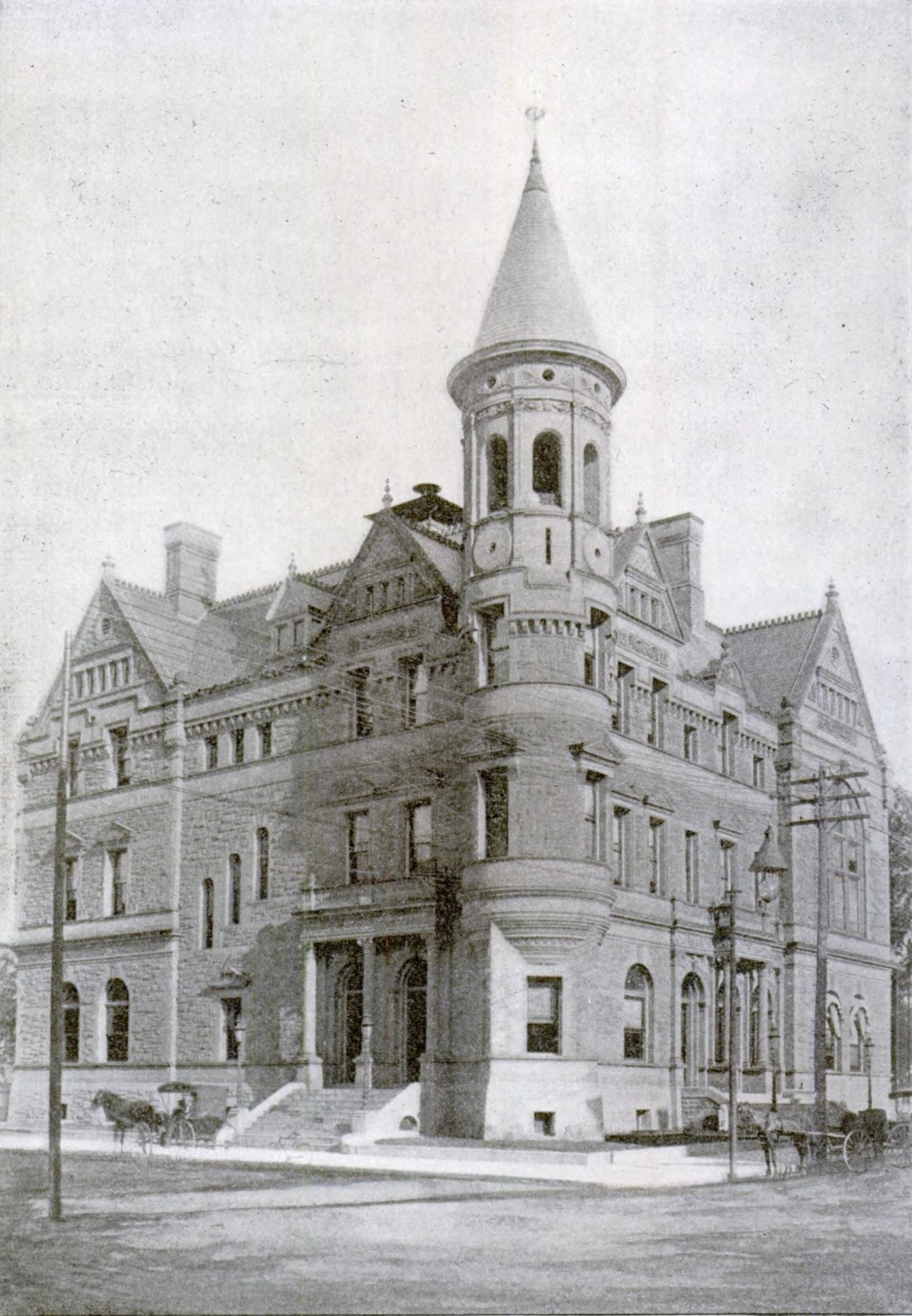
The county's first jail was a two-story building of hewn logs standing on the courthouse square, described in the county record as strongly built. It burned in the late 1840s — the historical marker account gives 1849; Griswold's 1917 history gives 1847 — and on April 7, 1849 the county commissioners ordered a replacement. The new jail, with a sheriff's residence attached, was completed in 1852 across Calhoun Street from the courthouse at a cost of $4,955.34. The county record notes escapes from it anyway. A larger jail followed in 1872. The line runs forward from there to the present Allen County Jail, opened in 1981 beside the courthouse, and the Criminal Justice Center dedicated in 2004 — but the nineteenth-century jail's grim distinction is that its yard was a place of execution.
Two men were hanged at Fort Wayne in the 1850s. Benjamin Madden and George Keefer confessed to the murder of John Dunbar, killed in a murder-robbery, and were hanged on May 3, 1855. The case is the county's first fully documented capital punishment, recorded in the History Center's journal and in the state's execution lists.
The last public execution in Allen County came a generation later. Sam McDonald, a woodcutter, murdered his friend Louis Laurent with an axe. He was tried at the Allen County Courthouse in May 1883, convicted, and his conviction was upheld by the Indiana Supreme Court. On October 9, 1883, he was hanged inside a walled enclosure in the jail yard, Sheriff William Schiefer tripping the lever himself. Admission was by ticket: some 250 ticket holders were let into the yard, and roughly 15,000 people viewed the gallows afterward. The hanging was botched — the fall did not break McDonald's neck, and he took seventeen minutes to die, as the News-Sentinel's later reconstruction recorded. The rope and the hatchet are held today by the History Center, which exhibits them as relics of the county's punitive past. No later execution was carried out in public in Allen County; Indiana's subsequent executions took place at the state prison at Michigan City, the last of them in this record being Franklin Click's in 1950, told below.
The vice geography · Calhoun Street and the saloon era
LATE 19TH CENTURY – 1918
For as long as Fort Wayne has had a downtown, its documented vice geography has centered on Calhoun Street and the blocks around the railroad stations. The News-Sentinel's decade history of the 1900s is blunt about it: the Calhoun Street area was home to Fort Wayne's red-light district, and gamblers and drinkers caroused at some forty saloons there. A scholarly study of the city in Indiana Magazine of History documents the same pattern — saloons and gambling dens clustered around the railroad stations, serving a traveling and working-class trade.
The scale of the legal liquor trade alone was enormous. In 1910, in a city of roughly 63,000 people, Fort Wayne counted 197 saloons; 39 of them stood on Calhoun Street alone. On top of the saloon trade sat the illegal and semi-tolerated layers: gambling rooms, and the segregated red-light district the city maintained and periodically disowned. Jesse Greene, editor of the Fort Wayne News and Sentinel, campaigned in print against the saloon and vice interests for years. By 1913 the segregated district had been ordered vacated, and Mayor William J. Hosey's re-election campaign that year openly favored re-establishing a segregated red-light district in the city — a position Greene attacked in the paper. The fight over whether Fort Wayne would tolerate a district, and where, ran through city politics for a decade.
It was ended not by the city but by the state. Indiana's legislature passed a statewide prohibition law in February 1917, and Indiana went dry on April 2, 1918 — nearly two years before national Prohibition. The saloons of Calhoun Street closed their legal trade, and the business of drink in Fort Wayne went underground, where it becomes the subject of the next entry.
Prohibition · the dry years, 1918–1933
BOOTLEGGING, ROADHOUSES, AND THE BOOZE ROOM
Fort Wayne sat on the natural routes of the illegal liquor trade: rail and road lines ran from Chicago and Detroit through the city toward the south, and the city's own two great breweries, Centlivre and Berghoff, were idled by the law into making near beer, soft drinks — Berghoff's was called Bergo — and ice. Neither could keep its workforce employed at it. The News-Sentinel's history of the era, "Dry and dangerous," reconstructs what replaced the saloons: stills operating in Fort Wayne basements and in Allen County farmhouses and barns; roadhouses set outside the city limits; speakeasies run behind legitimate fronts and out of back rooms. The trade's improvisation survives in small details the paper preserved — a Chicago bootlegger's car fitted with a false bottom welded at a local garage, and a police evidence room so full of confiscated liquor that officers nicknamed it "the Booze Room."
Enforcement came in waves, and the biggest documented wave broke in July 1931. On July 9, federal agents raided three Fort Wayne speakeasies and four roadhouses outside the city, jailing twenty-four people. Thirteen days later the era's violence crested. On July 22, 1931, bootlegger George Adams was the target of an undercover purchase and arrest attempt by federal agents; Adams opened fire, shooting three agents — two of them died, and one was seriously wounded. Adams was captured within hours.
The prosecution became a measure of how far public sympathy had swung against the dry law. Allen County Prosecutor Walter E. Helmke, elected in 1928 and a man who lived under death threats and police guard for his enforcement work, sought the death penalty. The jury instead convicted Adams of voluntary manslaughter — the News-Sentinel records that public sentiment ran so strongly against Prohibition that one prospective juror said Adams deserved a medal. Adams served about three years. National repeal came on December 5, 1933, and Centlivre and Berghoff resumed brewing; Fort Wayne's fourteen dry years, which had begun under Indiana's own law in 1918, were over.
The Broadway State Bank robbery · and the wrong "Machine Gun" Kelly
AUGUST 20, 1930
On August 20, 1930, the Broadway State Bank at Broadway and Taylor streets was robbed of $5,912. The city's newspapers called it Fort Wayne's first bank robbery, and the case is preserved in the Allen County Genealogical Society's timeline of the 1930s and in two careful newspaper reconstructions, the News-Sentinel's in 1990 and the Old Fort News's in 2015. The robber identified by witnesses was a Chicago gang member named George Kelly. He and his accomplices, William Naecker and Abe Shultz, were arrested in Chicago on September 4, 1930, brought back to Fort Wayne, and prosecuted by Walter E. Helmke — the same prosecutor then fighting the bootleggers. All were convicted, and Kelly drew fifteen years.
The case carries a correction that belongs in the record itself. The George Kelly of the Broadway robbery was not George "Machine Gun" Kelly, the famous outlaw. In August 1930 the famous Kelly was sitting in federal prison at Leavenworth on a bootlegging sentence, and he had not yet earned the "Machine Gun" nickname at all. The confusion crept into print anyway: Fort Wayne historian John Ankenbruck attributed the Broadway robbery to Machine Gun Kelly in his 1976 history of the city, and the error repeated for years before Ankenbruck himself corrected it in a later book. The robber was a Chicago gang member who happened to share the name — a documented case of a good story outrunning the record, set straight here as the sources set it straight.
Homer Van Meter · Fort Wayne's link to the Dillinger gang
1905–1934
Homer Virgil Van Meter is the city's one documented, first-rank connection to the great outlaw gangs of the 1930s: a Fort Wayne boy who became John Dillinger's associate in the gang the newspapers called the Terror Gang, and whose body came home to Lindenwood Cemetery when it ended. He was born in Fort Wayne on December 3, 1905 — some records, including the Allen County Genealogical Society's cemetery survey, give 1906 — to Cary B. Van Meter, a railroad conductor, and Julia Miller Van Meter. He ran away from home young and was living by petty crime while still in his teens.
His serious record begins with a train robbery. In March 1925 Van Meter was arrested, tried, and convicted of robbing passengers on a train at Crown Point, Indiana, and sentenced to ten to twenty-one years. He served the sentence first at the Indiana Reformatory at Pendleton and then at the state prison at Michigan City — where he met John Dillinger. In 1933, letters Van Meter wrote to two Fort Wayne relatives, expressing contrition and asking their help, supported his case for parole; the History Center holds the correspondence as part of the city's Dillinger-era record. He was paroled on May 19, 1933, and went almost directly from the prison gate to Dillinger's gang.
His work in the gang, as the History Center describes it, was identifying and scouting potential robbery targets; the genealogical society's account calls him the gang's getaway driver. Through the winter of 1933–34 he was part of the gang's run of bank robberies across the Midwest — Sioux Falls, South Dakota, on March 6, 1934, and Mason City, Iowa, among them — and of its raid on the police arsenal at Warsaw, Indiana, on April 13, 1934, when the gang armed itself out of a small-town police station. The gang's last robbery, of the Merchants National Bank in South Bend on June 30, 1934, left Patrolman Howard Wagner dead; later accounts attribute the fatal shooting to Van Meter, and he was grazed in the head in the fight. No one was ever arrested or tried for the South Bend robbery: the FBI's record names three participants — Nelson, Dillinger, and Van Meter — and all three were dead within five months, none of them ever in custody for it, so Van Meter was never charged with the killing. He did not outlive the summer. On August 23, 1934, St. Paul police shot and killed him in Minnesota; he was twenty-eight years old, and John Dillinger had been dead a month.
His body was returned to Fort Wayne through the Robert Klaehn & Sons funeral home and buried in Lindenwood Cemetery, Section 4, Block 4, Row 2, Space 10, where his grave is catalogued in the county's survey of infamous burials. His Fort Wayne kin told the South Bend Tribune, the day after his death, that the family had shunned him. The runaway came home only as a burial record — and as the city's standing reminder that its Dillinger connection is not a legend. It is a documented life, and it is this one.
Sources: FBI, published summary of the Nelson case (as worked in the South Bend bank-robberies record) — the Merchants National robbery's three named participants and its disposition: no arrest and no trial; conform packet in the South Bend Crime-2 pass (entry cr2-merchants-packet).
The gang's other Allen County threads
THE 1930S, AS FAR AS THE RECORD GOES
Beyond Van Meter himself, the documented Dillinger-era record in Allen County is thin, and this entry states it at exactly its documented size. The Huntertown State Bank, in the small Allen County town north of Fort Wayne, was robbed in the 1930s by men the local record identifies as Dillinger gang members; a bullet hole in the bank's original window glass survived for decades as the robbery physical relic, and in 2020 the Northwest News reported the glass section's preservation for a museum. The surviving local accounts do not pin the robbery to an exact date, and none is asserted here. Two other Fort Wayne men stand in the gang's standard modern history — Girardin, Helmer, and Mattix's "Dillinger: The Untold Story" (2004) shows three Fort Wayne men in its photographic record: Van Meter; Clifford "Whitey" Mohler (1903–1968), identified by the county genealogical society as an early Dillinger accomplice, buried in Prairie Grove Cemetery; and Samuel Goldstine (1890–1975), buried at Lindenwood, whose specific role the sources reached for this section do not document further. Claims beyond this — hideouts, visits, and robberies resting on retelling alone — are not in this record.
"Killer in the Rain" · the murders of 1944–45 and the three men accused
1944–1951 · THE CASE THAT DEFINED AN ERA
In the last years of the Second World War, Fort Wayne was a boomtown of war plants working three shifts, and for eighteen months it lived in fear of a murderer the newspapers never named and the city never forgot. The fullest account is the News-Sentinel's own reconstruction — Richard Battin's "Killer in the Rain," published February 5, 1994 — assembled from the two Fort Wayne dailies' wartime files after the police department's own case files were lost or destroyed. It is the source of what follows, and the victims are named first, as they should be.
Wilhelmina "Billie" Haaga, 38, a defense worker at Inca Manufacturing, was attacked on the night of February 2, 1944, near the Maumee River off South River Road. Beaten and choked, she walked a mile and a half to a farmhouse on Hartzell Road and lived long enough to reach St. Joseph Hospital, where she died on February 5. The coroner, Dr. Edgar Mendenhall, ruled the death a homicide — her skull crushed — and found no sexual assault; her ring and watch were untouched, and robbery was discounted. Anna Kuzeff, 20, who worked the night shift at the General Electric Supercharger plant, was killed on the night of May 22, 1944, walking Fillmore Street toward her bus; her body was found the next day in a field south of Taylor Street, strangled and beaten. Phyllis Conine, 17, a South Side High School junior, disappeared on August 4, 1944, on her way to meet a friend at a downtown theater, and was found two days later in a field in Aboite Township, strangled, her clothing scattered along the road from Yohne Road. The three killings put the city into what the papers called "fearful discord." Police Chief Jule Stumpf kept his department on twenty-four-hour emergency call, blamed the work on "a maniac," and on August 8, 1944 the City Council authorized a $15,000 reward for the killer's capture — an enormous sum, and a measure of the city's fright.
There was a fourth victim. Dorothea Howard, 36, recently arrived from Arizona with her soldier husband, was found in the early hours of March 6, 1945, in an alley behind the 600 block of South Calhoun Street, assaulted and left in the cinders; she spoke her name at St. Joseph's Hospital and died eleven days later, on March 17. And there was arguably a fifth: Pearl "Torchy" Lee, 26, found dead in her East Main Street apartment on February 7, 1945. The coroner's office ruled her death heart disease, possibly aggravated by fumigation gas. The ruling never satisfied one of the patrolmen on the scene, Lester Eisenhut. When Eisenhut became chief of police in 1948 he had Lee's body exhumed and examined by Harvard's Dr. Alan Moritz, who found no heart disease and reported she had possibly died of intracranial bleeding from blows to the head. The prosecutor nonetheless found insufficient evidence to proceed, and Lee's death was never officially joined to the others.
Three men were accused, in turn, and the record of each must be stated exactly. Ralph Woodrow Lobaugh walked into the Kokomo police station on June 9, 1947, and confessed to the Haaga, Kuzeff, and Howard murders. Indicted for all three, he pleaded guilty before Judge William Schannen on October 22, 1947, and was sentenced to die on February 9, 1948. He then recanted, as he had recanted before, and the case unraveled into years of stays — eleven of them — while his first wife's family swore he had been living and working with them in Churubusco, digging graves at the Eel River Cemetery, when the murders occurred. Governor Henry F. Schricker, commuting the sentence to life in 1949, called the case "one of the most sordid messes in the history of the state." A 1975 investigation under Governor Otis Bowen concluded Lobaugh was "guilty of little more than perjury"; Bowen granted clemency in August 1977. Lobaugh, unready for freedom, asked after two months to be sent back to prison, and the state obliged. He died in a South Bend nursing home on June 18, 1981, having spent some thirty years in prison for murders the state's own later judgment held he most likely did not commit.
Robert Christen, 36, the son of a Fort Wayne drugstore owner, was indicted for Dorothea Howard's murder in October 1948, on the identification of Charles Dillard Dodson, the soldier who had left the Main Street bar with Howard on her last night and who had first identified Lobaugh and then changed the identification to Christen; Dodson was indicted alongside him, and the charges against Dodson were dismissed in March 1949. Christen was arrested in Denver, extradited, and tried in Whitley County, where a jury convicted him of second-degree murder in April 1949 and he was sentenced to life. In January 1950 the Indiana Supreme Court overturned the conviction, holding that the evidence rested on "mere possibility" and "guess and conjecture," and on January 27, 1950 the charges were dismissed and Christen freed. A later newspaper story claimed he was executed in Arizona for a similar crime; Battin's check of the records found no record of any such imprisonment or execution, and the claim stands unproven.
The man the law finally held responsible arrived by accident. On August 17, 1949, Franklin Click, 30, of Taylor Street, attacked Leona Sparks, who had come with her husband to show their house to a prospective buyer; she survived, and wrote down his license plate as he drove away. Arrested that night, Click confessed on August 21 to the murders of Haaga, Kuzeff, and Conine — in a letter to his wife first, saying he wanted her to have the reward. He was convicted of the Sparks kidnapping and attempted rape and sentenced to life; the grand jury then indicted him for the three murders, and the state tried him for the Conine killing alone. A jury convicted him on November 30, 1949, Judge Schannen sentenced him to die, and after appeals failed, Franklin Click was executed in the electric chair at Michigan City on December 30, 1950. He had recanted his confessions by then, saying he had made them so his wife could claim the reward; the reward commission in December 1951 divided the $15,000 three ways — among Marie Click, Leona Sparks, and Floyd Moreland, an amateur investigator who testified he had traced Click through a laundry ticket found at the Haaga scene as early as 1944 and been told by city officials to drop it. The Haaga and Kuzeff murders were never tried against anyone after Click's conviction for Conine's killing, and the Howard case closed with Christen's release. Between a man executed, a man's conviction overturned, and a man imprisoned thirty years on confessions the state itself came to disbelieve, the "Killer in the Rain" years remain the most sobering chapter in the city's criminal record — a wartime panic, four women dead beyond argument and a fifth in dispute, and a justice system that took six years and three accused men to settle on an answer.
Jack Molinas and the Pistons gambling case · 1954
THE NBA'S FIRST GAMBLING BAN, IN FORT WAYNE
Fort Wayne's mid-century gambling history has one fully documented national case, and it belongs to its basketball team. Jack Molinas, a Columbia University All-American, was the Fort Wayne Pistons' first-round draft pick in 1953 and an immediate star at forward. He also bet on basketball. By his own later admission, detailed in SPORT magazine's April 1955 investigation, Molinas had bet on Pistons games while playing in them — always, he said, on Fort Wayne to win — and had won about $400. The bets ran through a bookmaking contact reached at a Bronx grocery store. When the pattern of telephone calls surfaced, owner Fred Zollner suspended his rookie in January 1954; the NBA banned Molinas for life, the first such ban in league history. A Bronx grand jury examined the matter and found no evidence of a crime, clearing him of criminal wrongdoing in the Fort Wayne betting itself. His playing career continued in the minor-league Eastern Professional Basketball League, but the record follows him one step further, because it closed the Fort Wayne chapter's meaning: in the great college point-shaving scandal that broke in 1961, investigators found Molinas at the center of the fixing operation, and he was convicted in 1963. What had looked in Fort Wayne like a rookie's small bets was, in the fuller record, the first visible end of one of the largest gambling conspiracies in American sports — prosecuted not in Indiana, but impossible to understand without its Fort Wayne beginning. Beyond this case, the sources reached for this section document no comparable Fort Wayne bookmaking or numbers prosecution in the mid-century decades, and none is invented here.
The drug era in the federal record · the 1980s–90s
WHAT THE DOCUMENTED RECORD SUPPORTS
The late twentieth century's defining criminal economy in Fort Wayne was the drug trade, and the honest documentary base for it is the federal record rather than any single famous trial. The National Drug Intelligence Center's Indiana Drug Threat Assessment, published in April 2001 from the reporting of the decade just closed, records the shape of it for Fort Wayne specifically. Crack cocaine was prevalent in the city by the late 1990s. The Fort Wayne Police Department seized 1,678 grams of cocaine in 1998 and 1,992 grams in 1999, a rise of some eighteen percent year over year. Of the powdered cocaine shipped into the Fort Wayne and South Bend areas, roughly eighty percent was converted into crack, according to the two cities' police reporting — conversion and distribution carried on, the Fort Wayne department reported, by Mexican criminal groups and by independent local gangs. Statewide, the assessment identified Mexican drug trafficking organizations as the primary transporters and wholesale distributors feeding Indiana's markets, Fort Wayne's among them. That is the documented structure at the century's end: an importing trade run from outside, a conversion and street trade run locally, and a city police department measuring the flow in seized kilograms. The individual federal prosecutions of the era are matters of court record in the Northern District of Indiana; no single Fort Wayne organization of the period stands in the federal releases and reputable journalism reached for this section the way the Prohibition and Dillinger-era figures stand in theirs, and this entry therefore keeps to what the record shows rather than decorating it.
So the historical record closes where the century does. The gallows in the jail yard in 1883 and the seized cocaine of 1999 are the two ends of one documented line: a county that began by hanging two men for a robbery-murder in 1855 built, across a hundred and fifty years, the whole modern apparatus of investigation, prosecution, and punishment whose current state — its police force, its crime statistics, its public-safety debates — is carried in the Current section of this history, where the twenty-first century's record belongs.
Crime · addendum — the vigilante era and the grave-robbery panic
Two chapters of Fort Wayne's nineteenth-century crime record stand apart from the cases in the main Crime section and are told here. The first is the vigilante era of the 1850s, when companies of "Regulators," organized under color of state law, broke a gang of horse thieves and counterfeiters operating across the northern counties — and hanged one of its members themselves. The second is the grave-robbery panic of the 1870s, when the new medical colleges' need for dissecting bodies emptied graves at Lindenwood and filled the city's newspapers with ghouls. The county's judicial hangings — Madden and Keefer in 1855 and Sam McDonald in 1883 — belong to the main section's first entry; the hangings in this addendum were extra-legal, done by citizens outside any court.
The Regulators · the vigilante companies and the hanging of Gregory McDougall
1856–1859 · THE BLACKLEG GANGS AND THE COMPANIES THAT BROKE THEM
The gangs came first. Through the 1840s and into the 1850s, the lake country of northeastern Indiana — Noble, LaGrange, Steuben and DeKalb counties, with Allen County at its southern edge — was worked by organized bands of horse thieves, burglars and counterfeiters whom the region called blacklegs. The 1882 history of LaGrange and Noble counties traces the escalation: the Potawatomi complained of stolen ponies, then settlers of stolen horses, and then came house-breaking, house-burning, robbery, and counterfeit money passing through two counties and half of southern Michigan. The Tamarack, a trading house in Johnson Township, had become a noted resort for the gang, with hiding places in the swamps; Perry Randolph's house was, in the words of a confession printed by the movement's own historian, "a rendezvous and trading point in all the commodities of criminal commerce, for the whole fraternity of felons and counterfeiters, east, west, north and south." Stolen horses were run to market in every direction, Fort Wayne included: one confession tells of a horse sold in this city to Bill Vanalstine, keeper of a livery stable, for a gold watch valued at $75 and $55 in money. Griswold records former state senator George V. Kell's account of a stable belonging to the thieves in a great wood about a half-mile southeast of the railroad station at Huntertown, in Allen County itself. By the early 1840s, the county history says, the belief had become general that the ordinary processes of law were unequal to the band.
The answer was a statute, and the statute must be stated exactly, because Griswold misstates it. Griswold writes that the legislature of 1856 responded by empowering the Regulators "to capture criminals, give them a fair trial, and, if advisable, to inflict the punishment of death." The act on the books — approved March 9, 1852, "An Act to authorize the formation of companies for the detention and apprehension of Horse Thieves and other felons" — did no such thing. It allowed not fewer than ten nor more than one hundred citizens to form a company, file its articles and membership with the county, and, when engaged in arresting offenders, claim the rights and privileges of constables in the pursuit of felons and the reclaiming of stolen property. The 1882 county history draws the line in so many words: "The law gave them no right to try, convict or execute criminals. The authority conferred was confined to the detection and arrest of law-breakers." For four years nobody used the act. The first company in the region, the LaGrange County Rangers, organized at the Bullock schoolhouse in Milford Township in September 1856. Within three years there were thirty-seven companies in northern Indiana — six in LaGrange County and nine in Noble.
In January 1858 the companies moved together. Meeting at Wright's Corners in LaGrange County, they adopted resolutions naming the tavern there a rendezvous of "these infernal banditti" and pledged themselves, over one hundred and thirty signatures, to take the thieves "wherever they may be found" and to "deal with them in such a manner as to us may seem just and efficient." On January 16 the Regulator companies of Noble and LaGrange marched in double file through Kendallville at an Old Settlers' meeting, past, as the county history notes, many of the very men they were hunting. The next day, January 17, James McConnel with a posse of fifteen men of the Noble County Invincibles arrested nine men in and about Rome City and carried them to Ligonier; five more prisoners followed. There the examinations produced confessions — a "very fashionable performance about that time," the 1882 history says dryly, and its footnote explains the fashion: prominent Ligonier Regulators who took part informed the writer that several of the criminals refused to confess until they were threatened with lynching, that ropes were brought in and placed around necks, and that one man was actually suspended by the neck for a few minutes, after which his confession was given without further ceremony.
One of the nine was Gregory McDougall — the period accounts spell him McDougal and McDougle — a young Canadian. His confession, printed in M. H. Mott's History of the Regulators of Northern Indiana in 1859, admitted thirty-four horses taken in under a year, two jails broken, four stores, two tanneries and two peddlers robbed, and a great deal of counterfeit money passed; no account has ever disputed that record. The capital charge against him rested on one witness. A deputy United States marshal from Michigan named Halstead testified under oath that a reward stood for McDougall in Canada, where he was charged with robbery, with breaking jail at Chatham, and with murder — that he had killed a jailer's wife to free his brother from confinement. On the night of January 25, a committee of five appointed by the Noble County Invincibles examined the testimony and reported its recommendation: "that the said McDougle be hung by the neck until dead, on Tuesday, the 26th of January, 1858, at 2 o'clock P. M." His wife reached Ligonier at seven the next morning with their child, learned from her husband that he was to hang that afternoon, and went on her knees before the Regulators asking them to wait until somebody could go to Canada and establish whether he had killed anyone. The county history gives the answer in four words: "Her prayers were unheeded." He was driven to a place near Diamond Lake in a wagon carrying his coffin, a large crowd following; a rope was thrown over the limb of a tree and a plank run from the top of the wagon to a prop. Given five minutes to speak, he denied the murder, admitted the thefts, warned young men against his road, and said the Regulators were right to break up the gang. Then the prop was knocked out. Griswold, quoting the Fort Wayne Sentinel of January 30, 1858, preserves his own city's paper's account of the scene: the proceedings "are all conducted with order and decorum"; "McDougal was escorted by a procession of 1,000 armed, mounted men"; and the condemned man "expressed an earnest wish for the success of the present movement against the banditti." Griswold adds that McDougall's widow and children remained long as residents of Noble County, supplied with the necessities of life from mysterious sources — probably, he thought, by the Regulators themselves, whose organization, he wrote, "was based on principles of justice."
The murders for which Gregory McDougall hanged never happened. The same county history that tells the story, four pages after its account of the hanging, says it outright: "It was afterward ascertained, beyond doubt, that the persons alleged to have been murdered by McDougal were yet living in Canada." Halstead, the marshal who had sworn to the killings, came back to Ligonier some time afterward and left the town in a hurry, in fear of being lynched himself. The history further judges that the committee was probably not satisfied McDougall had murdered anyone, and recommended hanging him on general principles — because by his own confession he was an infamous villain, and perhaps because his death would frighten the rest. There was very nearly a second hanging: another man, a resident of the county, was voted to the rope, the proposition reconsidered and lost by a small majority; he served two years in the penitentiary instead. McDougall's death must be kept distinct from the scaffold cases in the main Crime section. He was tried by no court and executed by no sheriff; he was hanged by a committee of his captors in Noble County in 1858, a quarter-century before Allen County's last judicial execution — that of Sam McDonald, a different man with a similar name, hanged by law in the Fort Wayne jail yard in 1883.
Fort Wayne raised companies of its own. Griswold names the city's company — the Kekionga Guards, formed in 1858 — and prints its roll of fifty-two men, a roll of the city's first rank: Hugh McCulloch, Jesse L. Williams, Franklin P. Randall, Samuel S. Morss and Samuel E. Morss, Pliny Hoagland, Francis D. Lasselle, Samuel Edsall, Dr. B. S. Woodworth, Dr. Isaac Knapp, and their peers. The other Allen County organizations he lists are the Perry Rangers (his chapter heading calls them the Perry Regulators), the Lafayette Rangers, the New Haven Vigilants, the Adams Township Rangers, the St. Joe Detectives and the Springfield Detectives. By Griswold's account the Fort Wayne Regulators attended McDougall's execution; the city's Sentinel in any case covered the movement week by week — "Great Excitement in Noble County" on January 23, 1858, "The Vigilance Committee in Noble County — Man Hung!" on January 30, and "The Noble County Regulators" on February 6. No hanging by an Allen County company appears in the accounts reached for this entry; the county's companies organized just as the Noble and LaGrange men were finishing the work.
The movement ended in the courts it had bypassed. The gang's surviving leaders — William Latta, William Hill and George Ulmer — had fled; the Regulators employed a Chicago detective, C. P. Bradley, at $500 a head to run down Ulmer and Perry Randolph, who were taken in Kentucky, delivered to the LaGrange County sheriff in July 1858, and indicted at the October term. The Noble County Invincibles' final report counted the breakup and prosecution of more than one hundred gang members through the regular courts, and the companies disbanded; the Fort Wayne Sentinel of February 1859 recorded that the Noble and LaGrange Regulators, "having performed their task and rid themselves entirely of the gang who have so long infested their neighborhood, have peaceably abandoned" their organization. No prosecution of the men who hanged McDougall appears in the surviving accounts. What lingered was the feeling: Andrew Ellison, the LaGrange lawyer who defended the indicted thieves against the whole community and got most of them acquitted or released, was remembered for it for years, and the 1882 history closes the subject by observing that "the bitterness engendered during these exciting times lasted many years and marred the happiness of many." In LaGrange County several Regulator organizations were still in existence when that history was written in 1882, still helping to make an arrest now and then — but the work, it said, had since been left almost entirely to the regular judicial officers.
The trial of Big Leg · 1830
1830 · ONE OF THE FIRST TRIALS OF A MYAAMIA MAN IN AN AMERICAN COURT
The man Griswold calls "an Indian chief known as Now-ee-ling-qua, or Big Leg" has a fuller record in his own people's keeping. The Myaamia Project — the Miami Tribe of Oklahoma's history and language program — writes his name Neewilenkwanka and reconstructs his life: born about 1800, he was of Waapeehsipana's (White Raccoon's) band, whose village stood on the Aboite River near present Columbia City, and he became an akima, a chief, of his own village nearby. In 1830 and 1831 he represented twenty Myaamia people, most likely the inhabitants of his village, in the annuity collections; in the treaties of 1834 and 1838 he received two reserves along the Aboite, across the river from White Raccoon's village, between Huntington and Fort Wayne. He married Kiišikohkwa (Nancy), a granddaughter of Little Turtle.
Griswold tells the killing this way: in 1830 Big Leg was charged "with the murder of Wish-mah, his slave, a woman half Indian and half negro" — the woman's name survives only in Griswold — who "had disobeyed her master while intoxicated," and whom he stabbed to death in a cabin near the corner of Barr and Columbia streets. The Myaamia Project's account, built from the newspaper reports of the time and from a letter of the trader William Ewing to John Tipton, agrees on the woman's identity — a Myaamia woman of Big Leg's own village who, Ewing wrote, also had African ancestry and whom Big Leg claimed as his slave — and differs on the act's occasion: according to the newspapers, she had stolen from him and fled to Fort Wayne, where he killed her. The Project adds the caution that how much of the claim that she was his slave was Big Leg's own thought, and how much was shaped by American ideas of race at the time, cannot now be known.
On the trial itself the two accounts agree in shape, and Griswold supplies the courtroom. The case was heard at Fort Wayne before Judges Test, Hood and Thompson, Griswold names the bench; John B. Bourie and Chief Richardville acted as interpreters — the Project gives their Myaamia names, Soowilencihsia and Pinšiwa. Two of the jurymen, Jean Baptiste Godfroy and Henry Ossem, were of Indian blood. A party of the chief's friends, Griswold says, sought to substitute a worthless member of the tribe in the condemned man's place. Big Leg was convicted. In the log jail on the courthouse square, told that he might suffer the death penalty by hanging, he asked — in Griswold's telling — for a rope, hanged his dog with it to witness its death struggles, and, having seen them, pleaded to be shot; the Project's shorter version has the same core, that he did not know what a hanging was and, after being shown a dog, decided he would rather be shot. Mrs. Lucien P. Ferry remembered the prisoner for Griswold across seventy years: a girl of seventeen, she carried his food to the log jail, and he would reach through the bars of the window with his tin cup for her to pour his coffee. The jury recommended the convicted man to mercy, and the governor of Indiana granted him a pardon — the Project credits the interpreters' work on his behalf — and Big Leg went free.
He lived another twenty-eight years, and they were not quiet ones. In 1846 Big Leg and his family were among the Myaamia gathered at Peru and put on canal boats in the forced removal to the new reservation in Kansas — Mrs. Ferry, watching the Fort Wayne end of that removal, remembered the older people bound by the hands with ropes. In Kansas, after Principal Chief Francis Lafontaine's sudden death months after the removal and the death of his elected successor Oonseentia about 1848, the community chose Neewilenkwanka as akima; in 1853 he led the tribe's council in its negotiations with the federal government, and he died in 1858, his Kansas allotment passing after his death to his wife and his son Awansaapia. The trial that opens his story in Fort Wayne's record rests on two traditions — Griswold's Fort Wayne memory, with a named eyewitness, and the Myaamia community's own scholarship, working from the contemporary press and the Ewing letter — which agree on the arrest, the conviction, the death sentence, the dog, the interpreters and the pardon, and differ on the killing's motive. No page of the 1830 court record was reached for this entry, and the account is written at exactly that depth.
The grave-robbery panic · the resurrection years
1873–1883 · THE MEDICAL COLLEGES AND THE EMPTIED GRAVES
When Fort Wayne's rival medical colleges opened in 1876 — their founding, their schism and their eventual passage into Purdue and Indiana University are the Schools section's subject — their teaching rested on dissection, and dissection required bodies that Indiana law gave the schools almost no lawful way to obtain. The market answered. In December 1873 the Fort Wayne Journal Gazette reported that circulars had reached the city's physicians from medical colleges offering "LIBERAL PRICES FOR GOOD SUBJECTS," and the men who dug for that market carried the era's names in the papers: ghouls, resurrectionists, tomb tappers.
The panic predates the college by three years, and it begins at Lindenwood. "Dr." Weisse, a man who had died recently in the city calaboose, was buried in Lindenwood Cemetery; the Gazette's report of December 4, 1873, that the cemeteries were being rifled caused, its follow-up said, "quite a sensation among our citizens at large, and especially among members of the medical fraternity." The sexton, Mr. Doewell, opened the grave: the body was not there, and the coffin had been broken up by the ghouls. The paper learned that at the post-mortem examination on Weisse's body, two physicians had asked Coroner Webb how much he would take for a "lift of the body," and Webb had declined. The Gazette noted that the grand jury had the matter before it, and that the officers of Lindenwood — its president was I. D. G. Nelson, the same Nelson who three years later, as grand jury foreman, would condemn the medical college's dissecting room — were "determined to protect their cemetery from the raids of these ghouls." In January 1875 the Fort Wayne News and Sentinel carried the sequel of a body-snatching affair at Van Wert, Ohio, reporting an arrest in which the name of Dr. Myers figured; Dr. W. H. Myers was among the founders, the next year, of the Fort Wayne College of Medicine.
A later history of Fort Wayne medicine, published in the Indiana Historical Society's collections, describes how the supply worked once the college stood. It was common practice, the history says, for physicians to notify the pharmacist located in the medical school building when a suitable, recently deceased body was to be buried; the pharmacist would then notify the resurrectionist. Bodies were often passed around among the medical colleges of Indiana and sent on to schools in Cincinnati, Chicago and Michigan, to distract public attention from the desecration of any one burial site, and the Medical College of Fort Wayne was, in the history's phrase, "an ideal place for secretly receiving bodies" from the grave robbers.
The law's first answer was a grand jury. The Allen County grand jury of 1876, with I. D. G. Nelson as foreman, condemned the dissecting room of the college in the words Griswold preserves: it was "used for the purpose of depositing, concealing and dissecting human bodies, a portion of which, at least, are stolen from cemeteries or graveyards in this vicinity, in violation of law, common decency and the proprieties of life," and the alleged practice "has produced and is producing great excitement, anxiety and indignation, especially among those who have families or have recently lost friends." In February 1877 the Journal Gazette reported three Fort Wayne physicians caught up in the robbing of a grave at Huntington. The same year, a young woman's body removed from Lindenwood was recognized on a dissecting table by a relative who happened to be enrolled in one of the medical dissection classes. And in November 1877 the robbers took from Lindenwood the body of Charles Wright, one of the city's prominent citizens; the Journal Gazette of November 26 reported his exhumation, and the cemetery association offered a reward of $1,000 for the conviction of the offenders — the reward Griswold records.
Griswold writes that the investigation of the cases was "replete with sensational features" and that it resulted in the arrest of six physicians and one student. The Fort Wayne press file gives the December act of the drama in its own headlines. On December 28, 1877, the Daily News reported the examination at length: Charles Felts, who had driven the wagon, testified as a witness, and Drs. Van Buskirk and Sommers stood accused; the Journal Gazette's headline the next day read "'Cad' Catchers Caught." Dr. A. E. Van Buskirk had stood on the College of Medicine's first faculty list in 1876. The medical history completes one version of the proceeding: the medical school was raided and seven culprits arrested, and the trial was removed to Huntington County, where sentiment ran so hostile that the defendants required the sheriff's protection from the citizenry, were denied lodgings, and were forced to spend the night sitting up in the local railroad station. The accused were found guilty and fined four hundred dollars; the history adds that there is no record the fines were ever paid. A documented family history of Dr. Van Buskirk, written by his descendant E. Michael Van Buskirk, carries the doctor's own passage through the courts differently — indicted with his students, acquitted, retried and acquitted again, and convicted only when a second body went missing — and the two accounts stand side by side in the sources, as they are left standing here.
The college's defense, as Griswold preserves it, was that it had been framed. When the body of a Roanoke man was found within the college walls, a prominent member of the faculty declared that he believed professional grave robbers in the employ of the enemies of the institution had placed the body there "with a view to bringing our college into disrepute" — and added, in the same breath, that within a brief period thirty graves had been robbed. The newspapers kept the Roanoke case alive for two years: in November 1878 the Daily News reported Sheriff Kintz of Huntington County holding warrants for two men in the matter, and in June 1879 the News and Sentinel reported the Roanoke body snatcher brought to grief, the corpse — of a man its headline names as Father Payton — found at the Fort Wayne Medical College.
The city's answer, in the streets, was watchfulness. In September 1878 the Daily News reported police watching the fresh grave of Dennis O'Connor, body snatchers being at work; that July the News and Sentinel had noted a patented grave guard — "Peltier's Patent" — as the festive body snatcher's checkmate at last; in December 1878 a couple of snatchers were routed out of a cemetery and fled for their lives; and in October 1879 the Weekly Sentinel named the watchers posted at Lindenwood, William Henderson and T. S. White. The reports thin after 1879 but do not stop. In February 1883 the Journal Gazette reported a body stolen at Decatur — a man named Allen, killed by a train — being searched for at the Fort Wayne medical college. And in November 1902, when the Indianapolis grave-robbing syndicate of Rufus Cantrell was exposed, the Fort Wayne News and Sentinel reported under the headline "Ghouls Were Here" that Fort Wayne graves, Lindenwood's among them, had been robbed for the Indianapolis schools.
The law's answer came in pieces, and only in brief here. Indiana's criminal code made the whole trade a ladder of felonies — the sections as the Indianapolis News printed them in 1902 punished opening a grave or taking a corpse with three to ten years in the state prison, aiding the concealment of a body taken for dissection with one to three years, and buying a body known to have been stolen as an accessory's crime. In 1879 the state opened a lawful channel beside the felony law: an anatomy act permitting the use, for medical teaching, of bodies left unclaimed for twenty-four hours after death in public institutions — the prisons, county asylums, infirmaries and public hospitals — a legal supply whose burden fell, by design, on those who died in public custody with no one to claim them. And in 1903, after the Cantrell scandal broke in Indianapolis, the General Assembly created the State Anatomical Board to oversee the distribution of cadavers to the medical schools. Fort Wayne's panic thus ended the way it had begun — not with a single verdict in a Fort Wayne courtroom, but with the slow replacement of the resurrectionist by the state.