The exact page text, read by your browser's voice.

The Underground Railroad & the Antebellum City · freedom seekers, the exclusion vote, and the politics of 1860–1864
Fort Wayne stood on the road north. Fugitives from Kentucky slavery crossed the Ohio, climbed Indiana's eastern tier of Quaker settlements, and passed through this city on their way to Toledo, to Adrian and Detroit, and across the river into Canada — while the law of the United States, and after 1851 the constitution of Indiana itself, was arranged to stop them. This section holds that record whole: the one fully told passage through the streets in 1829, the routes and the single abolitionist house that still stands, the legal machinery the work ran against, the vote by which Allen County chose exclusion, the colonization answer Fort Wayne's Black residents gave in 1849, the abolitionist newspaper that was egged for its trouble, and the city's politics from Stephen A. Douglas's great 1860 ovation to the Sons of Liberty resolutions of 1864. Sources are named in each entry. Where a fact rests on a single account — above all on B. J. Griswold's Pictorial History of Fort Wayne (1917), whose chapters on these years remain the fullest local telling — the entry says so plainly, and where later scholarship (the History Center's and ARCH's researchers, the Indiana Magazine of History) confirms or bounds him, that is said too.
The flight of the fugitive slaves · October 1829
1829 · THE HOOVER MANUSCRIPT
The earliest fully narrated passage of freedom seekers through Fort Wayne comes down in a single document: a manuscript written in the biblical cadence of the Society of Friends by Frederick Hoover, a Quaker of the Richmond settlement in Wayne County, Indiana, dated 1829 and preserved, in Griswold's day, by Hoover's great-granddaughter, Mrs. Charles A. Dunkelberg. Griswold printed its substance in his chapter on the years 1829–1831, and his telling — the only one that exists — is this. Enslaved people in Kentucky "lifted up their eyes toward the land of Indiana"; they crossed the Ohio and came up through the country toward Brookville in Franklin County and settled, for a time, in Indiana. Slave hunters followed. The hunters seized Saby, the wife of Isom, and carried her off; local men pursued and "delivered Saby." Twice more the rescuers intervened, freeing two other fugitives the manuscript names as George and Jacob. The rescued people then resolved to tarry no longer in a land where they could be "spoiled of their possessions," and made ready to flee "even unto the land of Canada."
Under the protection of their Quaker deliverers the party traveled north across the Wabash country and the Mississinewa — the manuscript pauses to complain of "the bitterness of the waters of the brook Mississinnewa" — and so to the St. Marys and the neighborhood of Fort Wayne. There, fearing the town might hold "men of belial" who would "evil entreat them," the party halted while the Friends conferred with "the chief men of the city" and struck a bargain in the manuscript's scriptural language: the procession might pass through if the strangers "would not turn to the right hand nor to the left hand," and would pay in silver for anything they took. On 10 October 1829 the company — Griswold calls it "a strange and motley company of negroes and whites," the "passengers" and "conductors" of an "underground railroad," and judges it probably the first procession of its kind in this part of the Middle West — passed through the streets of the newly incorporated village, then encamped on the Maumee, where, the manuscript says, the people "sang songs of praises to the Lord for his mercies in delivering them from their enemies."
The journey's remainder the manuscript tells in its incidents: a quarrel between Sarah, the wife of James, and Nancy, the wife of Robert, "concerning their stuff," composed by Robert, whose surname the narrative gives as Hopkins; a river crossing where Thomas, helping Saby and her daughter Nancy over the water and the mire, fell in with them and all were drawn out together; and the approach to Detroit by way of Defiance, Ohio, and Monroe, Michigan. On the outskirts of Detroit the leaders prepared the party to pass through the city in daylight respectability — "ye must shave off your beards and purify yourselves with water; ye must also put on goodly raiment" — and the crossing into Canada was made, in the manuscript's closing words, with great rejoicing, after which the Friends "imparted good counsel," bade the fugitives farewell, and returned to Richmond. Griswold illustrated his volume with a map of the rescuers' route and a facsimile of the manuscript's first page. A plate elsewhere in the volume quotes Judge Robert S. Taylor of Fort Wayne on the Ohio end of the same world: at Salem, Ohio, his grandfather William Taylor's house was a station, and Taylor's uncles worked at night conveying fugitives by wagon to Robert Stewart's farm some twenty miles north — the household machinery of the road, described by a man whose parents met in it.
The corroboration position, stated plainly: the 1829 Fort Wayne passage rests on the Hoover manuscript as Griswold prints it. No contemporary newspaper or court record of the procession has been found — the village had no newspaper of its own in 1829 — and the manuscript's own later whereabouts are untraced in the sources consulted. Modern scholarship treats the account as the founding document of the local story: Peggy Seigel's study of Fort Wayne's abolitionist newspaper in the Indiana Magazine of History (2001) cites it, through Griswold, as "Hoover's account of escorting a group of fugitive slaves through Fort Wayne to Detroit and into Canada in 1829," and the route it describes — north through Fort Wayne to the Maumee crossing and Detroit — is the route the independent route literature independently draws.
Sources: B. J. Griswold, The Pictorial History of Fort Wayne, Indiana, Vol. I (1917), Ch. XXIV, pp. 290–292 and the "Route of the 'Underground Railroad'" plate (read first-hand, archive.org item pictorialhistory00gris); Peggy Seigel, "The Fort Wayne Standard: A Reform Newspaper in the 1850s Storm," Indiana Magazine of History XCVII (September 2001), n. 19.
The road through Fort Wayne · the routes
THE LINES, 1820s–1865
Fort Wayne was a junction, not a terminus. The Indiana Historical Bureau's account of the state's Underground Railroad lines, drawn from Wilbur H. Siebert's foundational research, describes an eastern splinter line running from the Wayne County settlements "through Winchester, Marion, and Bluffton to Fort Wayne, then to Toledo, Ohio, and on to Canada," with a parallel Wabash line through Huntington and Logansport. The Levi Coffin station at Newport (now Fountain City) fed three northbound routes, one of them — in the Coffin circle's own summary — "to Fort Wayne, to Adrian, Michigan and then to Canada," run so that conductors could shift fugitives from one line to another to confuse the hunters. Coffin's Reminiscences preserve the forwarding practice in a single quoted direction (p. 455): "Please receive and forward the same to George D. Baptist, Detroit, Michigan, by way of Camden and Fort Wayne; I consider that to be the safest route." ARCH's executive director Connie Haas Zuber, summarizing the surviving correspondence for WANE-TV in October 2023, put the same point in Coffin's name: letters survive in which Coffin recommends that travelers be sent through Fort Wayne because he believed it the safest route.
The county's scholarly baseline is Angela M. Quinn's The Underground Railroad and the Antislavery Movement in Fort Wayne and Allen County, Indiana (ARCH, Inc., 2001), a 182-page documented study prepared for the National Park Service's Network to Freedom work, against which later site claims in the county are measured. The geography explains the route: Fort Wayne sat at the head of the Maumee, on the shortest overland line between the Ohio River settlements and the Detroit River crossings, with the Wabash & Erie Canal's corridor (the canal reached Fort Wayne in 1835 and Toledo in 1843) and the Maumee itself for company. Corridors are geography, however, not proof of use for any particular structure: the Allen County Genealogical Society's compiled county record states the standing plainly — one house in the county is confirmed.
Sources: Indiana Historical Bureau, "The Underground Railroad" (in.gov), route structure after Wilbur H. Siebert, The Underground Railroad: From Slavery to Freedom (1898); Levi Coffin, Reminiscences (1876), p. 455; Allen County Genealogical Society of Indiana, "U Named Places in Allen County" and "Underground Railroad" compilations (acgsi.org), citing Quinn (2001) and WANE-TV (23 October 2023).
The one standing house · Alexander T. Rankin and 818 South Lafayette
1838–1844 · THE DOCUMENTED STATION
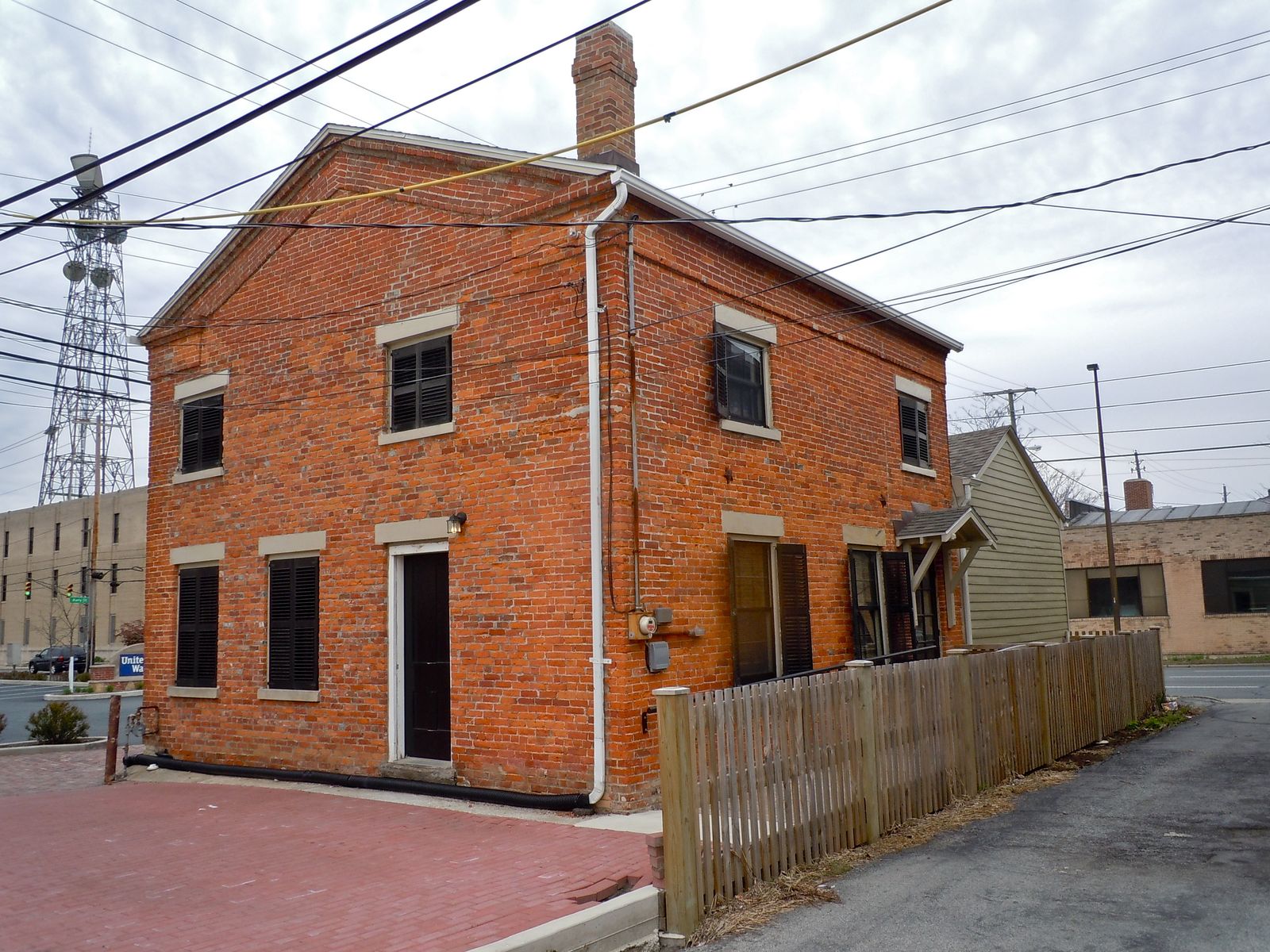
The one Fort Wayne building whose abolitionist connection is documented to the National Park Service's standard is the house built about 1841–1844 at 818 South Lafayette Street by the Reverend Alexander Taylor Rankin (born 4 December 1803, Dandridge, Tennessee), pastor of Fort Wayne's First Presbyterian Church. Rankin came out of the movement's Ohio heartland: he was the younger brother of the Reverend John Rankin of Ripley, Ohio, among the earliest and most active conductors on the Ohio River, and one of the seven students John Rankin trained for the Presbyterian ministry in his own house. In September 1838 Alexander T. Rankin was one of the organizers of the Indiana Antislavery Society; the National Register nomination for his house records that he is the only recorded individual who participated in the organization of antislavery societies in both Ohio and Indiana, that he organized abolition organizations in southern Ohio and northern Indiana alike, and that he "has been identified as an Underground Railroad participant." He served the Fort Wayne congregation into the early 1840s (the News-Sentinel's church history dates his departure to 1843) and afterward ministered in abolitionist New York communities, Mendon in Monroe County and Black Rock near Buffalo.
The house — a modest Greek Revival brick residence — was certified to the National Register of Historic Places on 26 October 2004, under Criterion B for Rankin's person, as "the only standing structure in Fort Wayne that is known to be connected to abolition or Underground Railroad activities." It is today the home of ARCH, the city's architecture and heritage organization, which is also the custodian of Quinn's county study. Local retellings attach the road to other addresses — the county genealogical society's compilations pass some of them along — but none carries documentation of this order, and this record asserts no other station location in the city. What the Rankin house documents beyond dispute is the organized thing itself: by 1838 Fort Wayne had an abolitionist minister of national movement standing, planted in a pulpit three blocks from the canal, in a town whose voters five years later would choose exclusion by seven to one.
Sources: National Register of Historic Places nomination, "Rankin, Alexander Taylor, House" (certified 26 October 2004; NPS, npgallery.nps.gov); Allen County Genealogical Society of Indiana, "R Named Places in Allen County" (acgsi.org); News-Sentinel, "Cityscapes" (15 November 1993), on the First Presbyterian pastorate.
The law it ran against · fugitive-slave machinery and Indiana's Black Laws
1793–1866 · THE LEGAL FRAME
The work described above was federal crime. The Fugitive Slave Act of 1793 and, far more harshly, the Fugitive Slave Act of 1850 (18 September 1850) put rendition in the hands of federal commissioners: a claimant's sworn affidavit sufficed, the accused could not testify, there was no jury, and aiding a fugitive exposed the helper to a $1,000 fine, six months' imprisonment, and $1,000 in civil damages for each person aided. Indiana added a state apparatus of its own. From 1831, any Black person coming into Indiana had to register with the county clerk and post a $500 bond for good behavior and against becoming a public charge. The constitution of 1851 made settlement itself unconstitutional (the vote is told below), and the enforcing act of 1852 required registration of those already in the state, voided contracts made with newcomers, and fined anyone who employed or "encouraged" a Black newcomer to remain — fines of $10 to $500 under the constitution's own text, collected into a fund to pay for colonizing the Black residents already here. Griswold prints the machinery working in Fort Wayne: in 1855 County Clerk Joseph Sinclear published notice "to all negroes and mulattos" that those resident before 1 November 1851 were required to register, and that those who had come after that date were subject to the fines.
No case of a fugitive actually seized and rendered out of Allen County appears in the scholarship consulted — not in Seigel's study of the local abolitionist press, not in the county compilations, and not in Griswold, whose anti-slavery material is celebratory rather than judicial. That absence is stated here as exactly what it is: an absence in the sources reached, not proof that no seizure was ever attempted. The cases that taught Fort Wayne what the law meant were the ones its abolitionist newspaper followed at Indianapolis. In 1853 John Freeman, a Black Indianapolis resident of nine years' standing, was tried under the 1850 Act; the claimant could not prove ownership and the case collapsed, but Freeman had spent more than sixty days in jail and faced some fifteen hundred dollars of expense besides his lawyers' fees. In December 1854 came the trial of Benjamin B. Waterhouse of LaGrange County — Indiana's first test of the 1850 Act's penalty provisions — accused of carrying two men who had escaped a Lexington, Kentucky, owner in 1843 onward to relatives at Kinderhook, Michigan, in August 1853; federal officers had traveled at public expense to Windsor, Ontario, to have the men identified. Defended by George W. Julian and E. H. Brackett, Waterhouse was convicted — and fined $50 and imprisoned for one hour, a verdict the Standard celebrated as a mockery of the statute. The same spring, the paper reported, seven or eight indictments against Steuben County abolitionists in Judge Elisha Mills Huntington's federal district court had been dropped for want of evidence. Fort Wayne's own bar held movement experience: attorney Charles Case, who settled in the city in 1850, had already won a fugitive-slave case and edited a Free Soil newspaper before his arrival, and he argued the Standard's constitutional case against slavery in its columns.
Sources: Peggy Seigel, "The Fort Wayne Standard," IMH XCVII (2001), pp. 171–183 and notes (drawing on Charles H. Money, "The Fugitive Slave Law of 1850 in Indiana," IMH XVII (1921), and Emma Lou Thornbrough, "Indiana and Fugitive Slave Legislation," IMH L (1954)); B. J. Griswold, Pictorial History, Vol. I, p. 414 (the Sinclear notice); Indiana Historical Bureau, "The 1851 Indiana Constitution" (the 1831 bond law and Article XIII's machinery).
1851 · the exclusion vote
4 AUGUST 1851 · ARTICLE XIII
On 4 August 1851 Indiana's voters decided two questions: whether to adopt the new state constitution, and — submitted separately, so that no man's vote for the constitution need be read as his vote on this — whether to write into it Article XIII: "No negro or mulatto shall come into or settle in the State, after the adoption of this Constitution." Contracts with newcomers were void; employing or encouraging one was finable up to $500; the fines were earmarked "for the colonization of such Negroes and Mulattoes … as may be in the State at the adoption of this Constitution, and may be willing to emigrate." The state answered overwhelmingly. The Indiana Historical Bureau's figures give the constitution itself 113,230 for and 27,638 against, and exclusion 113,828 for and 21,873 against — the exclusion article outpolled the constitution that carried it. Only four counties in Indiana rejected it: Randolph, Elkhart, LaGrange, and Steuben, the Quaker and Yankee tier. Allen County was not among them. Griswold, in the immigration chapter of his history, prints the county's return in one flat sentence: "Allen county's vote stood 1,803 in support of exclusion, with only 261 in favor of allowing the blacks to come in," adding that those already resident could remain "under certain conditions" — registration, as Clerk Sinclear's notice would spell out. The county's figure rests on Griswold's report; no independent county-level tally was reached, and it is carried here as his number, consistent in pattern with the constitution vote he prints beside it (Allen County for the constitution, 1,775 to 260) and with the statewide result. The county's delegates to the convention that framed the article were Allen Hamilton and Judge James W. Borden.
The community the article fell on was small and established. Charles R. Poinsatte's count from the 1850 census, carried in Seigel's study, found 81 free Black residents in Fort Wayne and 102 in all of Allen County, in a county population of 16,919 — families who had been forming here since the 1830s, free settlers and freedom seekers together, and who had founded the city's African Methodist Episcopal congregation in 1849, the ancestor of Turner Chapel AME (the community's own record is in Communities; the congregation's in Religion). Their position after 1851 was the article's design: lawful to remain if registered, unlawful to be joined, their contracts voidable, their employers finable. Article XIII outlived the war it preceded: the Indiana Supreme Court voided it in Smith v. Moody (1866), after the Thirteenth Amendment had made its premise unconstitutional, and the state's voters did not strike the words from the constitution until 1881.
Sources: B. J. Griswold, Pictorial History, Vol. I, Ch. XXXIII, pp. 408–415 (county return, delegates, Sinclear notice; read first-hand); Indiana Historical Bureau, "The 1851 Indiana Constitution," by David G. Vanderstel (statewide returns; the article's text and machinery); IHB, "Sojourner Truth Visits Indiana in 1861" (repeal, 1881); Smith v. Moody, 26 Ind. 299 (1866), via the Allen County timeline (acgsi.org); Peggy Seigel, "The Fort Wayne Standard," IMH XCVII (2001) (the four rejecting counties; the 1850 census count, after Poinsatte, Fort Wayne during the Canal Era).
Colonization · the offer, and Fort Wayne's answer
1849–1863 · LIBERIA AND THE DENUNCIATION
Exclusion had an official companion: removal. The Indiana Colonization Society — an auxiliary of the American Colonization Society, organized in Indianapolis in 1829, dormant, then revived in 1845 — worked through the 1850s with an agent, the Reverend James Mitchell, and after 1852 with a State Board of Colonization spending public money (including Article XIII's fines) to carry Indiana's free Black residents to Liberia. The Indiana Historical Bureau's account of the movement records what the appeal met in Fort Wayne. In 1849 the society circulated William W. Findlay's printed appeal "To the Colored People of Indiana," written by a Black emigrant who had resolved to go, inviting others to join him — and the appeal, the Bureau writes, "caused Fort Wayne blacks to voice an extremely strong denunciation of African colonization," preserved in excerpts in the society's own eleventh annual report and in Emma Lou Thornbrough's The Negro in Indiana. No Fort Wayne auxiliary of the colonization society is documented in the sources reached; the city's documented part in the movement is its Black community's refusal of it, in print, in 1849 — the same year that community founded its first church. Statewide the enterprise failed on its own numbers: eighty-three Indiana emigrants to Liberia across the whole movement, only forty-seven of them carried by the state board, and the board secretary William Wick's final report of 1863 concluding the movement had been "a total failure."
Sources: Indiana Historical Bureau, "Indiana Colonization Efforts" (Indiana Historian, "Indiana Emigrants to Liberia," March 2000), citing the Eleventh Annual Report of the Indiana Colonization Society and Thornbrough, The Negro in Indiana (1957), pp. 75–87; Indiana State Library, "The Colonization Movement" (the Mitchell agency, the 1852 State Board, Wick's 1863 report).
The abolitionist press · D. W. Burroughs and the Fort Wayne Standard
1854–1855 · THE EGGED EDITOR
For one year the road had a voice in print. The Fort Wayne Standard — bought by the Baptist minister and reform publisher Daniel W. Burroughs in 1854 from the literary Laurel Wreath line and re-founded as a reform weekly — appeared from 1 June 1854 to June 1855 (the surviving run, on microfilm at the Allen County Public Library, runs to 7 June 1855 with four May issues missing), supporting repeal of the Kansas-Nebraska Act, temperance, and public schools, and covering the People's Party campaign that swept the Democrats from state office in the fall of 1854. It is the subject of the one modern scholarly study of Fort Wayne's slavery debate: Peggy Seigel's "The Fort Wayne Standard: A Reform Newspaper in the 1850s Storm" (Indiana Magazine of History, 2001). The circle around it — attorney and former Free Soil congressman Lindley M. Ninde, whose Quaker wife Beulah was a niece of Levi Coffin; attorney Charles Case; the Berry Street Methodist pastor J. D. G. Pettijohn, who had joined his conference's call in September 1853 for slavery's end "by all peaceable as well as reasonable means" — was the city's organized antislavery leadership.
Seigel's finding on the question this section most wants answered is precisely worded, and is carried here in her terms: Burroughs was, "like so many other abolitionist leaders," a reputed operator of the Underground Railroad; "while no records prove his direct involvement, he came close to admitting his participation when he wrote in the Standard that 'most abolitionists belong to the Underground Railroad.'" Griswold is blunter — "He was active in the 'underground railroad' system of the time" — and preserves the cost of the advocacy: the Fort Wayne Sentinel of 26 February 1889, remembering him, wrote that "times were stormy then," that Burroughs "was as brave as a soldier," and that "the 'egging' of his newspaper office and the murmurs of the crowd had no terrors for him." Threats of personal injury attended his platform speaking against slavery. His competitor Tigar of the Sentinel warned in the summer of 1855 that Black suffrage meant Black equality — "Down with the poor white man, but up with the negro" — and the Standard's run ended that year. The debate it recorded, Seigel notes, had drawn little historians' attention before her study; the paper's exchange columns also kept Fort Wayne readers posted on rescues and escapes across the North, and on fugitives who "might come through their own neighborhoods."
Sources: Peggy Seigel, "The Fort Wayne Standard," IMH XCVII (September 2001), read first-hand; B. J. Griswold, Pictorial History, Vol. I, pp. 414–415 (the egging, quoting the Fort Wayne Sentinel, 26 February 1889).
1860 · the Douglas ovation
AUTUMN 1860 · THE LITTLE GIANT AT THE RIVER
Fort Wayne in 1860 was a Douglas town, and it showed him the largest demonstration in its history to that day. Griswold's chapter on 1860–1861 tells it as the city's great political memory. Senator Stephen A. Douglas, the Democratic candidate against Abraham Lincoln, came from South Bend on the evening before the main event and was entertained at the Rockhill House; the route from the station was lined with crowds, and he rode in Frederick Nirdlinger's carriage through a torchlight escort to a brief balcony address. The following day's parade took two hours to pass the reviewing stand: marching clubs from Huntington, Warsaw, and New Haven in "hickory shirt and glazed cap"; four brass bands and four fife and drum corps; floats for the town's industries; the Douglas Hickory Club (president Byron D. Miner; vice president Edward Slocum; secretaries William Lytle and B. H. McCrary; treasurer Caspar Schoepf) and the Young Men's Democratic Club (A. H. Hamilton, J. W. McArthur, L. M. Bowser, John Tigar, A. Nettlehorst, Clement A. Rekers). The stand stood on or near the present Thieme Drive, between Main and Berry, the speaker facing south over what Griswold calls a natural amphitheatre of open ground. The crowd he faced Griswold estimated at 60,000 — the figure stands here as Griswold's estimate, and a generous one for a city whose whole 1860 population was near ten thousand, though the rally drew on the whole region by rail and plank road. A scrapbook of Fort Wayne clippings kept by P. A. Waldron and preserved in the Lincoln Financial Foundation Collection corroborates the setting independently: Douglas stayed at the Rockhill House, spoke five minutes from its balcony, and made his "speech of the day" on the river bank just south of the Main Street bridge, where bleachers had been built for the crowd, after a parade from the courthouse.
The speech was Douglas's answer to the House Divided: "Let me ask you … why cannot this nation endure forever as our fathers made it, divided into free states and slave states, with the right on the part of each to have slavery as long as it chooses, and to abolish it when it pleases? … Why cannot we allow the new states and the new territories to do the same thing?" A band concert and a torchlight procession closed the day. Griswold prints Allen County's November return beside the memory: Douglas 3,224; Lincoln 2,552; Breckinridge 42; Bell 32. Lincoln had his own Fort Wayne moment that year — he changed trains here on 23 February 1860, per the same Waldron scrapbook — but the county's preference was not close, and the winter's politics followed the preference: on 15 December 1860 a bipartisan mass meeting at Colerick's Hall (John W. Dawson stating its object; a resolutions committee of six Democrats, five Republicans, and one undeclared, including Samuel Hanna, Allen Hamilton, George W. Ewing, and Sion S. Bass) adopted the slogan "Indiana for the union, first, last and always" — Union, in Allen County's majority formulation, without abolition.
Sources: B. J. Griswold, Pictorial History, Vol. I, Ch. XXXVII, pp. 451–454 (read first-hand); P. A. Waldron scrapbook excerpts, Lincoln Financial Foundation Collection (archive.org item indianafortwaynelinc_3).
Copperheads and the Sons of Liberty · the Fort Wayne edge of the treason-trial era
1863–1864 · THE SECRET ORDERS
The war's opposition in Fort Wayne had a vocabulary — "copperhead," "butternut," "traitor" — and, by 1864, an organization with a local public act to its name. The lineage, as the Indiana Historical Bureau summarizes it, ran from the Knights of the Golden Circle, founded in the mid-1850s under George W. L. Bickley to spread slavery southward, through a change of name and trappings in 1863 to the Order of American Knights, and in 1864 to the Sons of Liberty — the order whose Indiana leadership Governor Morton's detectives and Army spies spent that year infiltrating. Griswold preserves the order's Fort Wayne appearance in the open. On 13 June 1864, the "Order of the Sons of Liberty (or Knights of the Golden Circle) of Allen and adjoining counties, assembled in Fort Wayne," adopted resolutions against the pending draft of 500,000 men, declaring: "We re-affirm our adherence to the doctrine of state rights. … We will never give any aid to this unholy and unconstitutional war!" Griswold describes the order's two branches — a civil branch and a military one that "contemplated the formation of a Northwestern Confederacy composed of Indiana, Illinois, Wisconsin and Michigan, and, failing in success, to cast their power with the South." He names no Allen County officers of the order, and none are asserted here.
The Fort Wayne edge of the conspiracy's collapse is documented independently. The order's Indiana grand commander after Dodd was Lambdin P. Milligan of Huntington — the next county — and the archivist Stephen E. Towne's research, reported in Fort Wayne Magazine (November 2015), places Milligan in Fort Wayne on 13 August 1864, addressing "a sizable minority of the party who clamored for an immediate end to the war against the Confederate states," weeks after the Democratic state convention had rejected him for its gubernatorial nomination. That fall the Indianapolis military commission tried the conspiracy: Harrison H. Dodd escaped to Canada mid-trial; Milligan, William A. Bowles, and Stephen Horsey were convicted and sentenced to hang; and in 1866 the Supreme Court's Ex parte Milligan voided the military trial of a civilian where the civil courts stood open — the trials' own record is cross-referenced here in a line, as the brief requires, because they were Indianapolis proceedings; Fort Wayne's part was the audience, the assembly, and the speaker. Griswold, a Union man's historian, closes his chapter's account of the opposition against the county's other ledger: 4,103 Allen County men sent to the war, 489 of them dead, and over $630,000 in county bounties and family relief — his figures, printed beside the resolutions so the two records stand, as they stood in the town, together.
Sources: B. J. Griswold, Pictorial History, Vol. I, Ch. XXXVII, pp. 452–453 (the 13 June 1864 resolutions and the county's Union totals; read first-hand); Indiana Historical Bureau, "Secret Societies in Indiana during the Civil War" (the KGC–OAK–Sons of Liberty lineage; the 1864 arrests and trials); "Saving a Son of Liberty," Fort Wayne Magazine (November 2015), after Stephen E. Towne in the Indiana Magazine of History (Milligan in Fort Wayne, 13 August 1864); Benn Pitman, ed., The Trials for Treason at Indianapolis (1865) (the trial record, cross-referenced).