Fort Wayne Events: The City Calendar, Current and Past
Section 29 of 106 in the Fort Wayne record
The exact page text, read by your browser's voice.
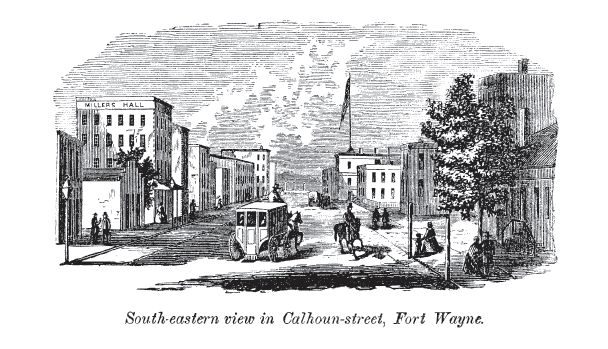
South-eastern view in Calhoun Street, Fort Wayne, engraving (Barber and Howe). Public domain · source file
§ 07
Events · on their own page
Current, Current Past, and Historic Past, the city's calendar, sorted the way time sorts it.
Events now live on their own page, in three bands: Current, happening now or coming up; Current Past, the recent past, this year's editions already held; and Historic Past, the deep record, from Harmar's Defeat to the flood fight. Events age through the bands: Current becomes Current Past once it happens, and Current Past settles into Historic Past over time.
Next on the calendar
WED NOV 25, 2026
HolidayFest & the Night of Lights
DOWNTOWN
The switch-on, Fort Wayne's official start to the holiday season, and the biggest annual gathering of the year.
NOV 12, 2026 – JAN 4, 2027
Holiday Lights at Parkview Field
PARKVIEW FIELD
More than a million lights choreographed to music in the ballpark bowl.
NOV 25 – DEC 2, 2026
42nd Festival of Trees
EMBASSY THEATRE
Dozens of decorated trees fill the 1928 Embassy for its signature week.
Events checked 1 November 2026 against the organisers' and visitors' listings; the full calendar, the recent past, and the historic record are on the Events page.
Fort Wayne, IndianaListings checked 1 November 2026Sorted for today
Everything the city gathers for, sorted the way time sorts it: Current, happening now or coming up; Current Past, the recent past; and Historic Past, the deep record, the events the rest of the site is built on.
BAND 1
Current
Happening now, and coming up.
The season opens with the lights. Fort Wayne's biggest annual gathering is not in summer, it is the Night of Lights, the evening before Thanksgiving, when downtown's displays switch on together: Santa and his reindeer on the PNC tower, the Merry Christmas wreath, the History Center turret. It opens HolidayFest, the season that runs to the new year. The three drive-and-walk light shows now sell as one bundled Fort Wayne Light Fest ticket, Fantasy of Lights, Wild Lights and Parkview Field's Holiday Lights for 15% less than separately.
Encampments and reenactments run through the year under Historic Fort Wayne, Inc., at the 1975–76 reconstruction, not the original fort (“The Old Fort on Spy Run is Anthony Wayne's fort.” on the main record).
The organisation behind the programme has its own layered history. A first Historic Fort Wayne was established in 1964 and opened the reconstructed site for the Bicentennial in 1976; it disbanded in 1989, and the present Historic Fort Wayne, Inc. — a separate, all-volunteer nonprofit founded in 2004 — runs the fort today (the distinction is “The Old Fort on Spy Run is Anthony Wayne's fort.”'s second point). The season opens with Muster on the St. Marys, a timeline event that puts soldiers of many eras on the same ground (9–10 May in 2026), and runs through the Camp Allen Muster for the Civil War years, Post Miamies for the French era, Fright Night lantern tours in October and a Christmas open house in late November. Events are free, staffed entirely by volunteers and funded by donations.
A walk-through of more than a million lights choreographed to music, with a train ride and appearances by “Johnny Claus.” Part of the Light Fest bundle. An annual edition, one entry, editions noted by the code below.
The newest of the city's light shows. It debuted on 14 November 2024 and drew more than 97,000 guests over 48 nights in its first season: over a million lights synchronised to music, walk-through access to the field itself, and the “Holiday Express” train on the concourse; nearly 5,000 people came on the opening Saturday alone, and two late-December nights were lost to weather. The 2026 edition is the third, runs 12 November to 2 January, and roughly doubles the display to about two million lights; across its first two years the event has drawn more than 170,000 visitors.
Sources: TinCaps / Minor League Baseball releases, milb.com and 963xke.com
NOV 13 – JAN 2
Wild Lights at the Fort Wayne Zoo
FORT WAYNE ZOO
Nearly a million lights on the zoo paths: nightly tree lighting hosted by Santa's elves, s'mores, the Evergreen Express, and reindeer on select dates. Part of the Light Fest bundle. Annual.
The youngest entry in this band. Wild Lights was brand new in 2025, when the Fort Wayne Zoo and Blue Jacket paired it with the Fantasy of Lights drive-through under the single Fort Wayne Light Fest banner. Its first edition opened on 28 November 2025 and ran to 4 January 2026, beginning at Santa's Cottage inside the zoo. (The zoo's lights have a longer local lineage in one sense: the Fantasy of Lights drive-through, next entry, was itself first set up within the zoo grounds in the 1990s.)
The season's elder: a three-mile drive-through light show at Franke Park, run by Blue Jacket Inc., with the YLNI Holiday Market on the Christmas Village dates. Annual.
The show began in 1995 — its 30th annual edition ran in 2024 — and was first set up inside the Fort Wayne Children's Zoo grounds before growing out into Franke Park. For most of its life it was an all-volunteer production run under the AWS Foundation; Blue Jacket Inc. took it over in 2015, inheriting about 68 display scenes on a mile-and-a-half loop, and has nearly tripled it: by 2024 it counted 186 scenes, some 750 display pieces and an estimated 3.5 million LED lights over a route approaching three miles, billed by its organisers as the largest nonprofit drive-through light display in the country. The 2021 season drew about 27,300 cars, its second-best year to that point. Proceeds fund Blue Jacket's employment programmes for people with barriers to work, and clients of the programme are hired onto the setup and teardown crews.
The Foellinger-Freimann Botanical Conservatory's holiday exhibit, silver bells, lights and greenery in the glasshouses, with Santa Saturdays in December. Annual.
The exhibit is the current edition of the Conservatory's long-running holiday showcase. The Foellinger-Freimann Botanical Conservatory, at 1100 S. Calhoun Street, opened in 1983; its Showcase Garden changes with the seasons, and the holiday edition fills it with poinsettias, evergreens and lights each November into January — the 2018 theme was “Victorian Holiday,” the 2026 theme “Silver Bells,” running 21 November 2026 to 3 January 2027. Evening $1 Night Light Display admissions run on selected nights from the eve of Thanksgiving, a dollar-admission tradition the Conservatory keeps through the season.
Sources: City of Fort Wayne, Botanical Conservatory listings and Fun Times guide, cityoffortwayne.in.gov
WED BEFORE THANKSGIVING
HolidayFest & the Night of Lights
DOWNTOWN
The switch-on: History Center turret lighting on Barr Street at 6:00 p.m. in the traditional running order, then the wreath, Santa and his reindeer, and the downtown displays in sequence. Fort Wayne's official start to the holiday season, in 2026, Wednesday 25 November. Annual.
The two anchor displays are far older than the ceremony that lights them. Wolf & Dessauer, the downtown department store at Calhoun and Washington, began animated Christmas windows in 1928; its 25-foot Merry Christmas wreath, reported at more than 40,000 lights, first hung on the Calhoun Street side in 1937, to sketches by the store's owner, G. Irving Latz, built by Brinkman Signs. Accounts differ on the Santa: the store's historians date both big displays to 1937, while Whatzup's history and the Genealogical Society's timeline put the first lighting of Santa and His Reindeer on 20 November 1940, switched on by Mayor Harry Baals, when it was billed as the nation's second-largest such display. Both datings are in print and both are carried here. The displays went dark for the war years (the 1942–44 blackouts), returned in 1945, and went into storage when the store moved — in 1958 on some accounts, 1959 on others. In 1979 GTE installer Jim Green found Santa in a warehouse; volunteers restored the 155-foot, 24,717-bulb, five-and-a-half-ton display (200 hours of work on a single reindeer), lit one reindeer in 1979 and the whole sign on Thanksgiving eve 1980, on the Fort Wayne National Bank building. It hangs on the PNC tower today, its bulbs since converted to LED, and the Night of Lights crowd is put at 25,000 to 50,000 people.
Sources: Input Fort Wayne, “A Timeless Glow,” inputfortwayne.com; Whatzup, Night of Lights history, whatzup.com; ACGSI, Wolf & Dessauer page, acgsi.org; Barron & Barron, Wolf & Dessauer: Where Fort Wayne Shopped (2011)
On the founding year the sources split, and the split is printed rather than smoothed. The Embassy's own site says “Founded in 1984.” The Embassy Theatre Foundation's history says the Embassadors — the theatre's volunteers — established the first Festival of Trees in 1985, on Barbara Wigham's recommendation, and that it raised $46,000, spent on restoring the front lobby entrances. The festival's own numbering follows 1985: the 40th annual ran in 2024 and the 41st in 2025, which makes 2026 the 42nd, as this entry's heading has it. The 2024 edition set the attendance record, 25,117 visitors over its week; the lobbies of the Embassy and the former Indiana Hotel hold the trees — 64 of them in 2024 — and the festival opens each year as a Night of Lights stop, with the Harrison Street windows lit the same evening.
Sources: Embassy Theatre, Festival of Trees, fwembassytheatre.org; Embassy Theatre Foundation history via CICATOS, cicatos.org; WPTA, 2024 festival results
NOV 27 – DEC 20
Festival of Gingerbread
THE HISTORY CENTER
More than a hundred edible constructions, from pre-K classrooms to professionals, in the 1893 Old City Hall. An Allen County–Fort Wayne Historical Society tradition since 1986; admission $5–$7 on the Whatzup listing.
The festival is run by the Allen County–Fort Wayne Historical Society in its home, the 1893 Old City Hall Building on Barr Street, and opens on the Night of Lights. The History Center's holiday season also puts the store behind “Johnny Appleseed died in Fort Wayne and lies under the marker in Johnny Appleseed Park.”'s neighbourhood back on display: the Center holds more than 30 animatronic figures from Wolf & Dessauer's Winter WanDerland windows, the animated department-store Christmas windows Fort Wayne queued for in the store's prime.
The Komets have played at the Allen County War Memorial Coliseum since both opened in 1952, the franchise founded that year in the original International Hockey League. The original club moved to Albany in 1990 and folded there mid-season; the Franke family bought the Flint Spirits the same year and took the Komets name and history, so the team has been in Fort Wayne without interruption since 1952. The championships, in brief: Turner Cups in 1963, 1965, 1973 and 1993, then a three-peat in 2008, 2009 and 2010; the UHL Colonial Cup in 2003; the CHL Ray Miron President's Cup in 2012; and the ECHL Kelly Cup in 2021 — with twelve regular-season titles alongside. Annual, one entry, editions combined.
Source: Fort Wayne Komets team history (franchise and championship record)
BAND 2
Current Past
The recent past · ended within the last year.
These filled the city's calendar within the last year and have now happened. Annual events rest here between editions, one entry each, editions noted, until their next edition approaches and the code lifts them back into Current.
22 OCTOBER
The fort's dedication · and its anniversary
THE CONFLUENCE · DOWNTOWN
One combined entry, as the record keeps it: the dedication itself, 22 October 1794, Col. Jean François Hamtramck, fifteen cannon rounds for fifteen states, and the anniversary the city keeps every 22 October since. The code files this entry by the anniversary: Current as it approaches, Current Past just after, and its origin stays noted here however far it ages. Told in § 02.
The back story, from the record: Wayne's Legion reached the confluence on 17 September 1794, weeks after Fallen Timbers, and Wayne chose the fort's site the next day. The post rose under Col. Jean François Hamtramck near today's Berry and Clay streets — built, its officers reckoned, proof against 24-pounder cannon — and was finished by 17 October. The dedication came early on 22 October 1794, the fourth anniversary of Harmar's Defeat on the same ground (deep record, below): fifteen cannon rounds for the fifteen states, and Hamtramck formally received the fort named for his commander. The garrison was about a hundred men, with families settled around it.
Sources: Fort Wayne (Indiana fort) summary; Allen County Public Library pamphlet on the fort, via Project Gutenberg
When did it start? The festival's own official history says 1974: about twenty vendors along Parnell Avenue, with sponsors including Eckrich, Lincoln Life and the city parks, and Settlers, Inc. — a founding sponsor — still involved today. The City of Fort Wayne's parks history instead lists “1975 — First Johnny Appleseed Festival,” Visit Fort Wayne likewise dates it to 1975 as a Bicentennial warm-up, and Whatzup's count — 49th annual in 2023, 50th in 2024 — also works back to 1975. Both datings stand in print; this record carries both rather than picking one. The festival runs two days over the third full weekend of September across Johnny Appleseed Park and Archer Park, keeps to period practice — 1800s dress, demonstrations, food cooked as in Chapman's time — and at more than 200 booths draws crowds the festival puts above 200,000 and the Genealogical Society at 300,000.
Sources: Johnny Appleseed Festival official history, johnnyappleseedfest.com; City of Fort Wayne Parks & Recreation history; Visit Fort Wayne; ACGSI
APRIL – SEPTEMBER
TinCaps baseball season
PARKVIEW FIELD
The season at Parkview Field, a franchise whose name honours Chapman's legend while the main record treats the legend as a legend. In winter the bowl fills with Holiday Lights until the baseball returns. Annual, one entry.
The franchise's own line: it began in 1993 as the Fort Wayne Wizards at Memorial Stadium — its first game played at Waterloo on 10 April 1993 — a Minnesota Twins affiliate through 1998 and a San Diego Padres affiliate from 1999 to the present. The move downtown in 2009 brought the new name, honouring the tin pot of the Appleseed legend, and the club marked its first Parkview Field season by winning the 2009 Midwest League championship (the opening of the park is its own entry in the deep record, below). The 2009 title remains the franchise's championship headline.
Sources: Minor League Baseball franchise records; ACGSI, TinCaps page
JULY
Three Rivers Festival
HEADWATERS PARK
Nine days at Headwaters Park, the city's flagship summer festival, named for the confluence itself. One entry for every edition: the code notes the last and next below.
This entry now records a finished arc, and there is no next edition to note. The first Three Rivers Festival opened on 12 July 1969 at Columbia Street Landing, with a river parade and some 60 events, and drew about 100,000 people. It grew into nine days in mid-July: attendance reported near a million in 1973, and above two million for the 1976 Bicentennial edition, which hosted even an international beer-can collectors' convention. For decades it was billed as Indiana's second-largest festival, built around the parade (in its later years the General Mad Anthony Wayne Parade), Junk Food Alley, the raft race, the bed race and the finale fireworks; it moved to Headwaters Park in 1997 as that ground was completed, sat out 2020 in the pandemic, and in its later years drew about 200,000 people a year. The money never matched the crowds: the festival's federal filings show a $387,193 net loss across the decade ending with its 2020 filing, outspending revenue in seven of the ten years from 2011. The last edition ran 12–20 July 2024, billed as the 55th annual. In February 2025 the board voted to file for bankruptcy, about $300,000 in debt, and cancelled the 2025 festival. One general reference work still ends the festival in 2023 in its summary box; the 2024 edition stands in the local record and is the one printed here. The July weekend did not stay empty — see Big Fort Fest, next entry.
Sources: ACGSI, Three Rivers Festival page; Whatzup, 12 February 2025; The Post & Mail, 18 February 2025; festival history via the Library of Congress Local Legacies programme
JULY
Big Fort Fest
HEADWATERS PARK
The replacement that kept the July weekend. When the Three Rivers Festival's board voted for bankruptcy in February 2025, brothers Jake and Jes Farris of Studio 13 Tattoo, working with promoter Jake Slater of Electric Promotions, personally bankrolled a new festival on the same ground and the same weekend — reported at $500,000 to $600,000 of their own money. The first Big Fort Fest ran 10–12 July 2025 at Headwaters Park, three nights headlined by Bone Thugs-n-Harmony and Theory of a Deadman among others, and the second edition ran 9–11 July 2026. Annual, one entry, editions combined.
Sources: Whatzup, February 2025 and festival coverage; Big Fort Fest reporting, 2025–26
MARCH
The flood anniversaries
CITYWIDE
The city keeps the flood weeks of March, 1913 and 1982 both crested in the same month, sixty-nine years apart. The floods themselves are separate entries in the deep record below; this is their annual observance. The workings are “The 1913 flood killed seven people in Fort Wayne.” and 15.
The March observances rest on more flood history than the two famous years. The Floods marker by the river records a disastrous flood at Kekionga itself in 1790, from a rapid spring thaw and heavy rain, before any dike existed. The federal flood guide's list of Fort Wayne's four greatest floods runs 1913, 1978, 1982 and 1985: in March 1978, on the melt of the blizzard winter, about 15 percent of the city was inundated and 2,400 of its 190,000 residents were forced out (deep record, below); floods inundated the area again in 1985 and in 1991. The city's flood file also holds 1959, when St. Marys River ice jams forced some 200 evacuations and dynamiting of the ice, and 13 June 1981, when three and a half inches of rain fell in a day — both from the University of Delaware Disaster Research Center's case study of the city's floods. No Fort Wayne flood of 1936 appears in any of these lists; the famous March 1936 floods were Pittsburgh's and New England's, and Indiana's great 1930s flood, January 1937, was an Ohio River event that never touched the three rivers here.
Sources: The Floods historical marker, hmdb.org; FEMA guide 116 (1987) via ACGSI floods page; Phillips, The Fort Wayne Flood: A Case Study, University of Delaware Disaster Research Center WP 73 (1984)
28 MAR – 23 APR 2024
A mayor dies in office; a mayor chosen by caucus
CITY HALL
Tom Henry, the longest-serving mayor in city history, dies in office; after Karl Bandemer's 26 acting days, a Democratic caucus seats Sharon Tucker on 23 April 2024. Told in § 04.
The sequence, as reported at the time: Henry announced a diagnosis of late-stage stomach cancer at a news conference on 26 February 2024, began chemotherapy, and said he intended to stay in office. He died on 28 March 2024, aged 72, four months into the fifth term he had won the previous November; his tenure, from 1 January 2008, was the longest of any Fort Wayne mayor. Deputy Mayor Karl Bandemer served as acting mayor from 28 March to 23 April 2024. The Allen County Democratic caucus met on Saturday 20 April: 92 precinct committee members cast votes, seven candidates stood including state Rep. Phil GiaQuinta, and 6th District Councilwoman Sharon Tucker won on the second round of voting. She was sworn in on 23 April 2024 — the city's first Black mayor, and, in the Journal Gazette reporting carried by IBJ and the Associated Press, its second woman in the office — and serves the balance of Henry's term, to 31 December 2027.
Sources: Indianapolis Business Journal / Associated Press, 21 April 2024, ibj.com; Black Enterprise, 22 April 2024; list of Fort Wayne mayors
BAND 3
Historic Past
The deep record · the events the rest of this site is built on.
Every entry below is told in full on the main record, in the Story of Fort Wayne section (§ 02) and the stories section (§ 03), checked against the earliest record that survives. This band is the index; the record itself is one link back.
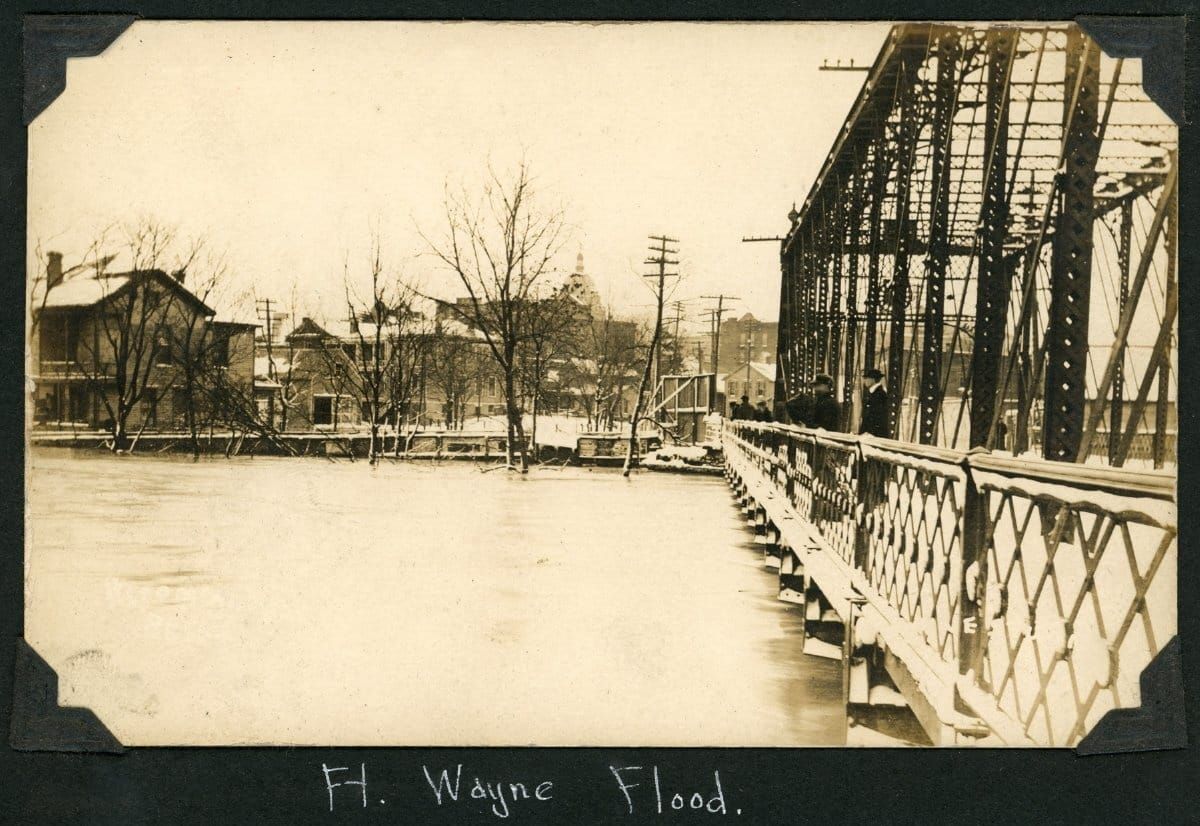
The Great Flood at the Wells Street Bridge, 25 March 1913, a period photograph, public domain, via Allen INGenWeb. Rights ledger on the main record.
Two floods anchor the deep record
The 1913 flood and the 1982 flood fight are the city's two defining emergencies, and both turn on figures that sources state differently: a death count of six drownings or seven flood deaths in 1913, and a crest the National Weather Service series and the History Center's own artifact label put a full foot apart in 1982.
Gen. Josiah Harmar's expedition is mauled in detachments by Little Turtle's forces, the disaster that opens the American record here. Told in § 02.
The fuller record: Harmar brought some 1,400 men up the Maumee and reached Kekionga on 17 October 1790 to find the Miami towns burned and emptied ahead of him. The army burned what was left — some 20,000 bushels of corn by the campaign's own accounting — and then lost its detachments piecemeal. On 19 October, Col. John Hardin's militia was ambushed near Little Turtle's town on the Eel River, the fight remembered as Hardin's Defeat. On 22 October, Maj. John Wyllys's regulars were cut apart crossing the Maumee in sight of the camp. How many Americans died is stated differently by the sources this record uses, and all three figures are printed: the state history marker puts US killed at 183 for the campaign; the campaign's general-reference summary puts 262 killed and 106 wounded; the narrative history hosted by the History Center gives 129 killed on 22 October alone, against fewer than 50 Miami losses. A red-moon lunar eclipse hung over the night of 22 October. Harmar withdrew down the Maumee; a court of inquiry cleared him; and the defeat set in motion the larger expedition destroyed the next year — the next entry.
Sources: Harmar's Defeat historical marker, hmdb.org; Calloway narrative via the Fort Wayne History Center; Harmar campaign summary
4 NOV 1791
St. Clair's Defeat · the road to Kekionga
THE UPPER WABASH · PRESENT FORT RECOVERY, OHIO
Harmar's failure brought a bigger army with the same destination. Gen. Arthur St. Clair marched north in the autumn of 1791 under orders to build a post at Kekionga itself; at dawn on 4 November 1791, on the upper Wabash some fifty miles southeast of the confluence, a confederacy force led by Little Turtle, Blue Jacket and Buckongahelas struck his camp before it could form. Of roughly 920 to 1,000 Americans engaged, about 632 were killed — 69 percent — and 264 wounded; only about two dozen came through unhurt, nearly all of some 200 camp followers were killed, and the army's second-in-command, Richard Butler, died on the field. Native losses are put at about 21 killed and 40 wounded. It remains the worst defeat the United States Army ever suffered at Native hands, with about three times the American dead of Little Bighorn a century later, and it forced the first investigation Congress ever conducted, and St. Clair's resignation. Kekionga was its objective; the road back to the confluence runs through Wayne's Legion and the fort of 1794.
Sources: Ohio History Connection / Ohio Memory; St. Clair's defeat summary; News-Sentinel history notes via ACGSI
5–12 SEPT 1812
The Siege of Fort Wayne
THE FORT
Some 500 Potawatomi and Miami besiege a garrison of about 100 until William Henry Harrison relieves it on 12 September. The garrison's orderly book survives. Told in § 02.
The detail the garrison's own records add: the fort held about 70 to 100 men under Capt. James Rhea, who was drinking through the crisis until his lieutenants — Ostrander, whose name also appears as Ostander, and Curtis — took effective command. On 4 September, at a parley inside the fort, the Potawatomi leader Winamac lunged at Indian agent Benjamin Stickney with a hidden knife; the trader Antoine Bondie knocked the blow aside. The besiegers, some 500 Potawatomi and Miami under Winamac and Five Medals, burned the village buildings and crops around the fort and tried repeatedly to fire the stockade, while the garrison kept the walls wet and answered with howitzers. The Ball State account drawn from Stickney's manuscript counts only two soldiers killed in the siege itself. Harrison marched to the relief with a Kentucky militia force the accounts put between 2,200 and 3,000 men; Winamac withdrew on 12 September as it arrived. Rhea was arrested and allowed to resign, and Harrison then ordered the Miami and Potawatomi villages around the fort destroyed in reprisal.
Sources: History Center Notes & Queries (Castaldi); Ball State University, siege orderly-book project; Siege of Fort Wayne summary
22 FEB 1832
Ground is broken for the canal
FORT WAYNE · THE FEEDER SITE AT BLOOMINGDALE
The canal began here, and the date was chosen twice over: 22 February 1832 was Washington's birthday, and it also beat a federal land-grant deadline falling in early March. Fort Wayne was then a village of perhaps 300 to 400 people. A meeting at the Masonic Hall, chaired by Henry Rudisill with David Colerick as secretary, preceded a procession out to the St. Joseph feeder site at the summit — 198 feet above Lake Erie, 790 feet above the sea. Judge Charles W. Ewing and Jordan Vigus gave the addresses; Samuel Hanna, who had been lobbying the legislature for the canal since 1823, and Capt. Elias Murray turned the first spadefuls; the evening ended with a parade, a bonfire and an illuminated canal-boat float built by Louis Peltier. Jesse Lynch Williams was the project's chief engineer from 1832. A later state-marker review questioned the marker's “two blocks north” siting of the ceremony; the ceremony's substance is not in dispute.
Sources: Indiana Historical Bureau marker review (02.1992.2); Wabash & Erie Canal Park, wabashanderiecanal.org; Hawfield, News-Sentinel Cityscapes
4 JULY 1843
The canal's grand opening
THE SWINNEY HOMESTEAD
Through navigation, Toledo to Lafayette by way of Fort Wayne, celebrated with Lewis Cass speaking, the Wabash & Erie at its summit. Told in § 02.
There were two celebrations, eleven years of digging apart. The first section of the canal, Fort Wayne to Huntington, opened with a gala on 4 July 1835: the packet Indiana, Capt. Oliver Fairfield, docked the evening before, Gen. John Tipton spoke, Hugh McCulloch delivered the oration and a public dinner closed the day. (One older journal account dates that opening to 4 July 1836; the canal histories and the dockside marker say 1835, and 1835 is printed here with the conflict noted.) The 1843 dedication of through navigation was the bigger day. Guests began arriving the Saturday before; the Toledo Guards came in on Monday night; at sunrise a cannon captured from a British ship in Perry's Lake Erie victory fired the salute; and Sen. Lewis Cass — a former military governor of this place, entertained at Allen Hamilton's mansion — arrived at six in the morning on a canal boat from Toledo, acknowledged the crowd's ovation, lost his footing on the gangplank and fell into the canal. Cass dried off and delivered the leading address at Swinney's grove; Hugh Hanna was marshal of the day; a banquet with senators and governors closed the evening. The boat Albert S. White made the first through trip, Toledo to Lafayette. At completion the canal ran about 459 miles, Toledo to Evansville — the longest canal in North America. It was abandoned by 1874.
Sources: The Wabash-Erie Canal (canal history, via Internet Archive); Reser, “The Wabash and Erie Canal at Lafayette,” Indiana Magazine of History (1934); Canal Society of Indiana newsletter (2022); Wabash & Erie Canal marker, hmdb.org
6–7 OCT 1846
The Miami Removal
FORT WAYNE / KIIHKAYONKI · PERU
Hundreds of Myaamia are loaded onto canal boats at Peru and at Fort Wayne for Kansas. The canal that made Fort Wayne carried its founders away. Told in § 02.
The route, stage by stage. Through September 1846 the Myaamia were rounded up by the US Army and held at Peru, on the Wabash. The removal proper began on 6 October 1846: about 500 people were gathered at Peru — 327 of them removed, by the tribally sourced count in the Tribes section — and loaded onto canal boats (three loaded at Peru; five passed Fort Wayne) and carried through Fort Wayne on the Wabash & Erie, then down the Miami & Erie Canal to Cincinnati, by the steamboat Colorado down the Ohio, held three days on Bloody Island at St. Louis, and up the Missouri on the Clermont No. 2 to the Kanza landing at Westport on 1 November — then fifty miles overland to the Sugar Creek reservation in Kansas, arriving 9 November 1846. At least seven people died on the journey — one older account says six — and at least 23 more within two months of arrival; the older account counts 323 reaching Kansas, against the Tribes section's 327 removed. Fewer than half the tribe was taken at all: the families of Richardville, Godfroy and Meshingomesia held treaty exemptions and stayed, which is why a Miami community remained in Indiana. Witnesses recorded people taking handfuls of earth from their ancestors' graves before boarding. A small second group was removed in 1867, this time to Oklahoma, under the Treaty of 1867.
Sources: Myaamia Project, removal remembrance, aacimotaatiiyankwi.org; Griswold, Pictorial History of Fort Wayne (1917); Indian removals in Indiana summary
1861–1865
Camp Allen · the Civil War camp
NORTHWEST BANK OF THE ST. MARYS · NOW CAMP ALLEN PARK
Fort Wayne's Civil War mustering ground stood south of Main Street on the St. Marys, on what is now the 3.5-acre Camp Allen Park. First called Camp Fort Wayne and Camp Bayless, it was renamed Camp Allen in August 1861 for Col. John Allen, a War of 1812 officer; Col. Hugh B. Reed was its first commandant. The 30th, 44th, 74th, 88th and 100th Indiana infantry regiments and the 11th Indiana Battery organised there. The 30th marched under Col. Sion S. Bass, who was killed at Shiloh, and carried a silk 34-star flag presented by the women of Fort Wayne in 1861, now a History Center artifact. Allen County sent 4,103 men to the war and lost 489. The 142nd Indiana rendezvoused at Fort Wayne in July 1864, likely at the camp, though the state marker review could not prove the camp was still in use that late. The city bought the ground in 1912 as Camp Allen Park — the same ground where the Kekiongas would play in 1871, in the next entry.
Sources: Indiana Historical Bureau marker 02.1963.1 and its review file; ACGSI Allen County timeline; History Center artifact record HE 8; SABR, Kekionga Ball Grounds
4 MAY 1871
The first game of the first professional league
LEAGUE PARK
The Fort Wayne Kekiongas beat Cleveland 2–0, “first” only because Boston–Washington was rained out the day before. Told in § 02.
The game itself, from the Retrosheet play-by-play rebuilt out of the next day's Cleveland papers: the Kekiongas won the toss and sent Cleveland to bat. Deacon White led off with a double off Bobby Mathews — the first hit in league history — and was doubled off moments later. Fort Wayne scored once in the second and once in the fifth, the second run advancing on passed balls, and Mathews, twenty years old and five-foot-five, finished a 2–0 shutout: the first win, the first complete game and the first shutout in the record books, at a score the site marker notes remained the lowest in the National Association's five-year history. Rain ended it in the ninth. The crowd was only a few hundred — contemporary estimates start at about 200 — kept down by threatening weather, and the game holds its “first” because the Boston–Washington game scheduled the same day was rained out. The grounds were the Kekionga Ball Grounds, west of the St. Marys on the old Camp Allen ground (previous entry). The club folded before the season ended, after eight more home games. A monument was unveiled on the site, now Camp Allen Park, on 4 May 2017.
Sources: Retrosheet, first National Association game play-by-play, retrosheet.org; SABR, Kekionga Ball Grounds (Griggs & Nitz) and “May 4, 1871” (Thorn); Baseball-Reference Bullpen; Kekionga Ball Grounds marker, hmdb.org
The visiting Quincy club was a professional nine trying the Jenney Electric Company's new arc lamps, and the experiment's notices — in the Gazette, the Fort Wayne News and Sporting Life alike — were bad enough that night baseball waited decades to return here in earnest. What was scheduled first, on 29–30 May 1883, and what had already happened at Hull, Massachusetts, in 1880, is the substance of “Fort Wayne hosted the first night baseball game, in 1883.”.
The week, day by day. A Good Friday windstorm (21 March) opened it; then rain from Easter Sunday — 4.75 inches between the morning of 23 March and the night of the 25th, 2.76 inches of it on the 24th alone. The Maumee stood at 6.7 feet on Easter and 19.6 feet the next morning; by 25 March some 2,000 homes were under water. The crest came at 11 p.m. on 26 March, 26.1 feet in the Weather Service series, and that night the dikes guarding Lakeside breached on both the St. Joseph and Maumee sides. Lakeside, Nebraska, Bloomingdale and Spy Run took the worst of it; every pumping station flooded, and the water supply failed with them. Martial law was declared, Mayor Jesse Grice ran the relief, and the Floods marker records the orders given to shoot looters. The relief organisation aided 11,187 people; some 10,000 homeless were fed in halls, churches and the courthouse; a Chicago lifesaving crew worked the city with a 30-person motorised rescue boat; Stephen B. Fleming sent a special relief train to Peru, Indiana, and Fort Wayne filled an order for 38 coffins for Peru's dead. Damage is stated at about $4.8 million in the News-Sentinel reconstruction and at about $3 million in another News-Sentinel account; both figures are carried here because both are in print. The river fell below flood stage on 3 April.
Sources: Jarosh, News-Sentinel flood reconstruction, egen.fortwayne.com; Midwestern Regional Climate Center / Purdue, 1913 Flood community profile, mrcc.purdue.edu; ACGSI, 1913 Flood page; The Floods marker
1950–2001
The tornadoes that struck the city
CITYWIDE
The Weather Service's Northern Indiana office keeps the city's tornado list, and its ceiling is low: no tornado stronger than F2 has ever been recorded inside Fort Wayne. The list, in brief. 19 July 1950: a tornado touched down at Taylor Street and Brooklyn Avenue and tracked northeast straight through downtown past Main and Calhoun, missing the courthouse by feet, injuring five people with bursting storefront glass, and lifting near the Tennessee Street bridge. 14 May 1972: one home demolished and 39 damaged, among the most destructive in the city. 28 March 1985: mobile homes at Countryside Village and Edgewood Estates on West Washington Center Road — two destroyed, two seriously damaged, nine injured; the newspapers attributed it to straight-line winds, while the federal storm database lists a tornado. 8 October 1992: a small tornado at Fort Wayne International Airport, winds about 100 mph, in a storm whose straight-line winds did the wider damage. 26 May 2001: an F2 a thousand feet wide touched down at 5:45 p.m. in the Northcrest Shopping Center lot on Coliseum Boulevard, flipped cars, tore at the mall and restaurant roofs, and crossed into the subdivisions and office park beyond — three injuries, no deaths. The county's worst day stands outside the city limits: the Palm Sunday tornado of 28 March 1920, an F4 across southern Allen County, leveled most of Townley, killed six people there and thirteen along its path in the county; city fire crews answered calls to Monroeville and Townley.
Sources: National Weather Service, Northern Indiana — Past Fort Wayne Tornadoes and the 26 May 2001 summary, weather.gov; Waynedale News; Friends of Wyneken newsletter
25–27 JAN 1978
The Blizzard of 1978
STATEWIDE
The storm Fort Wayne still measures winters against. The first statewide Blizzard Warning in Indiana history was issued at 3:45 p.m. on 25 January 1978. The storm's central pressure fell to about 956 millibars over Michigan, and Fort Wayne recorded the lowest pressure in its history, 28.78 inches (975 mb). Snow fell at one to two inches an hour into winds of 35 to 45 mph, visibility a sixteenth of a mile or less; by 27 January about seventeen inches lay on the ground in Fort Wayne, January's total reached 25.3 inches, and the winter's snowfall finished at 60.6 inches with a mean winter temperature of 17.8°F — the coldest winter in the city's records. The governor declared a statewide snow emergency on 26 January; the State Police treated every road in Indiana as closed; the National Guard deployed across the state, armour included. The Weather Service's Indianapolis office puts the statewide death toll at about seventy. The snowpack the storm left behind melted into the flood in the next entry.
Sources: National Weather Service, Northern Indiana, the Blizzard of 1978, weather.gov; NWS Indianapolis blizzard history; Fort Wayne snow records via Extreme Weather Watch
MAR 1978
The March 1978 flood
CITYWIDE
The blizzard winter's second act. Snowmelt put the Maumee at flood stage from 17 March to 2 April 1978, and Fort Wayne took its worst flood since 1913. The US Geological Survey's report on the basin puts about 15 percent of the city under water and 2,400 of its 190,000 residents forced from their homes, with the mayor's damage estimate for the city at $11 million; civil defense put Adams and Allen counties together at $44 million. At the New Haven gauge the Maumee ran 2.2 feet above its previous peak of record, 21.4 feet — about a 75-year flood on that reach. The federal flood guide of 1987 lists 1978 among Fort Wayne's four greatest floods, with 1913, 1982 and 1985.
Sources: Hoggatt, Floods of March 1978 in the Maumee River Basin, US Geological Survey (1981); FEMA guide 116 (1987) via ACGSI
The fight, as the record keeps it. The rivers began rising on the night of 12 March 1982, on a deep snowpack, a fast thaw and overnight thunderstorms. Evacuations are put at about 9,000 in most accounts, and at 10,000 by 17 March in the chronology of the University of Delaware's case study; both figures stand in print and both are carried here. The damage count: 1,820 residences and 260 businesses damaged — and, on the News-Sentinel's accounting, about 1,860 properties saved outright by the volunteers. The signature stand was the Pemberton dike in Lakeside, where volunteers relayed 287,000 sandbags hand to hand to plug the leaks. Sandbagging headquarters moved to Memorial Coliseum; the schools closed and their students filled bags, the “children's crusade” the national education press covered at the time. The Delaware study counts some 30,000 volunteers, about 18,000 of them students; Mayor Win Moses later put it at 11,000 high school students and more than a million sandbags (“In 1982 the river crested at 26.93 feet, 30,000 volunteers saved the city, and Reagan named it ‘The City That Saved Itself.’” keeps the split). Nebraska Elementary flooded, at a cost above $200,000. President Reagan landed at Baer Field on 16 March and sandbagged at the Sherman Boulevard dike in boots lent by a volunteer, Greg Miller; the federal disaster declaration followed his visit. The crest came on 17 March; its height is the dispute of “In 1982 the river crested at 26.93 feet, 30,000 volunteers saved the city, and Reagan named it ‘The City That Saved Itself.’”.
Sources: News-Sentinel flood retrospective; Phillips, The Fort Wayne Flood: A Case Study, University of Delaware Disaster Research Center WP 73 (1984); Education Week, March 1982; History Center artifact 97.29.2
27 SEPT 1982
International Harvester announces the end
THE SCOUT PLANT · CITYWIDE
On Monday 27 September 1982, International Harvester announced it would close its Fort Wayne works; the announcement front-paged the Journal Gazette the next morning. Who announced it is stated two ways in print, and both stand: the News-Sentinel's decade history names company president Louis Menk, while the Associated Press report of the same day names Donald Lennox announcing it at a news conference with Mayor Win Moses present. The closure meant about 2,100 layoffs as announced. The plant's employment had peaked at 10,600 in early 1979. In July 1982 the company had already said it would consolidate three truck plants into two; Springfield, Ohio — the newer plant — kept its line, despite Indiana's aid package, reported by AP at about $31 million. The last truck rolled off on 15 July 1983. Engineering and the parts distribution centre stayed, about 2,000 jobs in 1984. Scout production had ended earlier, in October 1980, at 532,674 built since November 1960; the plant's full truck count, 1923 to 1983, was 1,527,299, the millionth in 1963. City unemployment peaked at 12.1 percent in those years, with more than 30,000 jobs lost across the city in the era. Harvester renamed itself Navistar in 1986.
Sources: News-Sentinel decade history via ACGSI; Associated Press via the Ball State Daily News, 28 September 1982; ACGSI, International Harvester page; Input Fort Wayne
1984–1986
General Motors comes
ROANOKE · LAFAYETTE CENTER ROAD
The replacement anchor arrived two years after Harvester's announcement: GM's coming was celebrated on 31 August 1984, on a plant investment reported at about $500 million and some 3,000 jobs. The plant stands at 12200 Lafayette Center Road in Roanoke, southwest of the city — Fort Wayne Assembly by name, though not inside Fort Wayne's limits, and this record says so rather than claim it. The first pickup was built on 8 December 1986. The plant has since taken a $1.2 billion expansion (announced 2015), employs roughly 3,800 to 4,000 people in recent counts, and built its ten-millionth vehicle, a white GMC Sierra Denali, on 30 May 2023.
Sources: GM press materials; KPC News, 30-year retrospective; Fort Wayne Assembly summary
1993
Headwaters Park is dedicated
BETWEEN THE RIVERS
The flood-control project remakes the old “Thumb” as the city's festival ground, the ground where the Current band's summer festival now stands. Told in § 02.
The date on this entry needs the fuller record, and the fuller record splits it in two. What happened in 1993 was the groundbreaking: on 26 October 1993, at the groundbreaking ceremony, the park was dedicated as the premier “Lasting Legacy” of the Fort Wayne Bicentennial Celebration and a monument to the citizens of the “City That Saved Itself,” in the Bicentennial Commission's words as the Floods marker copies them. Construction of the roughly thirty acres in the Thumb ran from 1994 to 1999 — architect Eric R. Kuhne's flood-control plan, funded by the Headwaters Park Commission's ten million private dollars — and the completed Headwaters Flood Control and Park Project was itself dedicated and opened on 22 October 1999, Fort Wayne's 205th birthday, with Gov. Frank O'Bannon and Mayor Paul Helmke cutting the ribbon. Mayor Win Moses had first called for the park in 1981, a year before the flood that made its case. The Three Rivers Festival moved onto the ground in 1997, as the festival plaza took shape, and the park's concrete flood-retention walls, dedicated in 2001, stand where the sandbaggers of 1982 worked to protect the National Guard Armory.
Sources: Headwaters Park and Floods markers, hmdb.org; Around Fort Wayne, Headwaters Park anniversary account (2009)
16 APR 2009
Parkview Field opens
DOWNTOWN · HARRISON SQUARE
The ballpark was the centrepiece of the roughly $120 million Harrison Square project — the park itself about $31 million, with 8,100 seats. Groundbreaking came on 29 November 2007; the Wizards became the TinCaps on 2 October 2008; Parkview Health's naming rights, $300,000 a year, were announced that September. Parkview Field opened on 16 April 2009 before a sellout crowd put at 8,208 in most accounts and 8,206 in others, Mayor Tom Henry throwing the first pitch and the TinCaps beating Dayton 7–0. James Darnell's two-run homer is the park's first hit and home run in the TinCaps' telling; the Genealogical Society's account credits Dayton's Dave Sappelt with the game's first hit. Both versions are in print and both are carried here. The club started 10–0, finished 94–46, won the 2009 Midwest League championship, drew 404,418 fans in the first season, 378,529 of them in the regular season, and sent a Class A-record nineteen players from that 2009 roster to the major leagues.
Sources: Minor League Baseball, Parkview Field retrospective; Parkview Field summary; ACGSI, TinCaps page
2007–2023
The Mad Ants years
MEMORIAL COLISEUM
Professional basketball's second Fort Wayne act: the Mad Ants — named for “Mad” Anthony Wayne — began play in the NBA Development League in 2007 at the Coliseum. Their peak came on 26 April 2014, when they beat the Santa Cruz Warriors 119–113 at home to sweep the Finals two games to none and take the D-League championship, Tony Mitchell scoring 32 points; it was Fort Wayne's first professional basketball title since the Pistons' of 1945. They lost the 2015 Finals to Santa Cruz. Pacers Sports & Entertainment bought the club in September 2015, and after the 2022–23 season the team left for Indianapolis — the Indiana Mad Ants for two seasons, renamed the Noblesville Boom in 2025. The departure is filed in this band rather than the recent-past band: the last Fort Wayne season ended in the spring of 2023, outside the recent-past window this record keeps.
Sources: Noblesville Boom team history; Indianapolis Business Journal, April 2025
23 NOV 2022
Electric Works opens
THE OLD GE CAMPUS · BROADWAY
General Electric's Broadway campus — 39 acres, 18 buildings, 1.2 million square feet, grown from the Fort Wayne Electric works of 1883 — wound down with GE's exit; the closing year is stated as 2014 in the Indianapolis Business Journal and as finally 2015 in the developer's material, and both stand in print. RTM Ventures (Ancora) bought the campus from GE in 2017, and Phase 1 — about $286 million of adaptive reuse across ten buildings — opened the West Campus to the public on 23 November 2022. Union Street Market, northeast Indiana's first food hall, opened with it, and Do it Best, founded in Fort Wayne in 1945 and Indiana's largest private company, moved some 200,000 square feet of headquarters into Building 26 that November. The rooftop sign that replaced GE's reads “Do it Best.”
Sources: Quest Club paper on Electric Works (Lindquist, 2023), Allen County Public Library; Indianapolis Business Journal; Bisnow, November 2022; Visit Fort Wayne
1948–2018
Presidents in Fort Wayne
CITYWIDE
The visits the record can stand behind, in one entry. Harry Truman's special train stopped on 4 June 1948 — he arrived at 1:13 p.m. on the “nonpolitical” tour the Indianapolis Times covered that day. Jimmy Carter flew in on 1 June 1980 to visit Vernon Jordan at Parkview Hospital, three days after Jordan was shot outside the Marriott following the Urban League dinner; Carter's arrival led the first broadcast CNN ever aired. Ronald Reagan came on 16 March 1982, for the flood — the flood fight entry above. Candidate Barack Obama held a town hall at Wayne High School on 4 April 2008. Donald Trump filled Memorial Coliseum twice: as a candidate on 1 May 2016, the crowd put at 8,000 in rally listings and above 12,500 in Coliseum accounts — and as president on 5 November 2018, arriving at Fort Wayne International Airport at 5:24 p.m. to campaign for Mike Braun, with the Coliseum crowd estimated near 20,000 counting the overflow. Claimed Fort Wayne stops by other presidents — George W. Bush, Bill Clinton, John F. Kennedy and Theodore Roosevelt among them — were searched for and not sourced; they are not printed as visits.
Sources: Indianapolis Times, 4 June 1948; ACGSI Allen County timeline; American Presidency Project; White House arrival remarks, 5 November 2018; Waynedale News
Cite this page
Using this page? Copy a credit line. Last updated November 10, 2026.
Source: Fort Wayne Events: The City Calendar, Current and Past, Moosed History by Project Moosed, https://history.projectmoosed.com/usa/midwest/indiana/fort-wayne/events-calendar/
“Fort Wayne Events: The City Calendar, Current and Past.” Moosed History, Project Moosed, 10 Nov. 2026, history.projectmoosed.com/usa/midwest/indiana/fort-wayne/events-calendar/. Accessed 2026-11-10.
Fort Wayne Events: The City Calendar, Current and Past. (2026, November 10). Moosed History. Project Moosed. Retrieved 2026-11-10, from https://history.projectmoosed.com/usa/midwest/indiana/fort-wayne/events-calendar/
“Fort Wayne Events: The City Calendar, Current and Past.” Moosed History. Project Moosed. Last modified November 10, 2026. Accessed 2026-11-10. https://history.projectmoosed.com/usa/midwest/indiana/fort-wayne/events-calendar/.
@misc{moosed-events-calendar,
  title        = {{Fort Wayne Events: The City Calendar, Current and Past}},
  howpublished = {\url{https://history.projectmoosed.com/usa/midwest/indiana/fort-wayne/events-calendar/}},
  organization = {Project Moosed},
  note         = {Moosed History. Last updated 2026-11-10. Accessed 2026-11-10},
  year         = {2026}
}
Support Moosed History
If you would like to support the work of keeping this history online, you can make a one-time or monthly contribution. Every donation unlocks the downloadable book of the entire History site — a print-quality PDF, plus EPUB. Monthly supporters keep getting the latest edition. This is not a tax-deductible contribution.
Loading checkout…
Payments are processed by Stripe. Card details stay with Stripe and are not stored on this site. After checkout you will get a thank-you page and an email with your book.