The exact page text, read by your browser's voice.

Libraries
The Working Men's Institute library
1850s — before the public library
What it was: Fort Wayne's first library of which any trace survives belonged to the Working Men's Institute movement — the network of mechanics' and workers' libraries spread across Indiana in the mid-19th century. A Fort Wayne News-Sentinel retrospective dated a workingmen's library in the city to 1855. The institute itself did not survive as an institution, but part of its book collection had a long second life: some of its volumes passed into the Fort Wayne High School library, and from there, in 1895, into the opening collection of the public library.
Sources:
- Dawne Slater-Putt, Beyond Books: Allen County's Public Library History, 1895–1995 (Allen County Public Library, 1995), ch. 1 — the institute's books reaching the public library through the high school library; the 1855 News-Sentinel headline as cited there.
The Catholic Library Association and Catholic Library Hall
c. 1871 — the hall opened June 1882
Course: The Rev. Joseph Henry Brammer organized a Catholic library association in Fort Wayne about 1871; a Sentinel article of 9 January 1872 describes the young association. Its collection grew to about 5,000 volumes. In 1881 the association built Catholic Library Hall at Calhoun and Lewis streets, which opened in June 1882 at a cost of 40,000 dollars. In 1888 the hall was being called the finest library of its kind in Indiana. It served the city's Catholic readers through the decades when Fort Wayne still had no tax-supported library at all.
Sources:
- Slater-Putt, Beyond Books (1995), ch. 1 — the association, the 5,000 volumes, the hall's cost and 1882 opening, and the 1888 description.
The fourteen-year fight for a tax-supported library
1881–1895
The act: David N. Foster conceived the campaign for a public library in Fort Wayne, and Robert S. Robertson drafted Indiana's public library act, passed 7 March 1881, which allowed a library tax of up to three cents on each 100…
The Emerine J. Hamilton Free Reading Room for Women
1887–1895
Founded: Emerine J. Hamilton and her daughters Mary Williams, Ellen Wagenhals and Margaret Hamilton established the reading room in 1887 at 19 West Wayne Street, with about 400 volumes. In 1889 it became a circulating library.…
The Fort Wayne Public Library opens
28 January 1895
Opening: The Fort Wayne Public Library was formally opened at a public meeting on 28 January 1895, Mayor Chauncey B. Oakley presiding. Circulation began the next morning, 29 January 1895, at 10 a.m., from two rooms in City Hall …
Three moves in six years: Bayless, Brackenridge, Elektron
1895–1904
Bayless house: In September 1895 the library moved to the former Sol D. Bayless property at the southwest corner of Wayne and Clinton streets, reopening on 7 October 1895; the site later held the Strand Theatre. By 31 July 1896…
The Carnegie building
Dedicated 7 January 1904 — razed August 1965
The gift: In 1901 the Woman's Club League approached Andrew Carnegie. As the story was told at the time, Carnegie was prepared to give 250,000 dollars but required the city to spend ten percent of the gift each year on the…
Departments and firsts, 1905–1918
1905–1918
Course: The library's work specialized early. The Indiana Collection — the seed of the library's later local-history and genealogy strength — was collecting from 1905, and survived until the early 1980s, when its materials were…
The library goes county-wide
1920–1921 in the centennial history; 1923 in the library's later timelines
Course: In the summer of 1920 petitions for county library service circulated through Allen County, promoted by County Superintendent of Schools David O. McComb; at least a quarter of the county's taxpayers signed. The county tax…
Book wagons and bookmobiles
1927 – 28 February 1992
The idea: County Librarian Corinne Metz imagined it in 1922: "We may some day have a 'book wagon'" — to piece out, not supplant, the deposit stations. A book wagon served children in the Rolling Mills district in the summer of…
A million loans, then the Depression
1920–1939
Growth: Through the 1920s the Main Library kept hours of 9 a.m. to 9 p.m., Monday to Saturday. In 1929 — the year book-wagon service began — annual circulation passed 1,000,000 for the first time.
The Depression: The system's spending fell from 144,000 dollars in 1931 to 84,000 dollars in 1934. In 1933 ten librarians were discharged, branches were closed, and the Main Library shut on Sundays and Mondays. Between 1931 and 1935 the library discarded more books than it purchased. Even so, more than 35,000 people used the main reading room in 1932 — the Depression drove readers to the one reading room that cost them nothing.
Sources:
- Slater-Putt, Beyond Books (1995), ch. 2 — hours, the 1929 circulation milestone, the budget fall, the 1933 cuts and the 1932 reading-room count.
The Potterf years and the used-book hunts
1935–1959
Margaret Colerick retired in 1934 after thirty-six years, and the library board chose her successor from fifteen applicants. "Potterf to Head Library," the News-Sentinel announced on 19 December 1934. Rex M. Potterf took over as…
Deposit stations and the first branches
1909–1927
The Allen County branch system did not begin with buildings. It began with boxes of books left where people already were.
Shawnee Branch (first the Southside Branch)
Opened 1912 — in service today
The system's first branch opened in 1912 at 2520 South Calhoun Street, serving the city's south side as the Southside Branch. In the 1926 naming it became the Shawnee Branch, for the Shawnee people. It remains in service today as one of the system's thirteen branches.
Sources:
- Slater-Putt, Beyond Books (1995), ch. 2 and 4 — the 1912 opening, the address and the 1926 renaming.
- ACPL Facilities Master Plan, 2022 — Shawnee among the current thirteen branches.
Harlan Branch
Opened December 1921 — closed, date not established
Harlan's library service began with a deposit collection of one hundred books placed in the Reeder Drug Store on 6 November 1921; demand was strong from the first weeks, and the Harlan Branch room opened that December as one of…
Huntertown Branch
Opened 1921 — closed, date not established
Huntertown was one of the first four county branches opened in November 1921, when county-wide service began. The branch served the town for much of the twentieth century and has since closed; the sources used do not give the closing date. The library's 2022 Facilities Master Plan contemplates a potential new branch in Huntertown — which would restore a library to the town a century after the first one opened.
Sources:
- Slater-Putt, Beyond Books (1995), ch. 4 — Huntertown among the first four county branches of 1921.
- Northwest Allen County Schools, The Charger, report on the ACPL Facilities Master Plan — a potential new Huntertown branch in the plan.
Monroeville Branch
Opened 1921 — in service today
Monroeville was one of the first four county branches opened in November 1921, serving the town of Monroeville in the county's southeast. It is still in service — one of the four current branches outside Fort Wayne, with New Haven, Grabill and Woodburn — a direct survival from the first month of county library service.
Sources:
- Slater-Putt, Beyond Books (1995), ch. 4 — Monroeville among the first four county branches.
- ACPL Facilities Master Plan, 2022 — Monroeville among the current thirteen branches.
New Haven Branch
Opened 1921 — in service today
New Haven was one of the first four county branches opened in November 1921. It serves New Haven, Allen County's second city, and remains in service today as one of the four branches outside Fort Wayne.
Sources:
- Slater-Putt, Beyond Books (1995), ch. 4 — New Haven among the first four county branches.
- ACPL Facilities Master Plan, 2022 — New Haven among the current thirteen branches.
Little Turtle Branch (first the Northside Branch)
Established by 1926 — in service today
The branch began as the Northside Branch, one of the five city branches the centennial history counts as established between 1907 and 1927. In the 1926 naming it became the Little Turtle Branch, for the Miami war chief Little Turtle, whose world centered on the forks of the Wabash and the Maumee headwaters. It remains in service today.
Sources:
- Slater-Putt, Beyond Books (1995), ch. 4 introduction — the Northside Branch and the 1926 renaming.
- ACPL Facilities Master Plan, 2022 — Little Turtle among the current thirteen branches.
Pontiac Branch
Established in the 1920s — in service today
The Pontiac Branch was established in the mid-1920s wave of city branches and named, in Margaret Colerick's 1926 scheme, for Pontiac, the Ottawa leader. It remains in service today as one of the thirteen branches.
Sources:
- Slater-Putt, Beyond Books (1995), ch. 4 introduction — Pontiac established about the time of the 1926 naming.
- ACPL Facilities Master Plan, 2022 — Pontiac among the current thirteen branches.
Richardville Branch
Established in the 1920s — no longer in service
The Richardville Branch was established in the mid-1920s wave and named for Jean Baptiste de Richardville, the Miami civil chief whose house still stands in Fort Wayne. The branch does not appear in the system's modern branch lists and has closed; the sources used do not give its closing date.
Sources:
- Slater-Putt, Beyond Books (1995), ch. 4 introduction — Richardville established about the time of the 1926 naming.
- ACPL Facilities Master Plan, 2022 — Richardville absent from the current thirteen branches.
Tecumseh Branch
Established in the 1920s — in service today
The Tecumseh Branch was established in the mid-1920s wave and named for Tecumseh, the Shawnee leader. It remains in service today; in 1985 the library grouped it in a Northeast Region with the Georgetown, New Haven, Harlan and Woodburn branches, in a regional scheme that was later abandoned.
Sources:
- Slater-Putt, Beyond Books (1995), ch. 4 — Tecumseh established about the time of the 1926 naming; the 1985 Northeast Region grouping.
- ACPL Facilities Master Plan, 2022 — Tecumseh among the current thirteen branches.
Georgetown Branch
Opened 27 November 1972 — in service today
Roots: St. Joseph Township had library service as early as 1921, in a deposit station at Thomas Burns' general store. Serious steps toward a branch came in March 1970, when the board authorized Head Librarian Fred Reynolds to…
Hessen Cassel Branch
Opened in the early 1970s — in service today
The Hessen Cassel Branch opened in the same early-1970s building wave as Georgetown — the library system's 1973 budget already reflects the cost increases from "the opening of the Georgetown and Hessen Cassel Branches." It takes its name from the Hessen Cassel community and road south of Fort Wayne, and serves the city's south side. It remains in service today.
Sources:
- Slater-Putt, Beyond Books (1995), ch. 4, Georgetown entry — the 1973 budget reference to both openings.
- ACPL Facilities Master Plan, 2022 — Hessen Cassel among the current thirteen branches.
Aboite Branch
Built 1989 — in service today
The Aboite Branch was built in 1989, in the building program of Director Jeffrey Krull's first years, together with the Dupont Branch. It serves Aboite Township, the county's southwest growth corridor, today from 5630 Coventry Lane. The 2022 Facilities Master Plan calls for a replacement Aboite branch.
Sources:
- Slater-Putt, Beyond Books (1995), ch. 2 — construction of the Aboite and Dupont branches in 1989.
- Allen County Public Library, locations page — the Coventry Lane address.
- Northwest Allen County Schools, The Charger — the Facilities Master Plan's replacement Aboite branch.
Dupont Branch
Built 1989 — in service today
The Dupont Branch was built in 1989 with the Aboite Branch, serving the Dupont Road corridor on the city's northwest side. The centennial history remembers it for its volunteers — one began working before the branch even opened and worked nearly full time — and for the young-adult volunteer program it started in May 1991, in which twenty-seven teenagers signed up to shelve, stamp and help in the children's area. Branch manager Susan Waggoner left the system in 1994. Dupont remains in service today.
Sources:
- Slater-Putt, Beyond Books (1995), ch. 2 and 4 — the 1989 construction and the Dupont volunteer record.
- ACPL Facilities Master Plan, 2022 — Dupont among the current thirteen branches.
Grabill Branch
In service today — founding date not established in this section's sources
The Grabill Branch serves the town of Grabill in Cedar Creek Township, in the county's northeast, and is one of the four current branches outside Fort Wayne. The sources used establish its present service but not its founding date; the centennial history's chapter of branch histories was not fully mined for this entry, and the gap is recorded in the note that accompanies this section rather than filled by guesswork.
Sources:
- ACPL Facilities Master Plan, 2022 — Grabill among the current thirteen branches.
Waynedale Branch
In service today — founding date not established in this section's sources
The Waynedale Branch serves the Waynedale neighborhood of southwest Fort Wayne and is one of the system's current thirteen branches. The sources establish its present service but not its founding date.
Sources:
- ACPL Facilities Master Plan, 2022 — Waynedale among the current thirteen branches.
Woodburn Branch
In service by 1985 — in service today
The Woodburn Branch serves the city of Woodburn in eastern Allen County. The centennial history attests it by 1985, when the library grouped it in a Northeast Region with Georgetown, Tecumseh, New Haven and Harlan. It remains in service today, one of the four branches outside Fort Wayne; its founding date is not established in the sources used.
Sources:
- Slater-Putt, Beyond Books (1995), ch. 4 — Woodburn in the 1985 Northeast Region.
- ACPL Facilities Master Plan, 2022 — Woodburn among the current thirteen branches.
A new Main: the 1968 building
Dedicated 21 August 1968
The campaign: Postwar growth outran the Carnegie building, and its construction had been poor — the centennial history quotes the finding that its concrete was badly made. Library Building Consultants, Inc. recommended razing the…
The addition of 1981, and a new name
1977–1981
The addition: Construction of a major addition to the Main Library began in 1977; the Facilities Master Plan lists the addition's build year as 1979. The wing was finished and occupied across the turn of 1980–81: the genealogy…
The directors
1895–today
The first three: Susan Catherine Wines Hoffman (1895–96), who came from the Hamilton reading room, resigned in 1896. Clara M. Fowler followed in August 1896 and died in office on 27 July 1898; her assistant Margaret M. Colerick…
The Genealogy Center: DAR shelves and the book hunts
1928–1960
Beginnings: Genealogy at the library began with the Daughters of the American Revolution: a DAR shelf collection seeded by Sue Vesta Hanna's 1928 bequest of twenty-three books, growing to some 400 volumes, among them Griswold's…
The Indiana History and Genealogy Room opens
3 January 1961
Opening: Fred Reynolds opened the Indiana History and Genealogy Room on 3 January 1961, in a corner of the Carnegie building. The stacks were closed from the start — they still are — and Dorothy M. Lower became the room's first…
Photocopied libraries and the Polk depository
1960s
The copying scheme: Reynolds and Joseph C. Wolf, curator at Chicago's Newberry Library, devised the scheme that filled the department's shelves without buying a single rare book outright: genealogy collections held by other…
The Reynolds Historical Genealogy Collection
1971–1981
The naming: On 25 January 1971 the board renamed the genealogy collection the Reynolds Historical Genealogy Collection, in honor of the man who had built it; Reynolds called it "one of the five best in the country." The…
PERSI and the Witcher era
1986–today
The managers: Dorothy M. Lower managed the genealogy department from 1961 to 1983. Michael B. Clegg succeeded her (1983–1987), and Curt B. Witcher became the department's third manager in 1987. Witcher — titled in recent years…
The Genealogy Center's national standing
1985–today
The dated record: The collection's growth is best told in the figures its own era published, kept here as a dated series rather than merged. Genealogy visitors numbered 26,000 in 1985. By 1990 the department held more than…
The Lincoln Collection: an insurance company's museum
1928–2008
Origin: The Lincoln National Life Insurance Company was founded in Fort Wayne in 1905 and named — with his son Robert Todd Lincoln's blessing, in the usual telling — for Abraham Lincoln. In 1928 the company's president, Arthur F.…
The Lincoln Collection comes to the library
2008–2009
The gift: The museum's closure was announced in March 2008, and it closed to the public on 30 June 2008. In December 2008 the Lincoln Financial Foundation donated the collection to the people of Indiana — Governor Mitch Daniels…
The Rolland Center for Lincoln Research
Opened 10 January 2022
Course: In 2017 the decision was made to build the Rolland Center for Lincoln Research at the Main Library, to make the state's Lincoln collection publicly accessible and to honor the memory of Ian Rolland, a former chairman and chief executive of the Lincoln National Life Insurance Company. The Friends of the Lincoln Collection fund the center's interactive technology, research staff and educational outreach. The center opened on 10 January 2022, presenting the collection through physical displays, digital kiosks and a projection room that shows collection items in 180 degrees; it welcomed more than 20,000 visitors in its first year.
Sources:
- Friends of the Lincoln Collection of Indiana — the 2017 decision, the naming for Ian Rolland and the 2022 opening.
- Allen County Public Library, 2022 Community Impact Report — more than 20,000 visitors in the center's first year.
Beyond books: television, radio, reading services and maker labs
1979–today
Television: The 1981 addition housed the library's Telecommunication Center, the public-access television operation now known as Access Fort Wayne, which cablecasts three channels from the Main Library.
The 84-million-dollar bond and the new Main
2001 – 27 January 2007
The vote: In 2001 Allen County taxpayers approved a bond of 84,000,000 dollars to expand and completely renovate the Main Library and to renovate or build eleven branches. The branch work ran from 2002; the Main project itself…
Helmke Library at Purdue Fort Wayne
1972–today
Lineage: University library service in Fort Wayne began downtown — Indiana University extension classes from 1917, and the Purdue University Center permanently established in 1941 — before Indiana University–Purdue University…
Other libraries in the city
A short roundup
The History Center: The Allen County–Fort Wayne Historical Society's museum, the History Center, occupies the old City Hall — the very building in which the public library opened in 1895 — and keeps the society's archives and research collections there, one line in this record for the city's other great reading room.
The rest: Beyond Helmke Library, Fort Wayne's other colleges, its courts and law offices, its hospitals and its school systems keep working libraries of their own. The published sources document them only in passing; no individual history of any of them is documented.
Sources:
- Allen County Genealogical Society of Indiana, libraries page — the public library housed in City Hall, "today the History Center," to 1898.
The library today
2022–2026
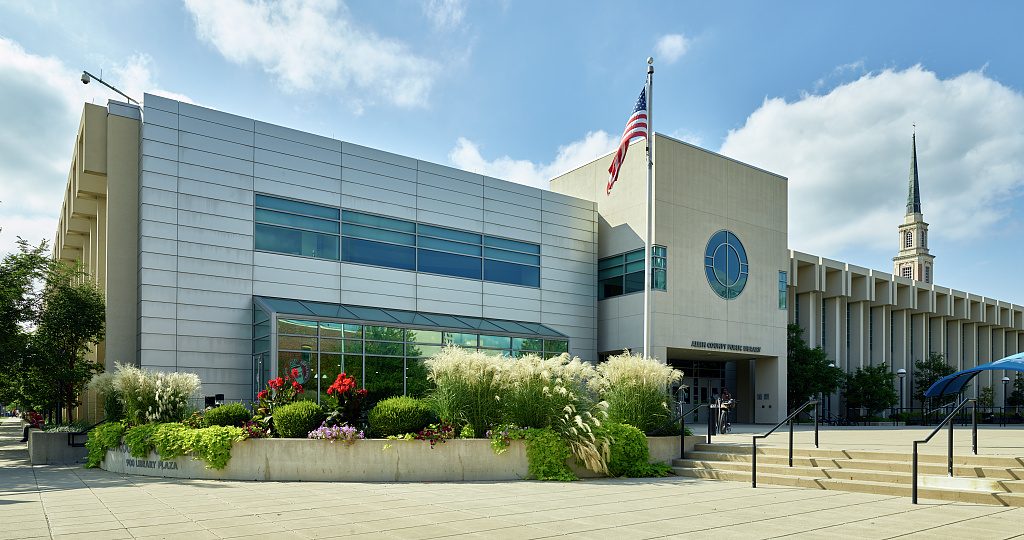
The system: The Allen County Public Library today is the 367,000-square-foot Main Library at 900 Library Plaza and thirteen branches — nine in Fort Wayne and four in other Allen County communities — serving a population of…