The exact page text, read by your browser's voice.

Parks and Plans — the First Park, the City Beautiful, and the Boulevards
Fort Wayne's park system did not grow by accident. It began with a fifth of an acre of the old fort's ground in 1863, was argued into a board in 1905, and was then — in the space of seven years — lectured, reported, planned and taxed into one of the earliest comprehensive park-and-boulevard systems in America: Charles Mulford Robinson's beautification report of 1909, George E. Kessler's park and boulevard plan of 1912, a ring of grand boulevards at the city's edge, and a harvest of donated parks that has never really stopped. The boulevard neighborhoods the plan created are treated as districts in the Architecture chapter, and the city's modern parkland is inventoried in Fort Wayne Today. This chapter is the founding story.
The First Ground — Old Fort Park and the Lawton Purchase, 1863–1866
The first piece of ground acquired for park purposes in Fort Wayne was fractional lot No. 40 of Taber's Addition — a little triangular spot of one-fifth of an acre, part of the ground enclosed within the historic old fort.…
The Early Parks, One by One — Swinney to Hamilton, 1869–1908
For four decades after Lawton, the system grew the way it had begun: by lease, bequest and gift, one tract at a time. Swinney Park came first among the great ones — Colonel Thomas W. Swinney leased his west-side land to the city…
A Board of Their Own — Park Government, 1894–1911
Through the nineteenth century the parks answered to the Board of Public Works: the department's chronology dates a Park Department formed under the Board of Public Works to 1894. The push for an independent board came from…
The Civic Awakening — Lectures, Clubs and a River Front Commission, 1909–1913
Griswold opens his chapter on these years with a "civic awakening," and the machinery of it was the Commercial Club. In 1909 the club — through its president Howell C. Rockhill, with Charles H. Worden, Robert B. Hanna and others…
Robinson's Report — the City's First Plan, 1909–1910
Charles Mulford Robinson of Rochester, New York, was the nation's leading missionary of civic improvement — author of The Improvement of Towns and Cities (1901), the first American guide to city planning, and later the first…
Kessler's Plan — the Park and Boulevard System, 1911–1912
George E. Kessler of St. Louis — the landscape architect of Kansas City's celebrated park and boulevard system — began work for Fort Wayne in 1911, reporting to the Board of Park Commissioners. His first Fort Wayne commission set…
The Harvest of 1912 — Foster Park and the System Doubles
The plan years were also gift years. Lakeside Park, east of the St. Joseph, came first: its original ground was acquired from the Fort Wayne Land and Improvement Company in 1908 — for $5,000 by Griswold's account; the…
Up and Over — the Track Elevation Fight, 1905–1956
The boulevards were drawn for a city the railroads had cut into pieces, and the same legislature-enabled decade took on the grade crossings. Years of discussion ended, Griswold records, in an agreement between the city and the…
The Centennial Week — Fort Wayne Celebrates Indiana's Hundredth, June 1916
The greatest civic production of the planning era was the celebration, in June 1916, of the one-hundredth anniversary of Indiana's admission to statehood. Griswold calls it, even with the handicap of almost continuous cold, rainy…
"The Glorious Gateway of the West" — the Pageant at Reservoir Park
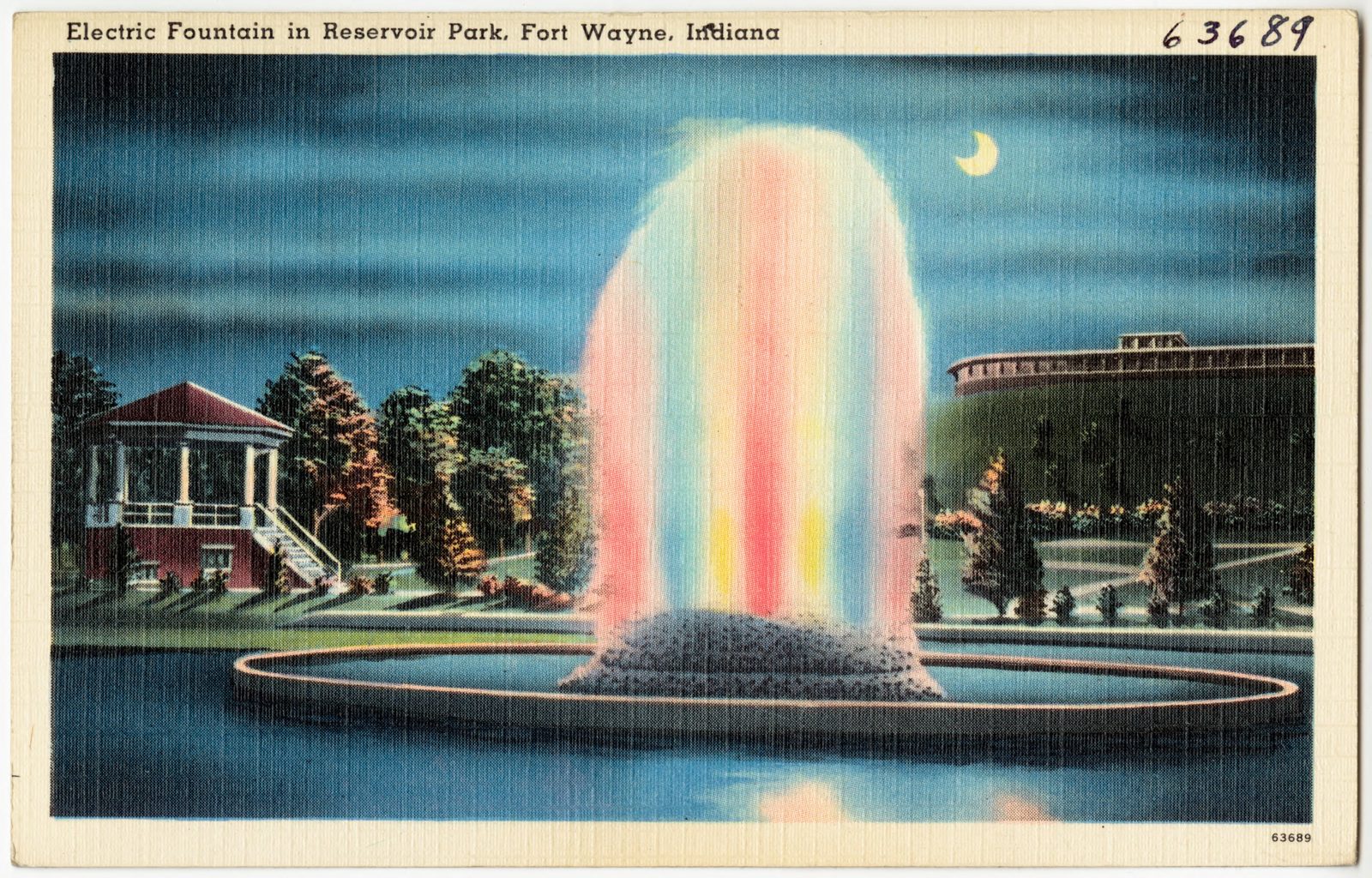
The center of the week was the historical pageant. Wallace Rice of Chicago wrote the Book of the Pageant and gave it its title, "The Glorious Gateway of the West"; Donald Robertson, the pageant master, trained one thousand…
Between the Wars — Statues, Pools and Franke Park, 1918–1941
The generation after the plan filled in its frame. In 1918 the Anthony Wayne statue was dedicated in Hayden Park at a cost of $15,000, the first public swimming pool opened in Lawton Park, and Memorial Park was established in…
The System Since — Pools, a Zoo, and 2,840 Acres, 1945–Today
The postwar system was built at neighborhood scale: the Jefferson Recreation Center (1945), the Franke Park Day Camp and Franklin B. Meade's world flower collection planted in Foster Park (1946), the McCulloch Center and Shoaff…