The exact page text, read by your browser's voice.

City Controversies · The fights Fort Wayne had with itself
Every city argues with itself; Fort Wayne's arguments are unusually well documented, because so many of them ended in a courtroom, a grand-jury room, a veto override or a ballot box. This section keeps the controversies of record at their documented size: the coal indictments that ended a mayoralty without ever reaching a verdict, the mayor who resigned in disgrace in July 1985 and was voted back into the same office twelve days later, the boycott that emptied four schools and the settlements that answered it, the annexation of Aboite that its opponents carried to the state's highest court and then to the legislature, the courthouse that was left to rot and then restored at $8.6 million, the flood-control land the city sold for $8,800 and watched resold for $525,000, the downtown ballpark and the downtown arena — one built after a fight, one shelved after a study — and the winter of 2011, when the whole country laughed at a name the city itself had voted for, overwhelmingly, in honour of a mayor it still reveres. Where a fight belongs to another section of this history — the preservation fights of the heritage record, the development fights of the business record — it is named and pointed to, not retold.
The coal indictments: a mayor, a police chief, and fifty-two charges that never reached a verdict
10 November 1950 — 1 May 1954
The indictments: On 10 November 1950 a grand jury indicted Democratic Mayor Henry E. Branning, Police Chief Lester Eisenhut, Councilman Charles Boyer, Traffic Captain Gregor Klug, City Utilities purchasing agent Harold Battenberg…
The mayor who resigned and came back in twelve days
8 — 20 July 1985
The plea: Winfield C. Moses Jr., the flood-fight mayor of 1982, resigned on 8 July 1985 after pleading guilty to three misdemeanor campaign-finance violations. City Controller Cosette Simon acted as mayor for the eleven days…
The clerk's office video
2015
Thirty-two years, one tape: Sandy Kennedy was the longest-serving city clerk in Fort Wayne's record — thirty-two years, 1983 to 2015. She resigned in 2015 after undercover video documented politicking inside the clerk's office. Her caucus-chosen successor, Michelle Chambers, served 2015–16 as the city's first African American city clerk. The clerk's office — the keeper of the city's own paper — supplied the modern era's neatest scandal of office: no indictment in the record, a resignation, and a first that the city had waited a long time for arriving by the scandal's back door.
Sources:
- The public-servants record, Public Servants — Kennedy's tenure and resignation, and Chambers's succession.
A congressman's resignation
21 May 2010
At record size: Representative Mark Souder resigned his House seat on 21 May 2010 over an affair with a member of his staff — the district's service scandal of the modern era, stated here at the size the public record gives it. The full telling stands in the public-servants record; the controversies ledger carries it as the federal entry in the city's scandals of office.
Sources:
- The public-servants record, Public Servants — the resignation and its stated cause.
The pay-to-play ordinance: two vetoes overridden, one injunction
2017 — June 2019
The ordinance: Fort Wayne prohibited business entities from bidding for city professional-services contracts if they had contributed more than $2,000 within one year to candidates or officials responsible for awarding the…
The school boycott and the settlements that answered it
1949 — 1979
The concentration: Before 1945 the Fort Wayne school board had not operated racially separate schools. After the war its boundary-drawing changed that: by 1949, 75.5 percent of Black elementary pupils were concentrated in three…
The annexation wars: Aboite, and the courtroom tail
1978 — 2017
The pattern in the courts: Fort Wayne grew by annexation, and its neighbours fought back in court for decades. In Adams v. City of Fort Wayne (1981) the Indiana Court of Appeals held that individual taxpayers and adjoining…
The merger that never happened
1971 — present
Fifty years of maybe: Fort Wayne and Allen County have shared a building since 1971 and a second building, Citizens Square, since 2011 — and have never merged a single department into a single government. Indianapolis…
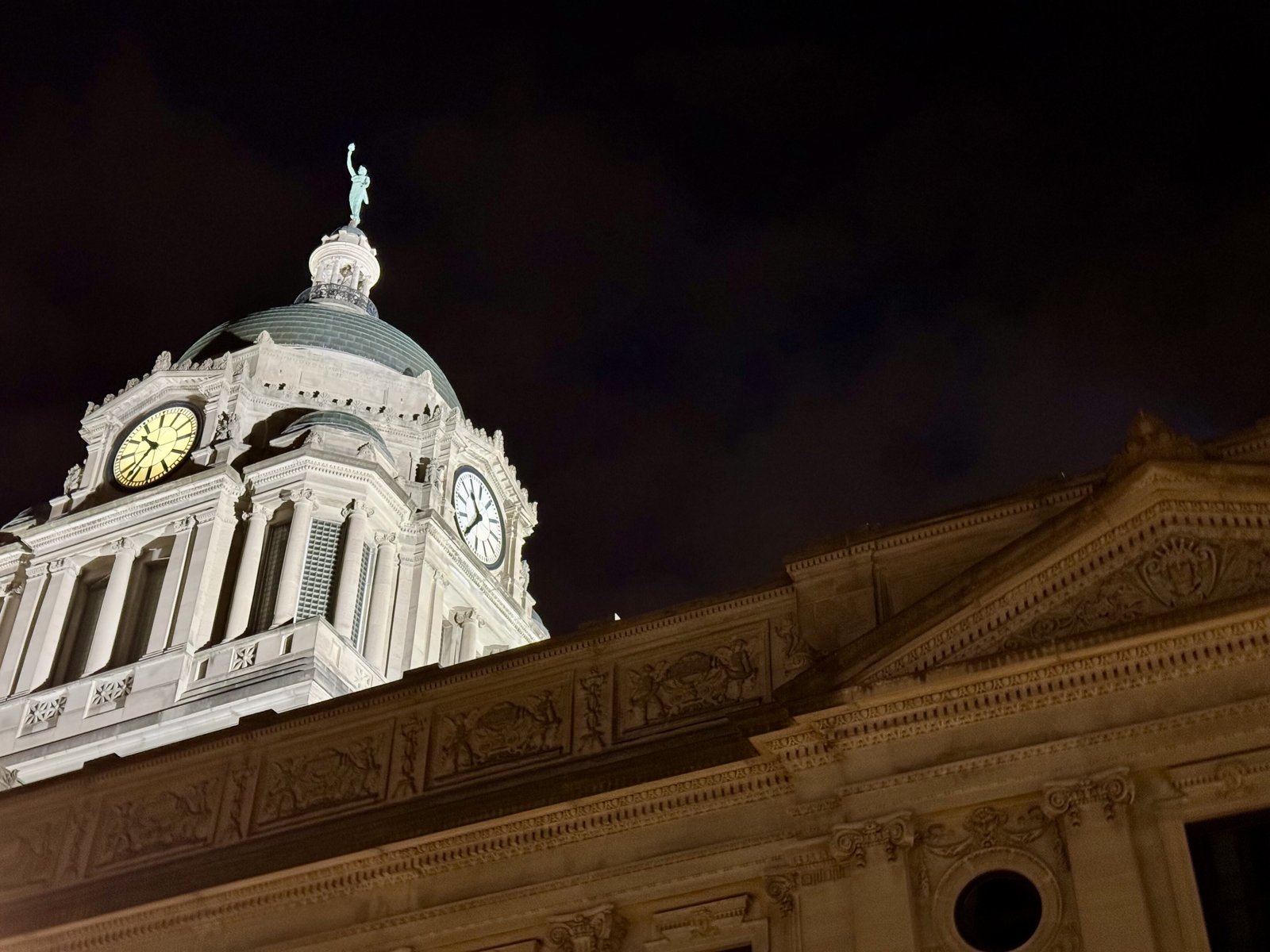
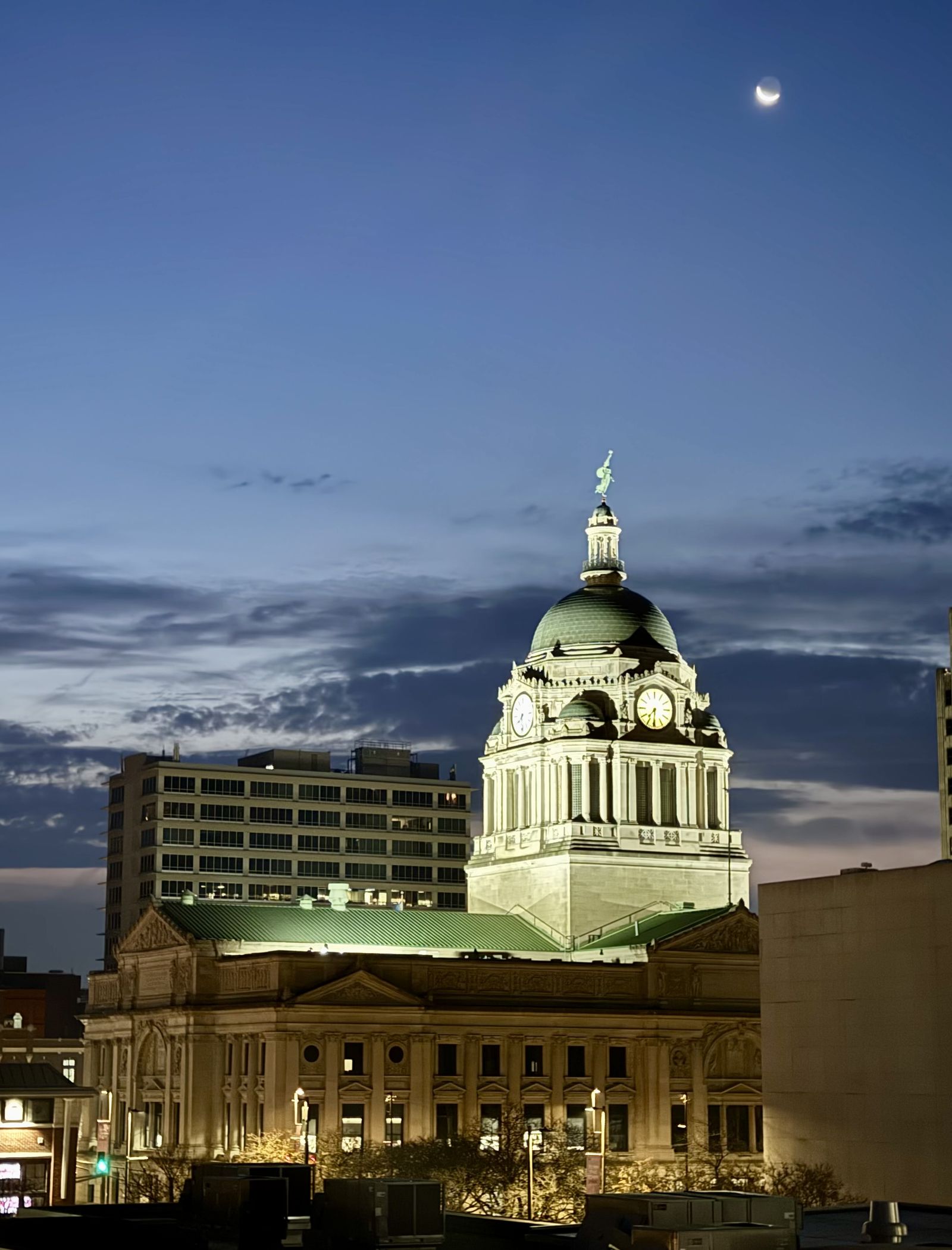
The courthouse: decay, rescue, and the price of keeping it
1993 — 2002
The decay: The Allen County Courthouse of 1902 — Brentwood S. Tolan's Beaux-Arts pile, built for $817,553.19 and listed on the National Register in 1976 — was allowed to decay from inside. A 1930s interior restoration had damaged…
Electric Works: the deal the city killed and then revived
2017 — 2020
At pointer size, by design: The fight over redeveloping the old General Electric campus is told whole in the heritage record; the controversies ledger carries its civic shape. The city bought the campus from GE in 2017 for $5.5…
The fort ordered out of the floodway
1976 — 9 June 1978
Built first, permitted never: Historic Fort Wayne built the Old Fort replica in 1976 on the banks of the St. Marys River — without the prior approval of the Natural Resources Commission, in the regulatory floodway. The Commission…
Fairmount Place: flood land sold for a song
1984 — 2009
The buyout: In 1984 the city spent $350,000 to buy seventeen homes along Fairmount Place, just north of the St. Marys River off Wells Street, and demolish them for flood protection. The flood-control apparatus on the ground …
After the waters: thirty years of arguing about the walls
1982 — present
The argument's frame: The flood fights that were not lawsuits were budget fights, and they ran for thirty years after the great flood of March 1982 — the flood that followed a winter of 81.2 inches of snow, the most since 1911…
Harrison Square: the downtown ballpark fight
2006 — 16 April 2009
The project: Parkview Field, the $30.6 million downtown ballpark built as the anchor of the Harrison Square project, moved the city's minor-league club from Memorial Stadium to a downtown block and wrapped housing, offices and a…
The downtown arena that a study stopped
June 2015 — 16 November 2017
The recommendation: Mayor Tom Henry's Downtown Arena Study Committee, chaired by Sweetwater founder Chuck Surack, began meeting in June 2015 and reported on 21 March 2016: unanimously, the city should pursue a downtown arena of…
The name the city voted for and could not use
February — June 2011
The vote: In early 2011 the city invited the public to suggest names, online, for its new government building — the former Wolf & Dessauer department-store building at Wayne and Clinton, bought in 2009 for $7.3 million and…