The exact page text, read by your browser's voice.

Hotels & Motels · Where Fort Wayne has slept its guests
Fort Wayne has been putting up strangers since before it was a town. The first two businesses licensed here, in August 1824, were taverns, and a tavern then meant beds as well as whiskey: the traveler's night was the settlement's first trade. What followed runs in long waves. The canal made Columbia and Barr streets a row of stage-and-packet houses — the Hedekin, the Rockhill, the American — and the railroads and the drummers made the Aveline and the Randall. The twentieth century built two towers, the Anthony of 1908 and the Keenan of 1923, and then, in a single year, 1974, blew both of them up. For a decade downtown had no real hotel at all, until the city built one itself, attached to a convention center, in 1985. The automobile meanwhile moved the trade to the bypasses and the interstates, where it mostly remains — though since 2010 the downtown stock has quietly rebuilt itself, room by room, to four hotels. This section keeps the whole record: who built the houses, who slept in them, who was turned away from them, and what stands on their sites now.
The first beds in town: the tavern licenses of 1824
1824 — 1838
Lodging is the town's first licensed business: On August 10, 1824 — months after the townsite was platted — the first tavern licenses in Fort Wayne were granted, to William Suttonfield and to Alexander Ewing, each on payment of…
The canal-era houses: American, Rockhill, Hedekin
1836 — 1969
The canal fills the houses: When the Wabash and Erie Canal was completed to Fort Wayne in 1843, the town's lodging moved up a class. The American House — John Spencer erected the building in 1836 on the northeast corner of the…
The Randall Hotel: a tannery that became "the best $2 hotel in Indiana"
1828 — 1963
From hides to guests: The Randall's building began in 1828 as a tannery at the foot of Columbia Street — built, in Michael Hawfield's account, by Absalom Halcomb and Isaac Marquis, its basement vats soaking hides in urine and oak…
The Wayne Hotel, 118 West Columbia
Late 19th century — early 20th century
The Randall's pair: The other leading house of the drummer era stood at 118 West Columbia Street, in the Landing. Winifred Randall's memoir names it directly: in the years before the towers, "the Wayne Hotel and the Randall Hotel…
The Aveline House: the city's leading hotel for forty-five years
1860 — 1908
A contractor builds the grand house: Francis Aveline was born in Vincennes in 1814 and came to Fort Wayne in 1820 as a child; he became one of the city's most important contractor-builders. After three years of effort to secure…
The Anthony Hotel — later the Van Orman: the grand dame, 1908–1974
1908 — 1974
Three years and half a million dollars: The Anthony was proposed by dry-goods merchant Ernest Rurode and built by the Fort Wayne Hotel Company, a group of the city's leading businessmen who had determined that Fort Wayne needed a…
The Keenan: the manager builds his own tower, 1923–1974
1923 — 1974
Three blocks from his own lobby: The Keenans were a hotel family — Hugh Keenan and his sons managed houses in Pennsylvania, Michigan, and Iowa besides Fort Wayne — and James F. Keenan, a Notre Dame graduate, had run the Anthony…
The Indiana Hotel: the theatre's hotel, 1928–1971, and its second life
1928 — 2016
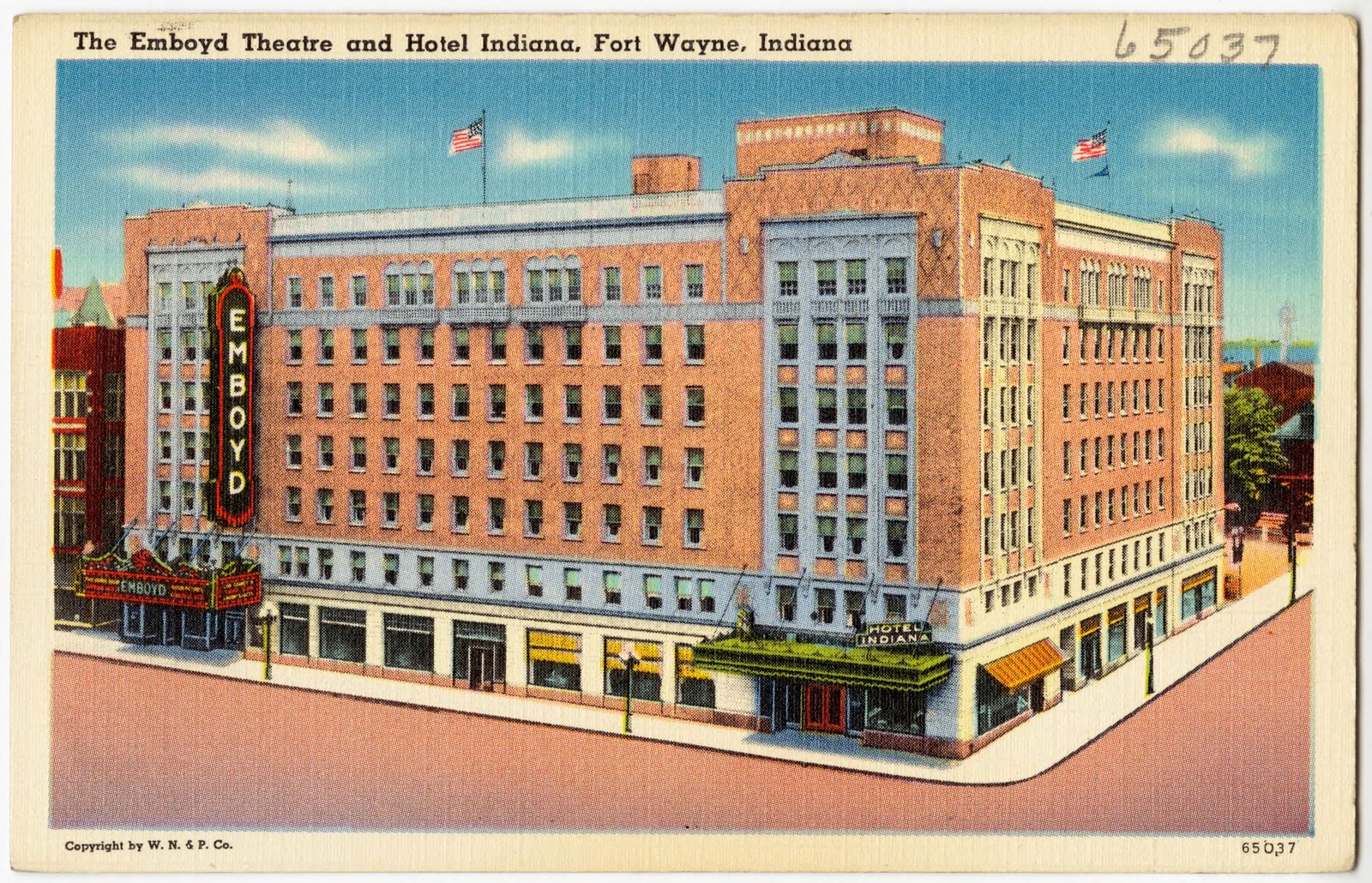
A hotel wrapped around a movie palace: The last of the downtown grand houses was built as half of an entertainment complex. Clyde Quimby's Emboyd Theatre opened on May 14, 1928, and with it, wrapped around the theatre's north and…
What the hotels were for: drummers, banquets, and the meeting trade
1851 — 1985
Fort Wayne's hotels were never mainly for tourists. They were machinery for commerce, and each generation of them was built for the traveler of its day: the canal and stage passenger, then the drummer with his sample cases, then…
The color line, and the Green Book's Fort Wayne
1936 — 1967
Not welcomed at the grand hotels: The Anthony, the Keenan, and the Indiana do not appear in the record as houses that took Black guests, and the state's own summary of the era states the arrangement flatly: Black travelers "were…
The motor age: tourist cabins, the Lincoln Highway, and the bypass
1913 — 1960s
The guest arrives by car: The automobile reached Fort Wayne's lodging trade down the Lincoln Highway, which crossed Allen County for 33.5 miles on its 1913 route, later US 30. The Indiana Lincoln Highway Association's…
Decline and the downtown gap, 1963–1985
1963 — 1985
Eleven years that emptied downtown: The end came in sequence. The Randall, residential and faded, was razed in 1963 on Winifred Randall's death. The Hedekin — by then the Home Hotel — came down in the Columbia Street clearances…
The city's own answer: the Grand Wayne Center and its Hilton, 1985
1985 — present
A hotel as public works: The Grand Wayne Convention Center opened on January 18, 1985, after five years of planning and construction and a $12 million investment, under the Fort Wayne–Allen County Convention and Tourism…
The Coliseum corridor's full-service house: Holiday Inn at IPFW, 2008
2008 — present
The events trade gets its hotel: The War Memorial Coliseum had drawn crowds to Coliseum Boulevard since 1952, and the lodging along the boulevard grew up as motels. The corridor's full-service turn came on November 14, 2008, when…
The downtown return: Courtyard 2010, Hampton 2019, the Bradley 2021
2010 — 2021
Rooms come back to the center: The Hilton stood alone downtown for twenty-five years. The return began with Harrison Square, the development built around Parkview Field (opened 2009): at the corner of West Jefferson and South…
The stock today: an interstate city's lodging map
Present day
Where the rooms are now: Counted by corridor, the modern stock repeats the motor-age pattern at interstate scale. Current lodging directories cluster the city's hotels at the I-69 interchanges — Coliseum Boulevard (Exit 309) and…


